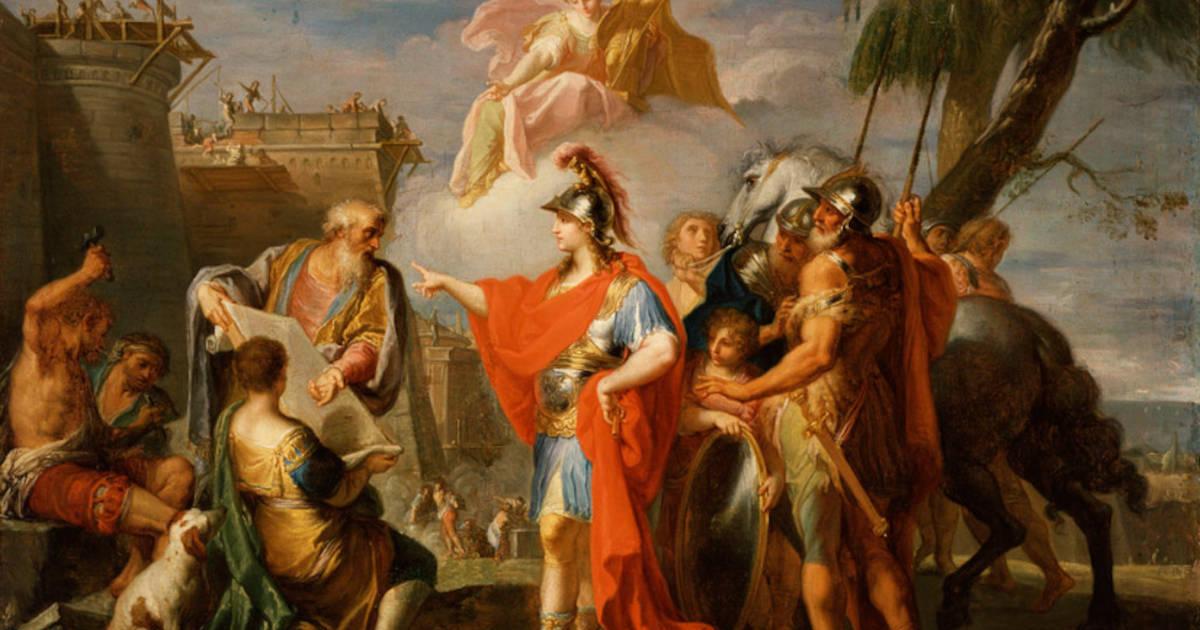

Many scholars who have studied the question have come up with theories about the location of Alexander the Great’s final resting place, which has made this one of the most hotly debated mysteries in archaeology.
The latest expert to jump into the fray is Calliope Limneos-Papakosta, Director and Founder of the Greek Research Institute on the Civilization of Alexandria, who believes she is close to finding the tomb beneath the streets of modern Alexandria.
"I am at the crossroads, and I believe that I have more possibilities to find the tomb than anybody else," she confidently told Live Science.
To support her thesis, she points to historical records that say Alexander the Great was buried in Alexandria, with important figures (including the very first Roman emperor Augustus) visiting the tomb to pay their respects.
"Alexander is buried in Alexandria, and we are sure about that because in the first century AD, we have information about visitors to the tomb, including Roman leaders like Julius Caesar. So, we know that the tomb was there," Limneos-Papakosta said.
She thinks that the tomb may have been hidden intentionally to prevent it from being looted or overrun with visitors in later centuries, and that the area she is searching in now is the most logical place for it to have been ultimately relocated.
- The Despairing Cry of the Tomb of Alexander the Great From the Desert at Siwa Oasis
- Has the Location of Alexander the Great’s Tomb Finally Been Identified?
"I believe that the priesthood around the cult of Alexander protected the tomb. He was considered a god, and they tried to protect him when they realized that destruction was coming by Christians. I believe that they hid his body and sarcophagus," she stated.
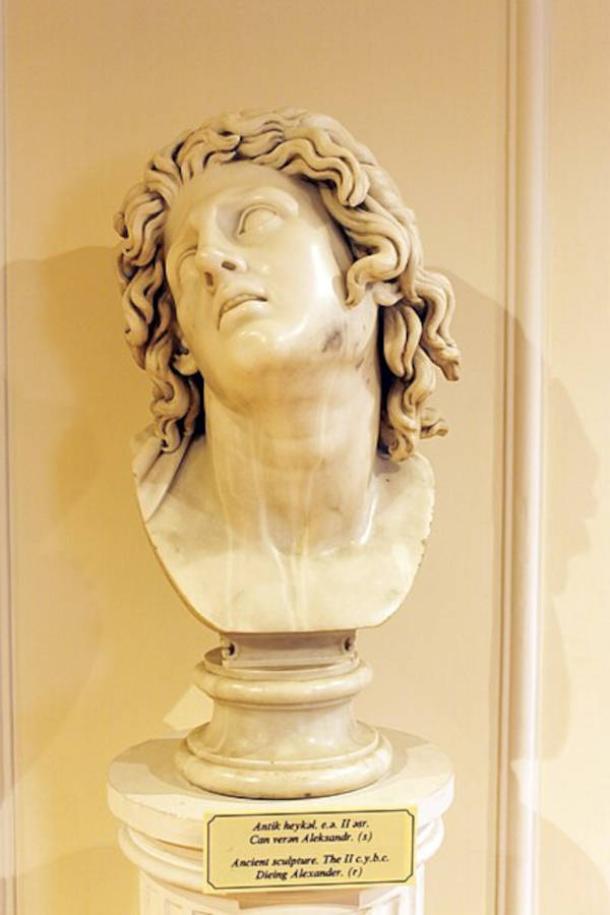
Bust of a dying Alexander the Great (marble copy of a 2nd century BC work by unknown Greek sculptor), National Art Museum of Azerbaijan. (Urek Meniashvili/CC BY-SA 3.0).
Under the Streets of Alexandria
Limneos-Papakosta's search has zeroed in on the area of the Shallalat Gardens near the Alexandria National Museum, where she has begun excavations searching for the intersection of two ancient roadways.
"Ancient sources suggest the royal quarters were in this location during antiquity, yet they had never been excavated," she explained. In 2009, she led a team of archaeologists who unearthed a sculpture of Alexander at this location, and it was this remarkable discovery that set her off on her quest for Alexander’s tomb.
- Does the Greatest Macedonian Rest In the Royal Necropolis at Aigai?
- What Made Alexandria the Intellectual Capital of the Ancient World?
"It was our last day at the site, and we were ready to end the season," she remembered. "But then we found the sculpture. It was kind of a miracle."
Topographical maps and ancient sources suggest the area where the statue was excavated is near Alexander’s tomb, Limneos-Papakosta said. As her team’s explorations have continued she has become convinced that Shallalat Garden area, located near the Alexandria National Museum, is the best place to look, at it contains ruins of the city’s ancient walls. Some ancient sources actually placed the royal quarters of Alexander there, but amazingly the area has never previously been excavated.
The current dig site is adjacent to a former ancient intersection mentioned by second-century Greek writer Achilles Tatius, who implied that the tomb's was not far away.
"He wrote that it was a few hundred meters west of the intersection of Alexandria's two main broad streets," she said, explaining her belief that a fantastic discovery may be close at hand.
Alexander’s Death and Entombment
The Macedonian world-builder Alexander the Great died in Babylon in 323 B.C., causing the collapse of his empire and setting off a struggle for control of the pieces of his kingdom among his generals and closest associates.
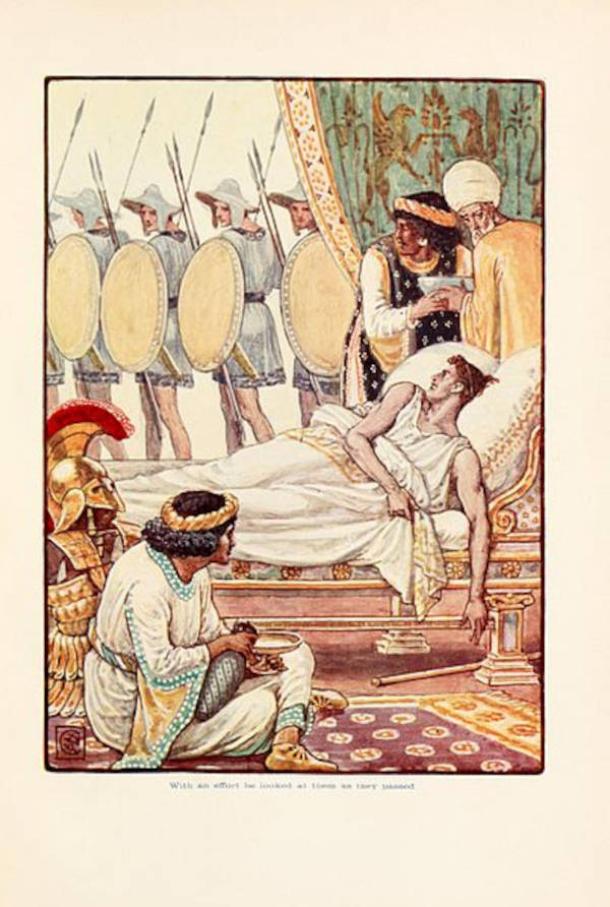
The death of Alexander the Great, image taken from children’s book. (Walter Crane/Public Domain)
Alexander’s body was apparently mummified in the Egyptian style, and after two years a caravan set off for Egypt with Alexander in their possession, with the idea that his body would be entombed there alongside the bodies of some of the great Pharaohs of the past. But on the way to Egypt Alexander’s escorts were met by Ptolemy Soter, one of Alexander’s most accomplished generals, who ultimately seized control of Egypt and founded the Greco-Egyptian line of Ptolemaic pharaohs who would rule Egypt from 305 BC until 79 AD. Historical texts suggest Ptolemy rode all the way to Syria to intercept Alexander’s body, after which he took possession of it with the presumed intent of returning it to Egypt for burial (appropriately enough in the city of Alexandria, which was founded by Alexander, andfrom where the Ptolemaic pharaohs would rule).
Virtually all scholars agree that this scenario is accurate. But where things get foggy is after Ptolemy took possession of Alexander’s body. From that point on there is disagreement among scholars about what happened to Alexander, specifically about where he was taken, where he was buried, and where his final resting spot might actually lie today. Adding to the complexity of the situation is the likelihood that Alexander's body was moved multiple times after his death, leading to shifting spots for his last tomb (and complications for those trying to figure out where the last one actually was).
There is no question that in ancient times the location of Alexander’s tomb was known and visited by foreign dignitaries. But somehow knowledge of that spot was lost, and Classical scholars have been trying to figure out where it was ever since.
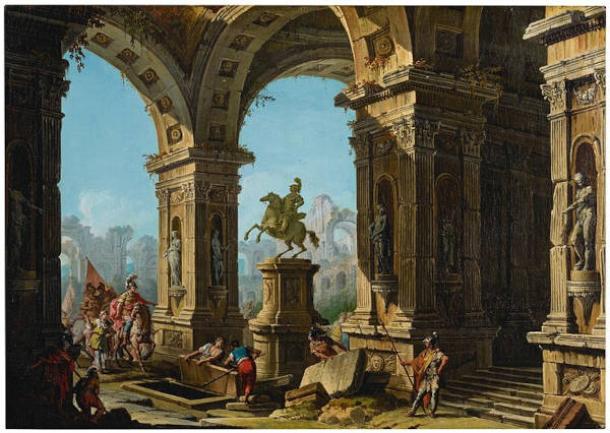
Alexander the Great visiting the tomb of Achilles, 18th century painting by Antonio Joli. (Public Domain).
Dinner for a Shark
The reaction to Limneos-Papakosta’s ideas reveals highlights the complexities and disagreements involved in trying to settle this question.
Dr. Paul Cartledge, a professor emeritus of Greek culture at the University of Cambridge and the author of "Alexander the Great" (Overlook Press, 2004), told Live Science that Alexander’s body would have been housed in a large mausoleum in a royal complex, and that this would have been in a different location than the one pinpointed by Papakosta-Limneos.
"A mausoleum conveys the notion that it's a very solid structure that should be locatable," he said. "The one in Rome, Augustus' mausoleum, is completely visible. Why isn't the mausoleum of Alexander visible? The simple answer is that the Brucheum of Alexandria, where the royal quarters were, abutted the sea.”
As Dr. Cartledge notes, sea levels have risen over the past 2,300 years, meaning there is a high likelihood that those royal quarters, and Alexander’s Alexandrian tomb (if there really was one), are now underwater.
"Unless he was in a coffin that preserved his body, he will never be found," Cartledge said. "My guess is that his body could've been eaten by a shark."
Top image: Painting completed by Placido Costanzi in 1737, entitled “Alexander the Great Founding Alexandria.”
Source: Public Domain
By Nathan Falde