From ancient times to the present, humans have longed for bliss: their ideals, dreams, utopias, Golden Ages, Eden, the Holy Land, Plato’s Republic, Shangri-La, Valhalla, Camelot, the American Dream, Brook Farm, Fruitlands, Intentional Communities, the New Deal, Dr. Martin Luther King’s “I Have a Dream” speech, the Green Encyclical, the Green New Deal and far more.
For some comparison, Dr. Salima Ikram (author of Ancient Egypt: An Introduction) mentioned to me that for the ancient Egyptians, “The dream was having a fabulous eternal life. So that’s sort of sums it up for them I think.” Prof. Frank Korn (author of Hidden Rome) compares Rome and America thus: “The ‘Roman dream’ was not unlike the American one: A good education, high paying prestigious job, a fulfilling career, a happy marriage, a home in the city, and another at the shore, or in the countryside, or in the mountains, and a nice social circle.”
An Epic Dream, Through Good Times and Bad
In The Epic of America (1931) historian James Truslow Adams used the phrase "the American Dream." When his book was published, the Great Depression was in a roar, and opportunities for the good life were severely diminished. Authoritarianism was on the rise in Europe, and Joseph Stalin was in charge of the Soviet Union. Back at home, Adams was concerned that the early, glowing ideals of our republic had been replaced by materialism and consumerism. The American Dream was a call for higher values, freedom and equality in the land of opportunity. It was a “dream of social order” whereby people could, through their best efforts, attain something better for themselves and their family.
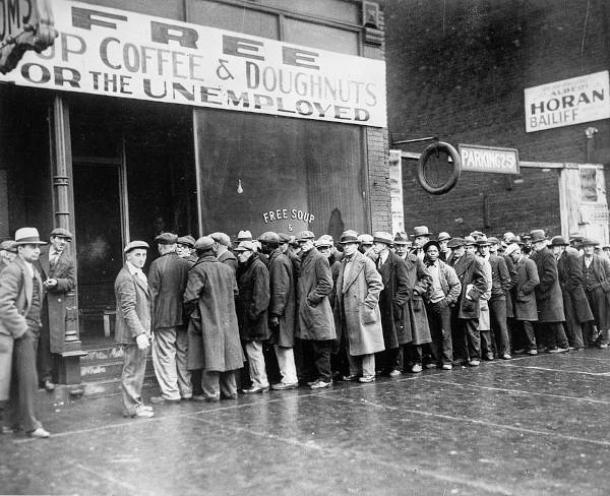
Unemployed men queued outside a depression soup kitchen opened in Chicago by notorious ganster Al Capone, who was living his own version of the American Dream (1931). (U.S. National Archives and Records Administration/Public Domain).
The American Dream perhaps begins with Europeans arriving in the New World and continues with the unique origins of America in the American Revolution and the ideals in The Declaration of Independence and Constitution. People have the right to “Life, Liberty and the pursuit of Happiness.”
We are a country built upon sacred documents. The late author and public intellectual, Susan Sontag (as part of a panel on BBC’s In Our Time: American Ideal episode), remarked when looking at her own family and upward mobility in general, that the “American experience is a project,” an opportunity for many people to find safety and opportunity. Upward mobility has meant transformed lives for generations – that’s the ideal.
(Sidenote: Family stories and myths are part of the mix that create our lives – generational tales to inform and delight. If I may: during the Great Depression, my mom’s family lived in Johnstown, PA; mom told me stories about when her mom/our grandmother used to give apples and what she could to itinerants and local poor who came to the back door. Another family story focused on the Johnstown Flood of 1936, when her family had to run for the hills. And still another, reaching back before the Depression, was that my grandmother’s brother got on the wrong boat in Calabria, Italy, ending up in San Paolo, Brazil with a wife and kids – and that’s mostly all that we know. My dad, who sang on stage for some years tended to tell many stories about that, along with adventures in his old Model T car, World War II service and more.)
- A Brief History of a Dutch Island – Manhattan
- American People Suffering Historical Amnesia With Many Citizens Knowing “Virtually Nothing” About Their History
Has the American Dream Lost Some Luster?
A critique of the American Dream is that it can rarely be satisfied, that it is often focused on excess and quantity at the sacrifice of mindful leisure and experiences. It is a mass ideology that has morphed from the desire for freedom and the ideals of the good life to something constantly material.
In The Paranoid Style in American Politics (Harper’s Magazine, 1964), the late great Prof. Richard Hofstadter argues that:
“this occupational and social mobility, compounded by our extraordinary mobility from place to place, has also had its less frequently recognized drawbacks. Not the least of them is that this has become a country in which so many people do not know who they are or what they are or what they belong to or what belongs to them. It is a country of people whose status expectations are random and uncertain, and yet whose status aspirations have been whipped up to a high pitch by our democratic ethos and our rags-to-riches mythology (52).”
Well, we live in a time of chaos, changing values, endless dislocation, along with the benefits of creativity, technology, medical advances, wealth, civilization and the rest. So many choices – how do we make the best ones? Who are we and what are we to be?
American Literature as a Reflection of Myth
Literature -- a product of individual and collective energies – illuminates the stories and inner life of varied perspectives, deepening our empathy and awareness. In A Short History of Myth, Karen Armstrong writes that “a novel, like a myth, teaches us to see the world differently; it shows us how to look into our own hearts and to see our world from a perspective that goes beyond our own self-interest.”
Literature allows us to be mind-readers of beings different from ourselves, but very much like us - life lessons as you read across the pages. Magical the way words can make us see green and hear things and excavate memories – and make us laugh and tremble.
The American Dream is a boundless theme for Ben Franklin, Ralph Waldo Emerson, Walt Whitman, Mark Twain, F. Scott Fitzgerald, Ralph Ellison, John Updike, Leslie Marmon Silko, Julia Alvarez and a host of others over the centuries (a few to be discussed below). Some writers promote it, while others focus on its shadow side.
In Leaves of Grass (1855), Whitman (“an American, one of the roughs, a kosmos”) illustrates the immensity and spirit of America, the unity of body and soul, the possibilities of equality and the Melting Pot. Whitman had a large vision of diversity, occupations, people, nature, animals. “The Americans of all nations at any time upon the earth have probably the fullest poetical nature. The United States themselves are essentially the greatest poem.” And in Crossing Brooklyn Ferry, Whitman show a keen interest in future generation as we and they are in his “meditations.” He is a bard and the greatest American poet.
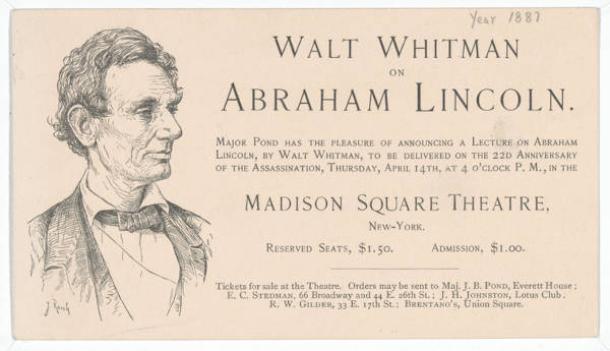
Flyer advertising a public lecture by Walt Whitman in New York City in 1887, where he spoke about the legacy of Abraham Lincoln. (Public Domain).
The American Dream, restless ambition and upward mobility are taken up in the great American classic, The Great Gatsby by F. Scott Fitzgerald. (April 2025: Happy 100th Birthday Great Gatsby; also 250th anniversary of the Battles of Lexington and Concord and Paul Revere’s Ride, by the way).
The Great Gatsby is among the most interesting, complete repositories of American myth and, like Whitman’s Leaves of Grass, the Gatsby novel plays with the grass theme:
The one on my right was a colossal affair by any standard—it was a factual imitation of some Hôtel de Ville in Normandy, with a tower on one side, spanking new under a thin beard of raw ivy, and a marble swimming-pool, and more than forty acres of lawn and garden. It was Gatsby's mansion.
A central image in the novel is the “fresh, green breast of the new world” -- the original land, even before the colonists, a land of promise.
Perhaps Fitzgerald’s outsider status at Princeton University and his work on Madison Avenue gave him sharp eyes for social satire. We see the American Dream in full motion in the transformation of Jay Gatz into the Great Gatsby. This is a master class in the American Dream, the potential, status and upward mobility, technology, wealth and self-invention, fame, sports, cars -- as well as the shadow side of all that. If there’s a car, there’s a car accident. (Jordan Baker, the golfer, begins the car glamour along with a car accident, prefiguring Gatsby’s cream-colored Rolls Royce at the end of the novel...)
It was all so hopeful. Early on, Gatz had a schedule of reading and exercise to improve himself, reminiscent of Ben Franklin’s self-improvement, Ralph Waldo Emerson’s Gospel of Self Reliance, the Horatio Alger story (which many of us know from school) and novels in Oprah’s Book Club. (As an aside, Fight Club by Chuck Palahniuk is also a fascinating study of status, as well as the lack of community trying to create community. Palahniuk said he was sort of updating The Great Gatsby.)
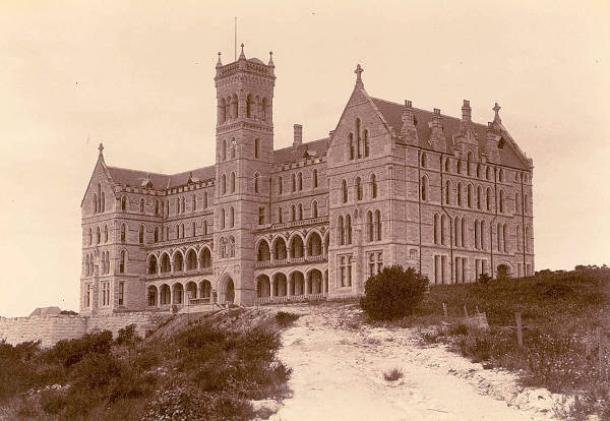
St Patrick's Seminary in Manly, Sydney, which was used to portray the Gatsby Mansion in the 2013 film, The Great Gatsby. (Public Domain).
In Kurt Vonnegut’s Slaughterhouse-Five, we follow the journey of Billy Pilgrim who, as a POW, experiences the bombing of Dresden and even the abduction by aliens. August Wilson’s Pittsburgh Cycle (a collection of ten plays) chronicle the lives of African Americans. Wilson said, “Put them together and you have a history.” Leslie Marmon Silko wrote Ceremony. This novel chronicles Tayo, a WWII veteran of Laguna Pueblo descent. Tayo reconnects to his cultural roots of sacred story, healing ceremonies and medicine men & women. Amy Tan’s Joy Luck Club is about Chinese immigrant families who start a Mahjong Club; the reader partakes of their storytelling, Chinese parables and generational family life. Junot Diaz’s Brief Wondrous Life of Oscar Wao blends magical realism and a Dominican Family’s exploration of love and identity.
- Women’s Changing Roles Before and During the American Civil War
- Heroes, Lumberjack-Giants And Monsters Of American Mythology
My students recently picked The Lottery by Shirley Jackson – with the fertility myth & ritual at the center -- as one of the most mythical American stories. Prof. Alan Mitnick (Passaic County College), mentioned to me: “This made me think of John Steinbeck's short story, ‘The Leader of The People,’ in which a young boy in California listens to his grandfather talk about pioneering, called ‘westering.’”
“Born to Run”
Wanderlust is written in our genes; some scientists say that the gene DRD4 is novelty-seeking. And America has plenty of space in which to seek a lot of things. Humans have spread out over the planet, to live just about everywhere. A second chance elsewhere is a predominant theme in American literature.
Two hundred years ago, Alexis de Tocqueville noticed that Americans were often on the move. Frederick Jackson Turner wrote that the frontier had closed in 1890. Almost 80 years later, Apollo 11 landed on the moon. “That’s one small step for man, one giant leap for mankind,” said Astronaut Neil.
In the next two decades, NASA hopes to send humans to Mars. In the 22nd century, Captain James T. Kirk says during the opening credits of Star Trek that the Enterprise and its crew will “boldly go where no man has gone before” -- updated in later Trek series to “boldly go where no one has gone before.”
We’ve discussed the Go West theme already. “Go West, young man,” said New-York Tribune editor Horace Greeley. Many believed that and followed the call (including the fateful Donner Party). Of course, going west meant heading right into Native American lands. The American Revolution, Thomas Jefferson’s Louisiana Purchase and the Mexican-American War added vast land to our country, making it into a continental power (a topic beyond this essay.)
What of Woods and Wilderness?
Henry David Thoreau, one of the Transcendentalists and early environmentalists (also the first American to refer to himself as a “yogi”) lived in a cabin near Walden Pond. From his 1862 essay, Walking: “The chivalric and heroic spirit which once belonged to the Rider seems now to reside in, or perchance to have subsided into, the Walker—not the Knight, but Walker Errant. He is a sort of fourth estate, outside of Church and State and People.” Thoreau influenced John Muir. Muir was friends with Pres. Theodore Roosevelt -- who established national parks and national monuments (such as Devil’s Tower and Muir Woods).

Muir Woods. Mill Valley, California. (Renah Marranca).
If there are two ways to travel – near or far from home – Thoreau embodies the former. Walden and the earth itself are sacred. Romantics and Transcendentalists tended to be huge walkers and encouraged the modern world to love nature and fear the machine. Others traveled further, such as Ralph Waldo Emerson (essayist), Frederick Church (painter), Margaret Fuller (feminist, salon leader, journalist). Fuller reported on the revolution in Rome in 1848 as her husband, Marquis Giovanni Angelo Ossoli, joined the barricades.
In the past few years, my family and I visited historical spots in Philadelphia; historical sites in Massachusetts, such as Plymouth Rock, Concord, Salem and Boston; Sleepy Hollow, NY; Native American lands across in Oklahoma, New Mexico and Arizona; Monticello and Mount Vernon, VA; Saratoga, Antietam, Gettysburg and other battlefields; New Orleans and Las Vegas and other tourist destinations. Do you feel the mythic allure or “enhanced” feeling if you are in a place where great people and events have come before? Famous hikes, famous cafes and diners and pizza joints and restaurants with a special history or longevity? How about the culture, history, music, Mardi Gras, food, ghost tours, vampire café & Voodoo store and all the rest in New Orleans?
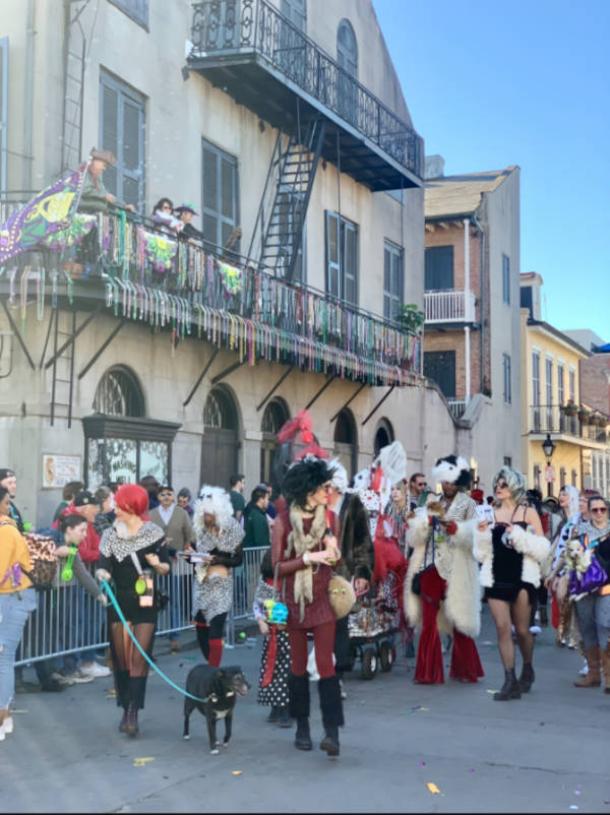
New Orleans. (Renah Marranca)
The Road Trip
Let’s not forget Harry and Bess Truman (President Harry S. Truman and First Lady Bess Truman, that is) on their three-week drive in their Chrysler from their home in Independence, Missouri to the East Coast and back again. One way to know that the world has utterly changed: would any retired president/first lady drive themselves, unescorted, on a road trip?
Travel classics include On the Road by Jack Kerouac; Travels with Charley: In Search of America by John Steinbeck; Blue Highways: A Journey into America by William Least Heat-Moon and many others.
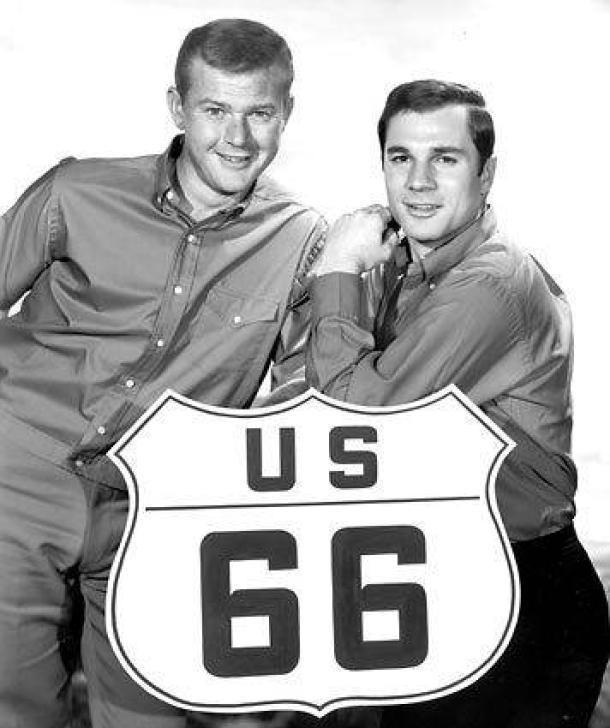
Publicity photo for the 1960s TV program Route 66, in which the characters played by Martin Milner and George Maharis traveled across America from job to job in their Corvette following America’s most famous transcontinental highway, seeking adventure. (Public Domain).
Inventors and Geeks in the Garage
Flying kites is an aery pursuit for kids and adults alike. When Ben Franklin flew a kite (with a key at the end of hemp string), he will “bring lightning from the heavens,” as Joseph Priestly wrote. Franklin, of course, is one of the very essential Founding Fathers; diplomat, author, inventor, founder of the University of Pennsylvania, and a much-loved figure. (In Paris, Franklin added to his frontier aura by wearing a fur cap or "coiffure a la Franklin.")
There is the techie as hero, replete with foundation stories. In their Dayton, Ohio bike shop, the Wright Brothers worked on their airplanes. Their first sustained flight was at Kitty Hawk, North Carolina on December 17, 1903. Heroic barnstorming pilots, such as Charles Lindberg, Amelia Earhart, Jimmy Doolittle, etc. helped create the Golden Age of Flight in the 1920s and 1930s.
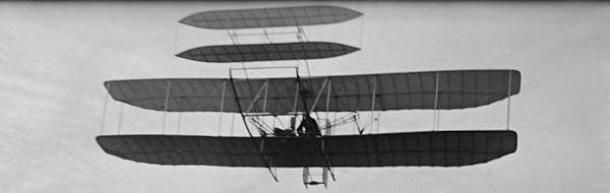
Orville Wright flying the Wright Flyer III over Huffman Prairie, Dayton, Ohio. (Wilbur Wright/Public Domain).
Science geeks such as Steve Jobs, Steve Wozniak and Bill Gates turned their garage experiments into industries. (Microsoft: established in 1975; Apple Computer in 1976). Bill Gates’s memoir, Source Code: My Beginnings, includes his parents, hiking with friends, high school teachers and of course computers and now philanthropy. Bill’s friendship with “the Oracle of Omaha,” Warren Buffett, is a classic friendship story. Like Ben Franklin, Buffett is a brilliant, well-read original.
Exploring the Heavens
Albert Einstein, who escaped from Nazi Germany and ended up at the Institute for Advanced Study in Princeton, is a legend and an icon for his discoveries and eccentric public image; he’s famous for his theory of Relativity, his equation E=mc2, which demonstrates the relationship between energy and mass, and more. He transformed the way we think about space and time, gravity and the universe.
The American Space Program is full of mythic symbolism – the Apollo Program, The Artemis Program, the United States Space Force Seal, etc.
Hidden Figures is a fascinating book (by Margot Lee Shetterly) and film adaptation (by Theodore Melfi) that recognizes the unheralded genius of three African American women during the Space Race. Mathematician Katherine Johnson is portrayed by Taraji P. Henson; mathematician Dorothy Vaughan by Octavia Spencer; and engineer Mary Jackson by Janelle Monáe.
Nichelle Nichols (who played Communications Officer Uhura on the original Star Trek series and its film sequels) sped around the universe with the crew of the USS Enterprise (Kirk, Spock, Scotty, Bones), discovering new places and ways of being. When she was considering moving on to other opportunities, it happened that she met Dr. Martin Luther King. During our conversation, Nichelle told me about their conversation: “‘You cannot do that,’ said Dr. King. He and his family were huge fans, and he thought I was a role model and vehicle for change.” For many years, Nichelle helped NASA recruit women and minorities for the space program.
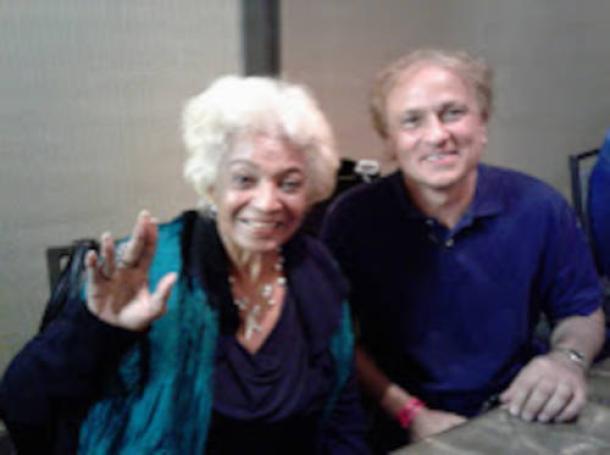
Nichelle Nichols (Uhura from Star Trek) with the author.
Car Facts
Cars (meaning “wheeled vehicle” in Latin). Much can be said about vehicles going back all the way to ancient times (see Hero of Alexandria). In 1831 Alexis de Tocqueville sailed with a friend into Newport, Rhode Island, to begin his remarkable journey across America, nothing that “All around you everything is on the move.”
In the 1800s and early 1900s, lots of entrepreneurs and inventors dabbled and worked seriously in their garages and factories on “horseless carriages.” We get a view of the rise of the automobile (disruptive force) in the wonderful movies The Magnificent Ambersons by Orson Welles and The Shootist starring John Wayne in which the car is a symbol of the new century. Cars are omnipresent and a total change agent in America, transforming open lands, suburbs and cities, reflecting/creating our need for mobility, power, individual transportation – and fast food. Some cars such as the Model T, Cadillac, Corvette, Thunderbird and Firebird are iconic and legendary, with the latter two named mythically. Mythologist Mircea Eliade wrote that the car is mythic. (Some scientific studies have linked small penis size and flashy cars.)
An interesting take on the car is “David Cronenberg’s 1996 cult film Crash, where James Ballard, a bored film director (played by James Spader), and Dr. Helen Remington (Holly Hunter) explore the erotica of car crashes. “In fact, crashes, the ultimate aphrodisiac, foreplay as near-death experience, convey the couple to delirious plateaus among the wreckage. If technology governs us, then the human body, full of curves and allure, is somehow inadequate. Technology has become divine. It watches us,” I wrote in an essay, Gatsby Sutra, for ASEBL (from St. Francis College).
Artist as Hero
The Renaissance gave us the brilliant and “heroic” artists Leonardo Da Vinci and Michelangelo. The 19th century includes the iconic Impressionists and the American Romantics or Hudson River School in Catskill, NY. The Twentieth Century is filled with “heroic” figures in all the arts, and the artist as hero is a big theme. In Midnight in Paris, for example, Woody Allen shows us many artist-heroes: Picasso, Dali, Cole Porter, Josephine Baker, Gertrude Stein, Ernest Hemingway and the Fitzgeralds.
The Harlem Renaissance was a brilliant cultural movement across the arts and humanities and Civil Rights of the 1920s/1930s and thereafter. The Transcendentalists, Algonquin Round Table, the Beat Poets, The Factory, Harlem Writers Guild and other creative groups have a legendary or mythical status. (My friend and former professor, Ed Adler, author of Departed Angels: The Lost Paintings of Jack Kerouac, sponsored the Beat Generation Conference at New York University in 1996 when many of the Beats were still alive.)
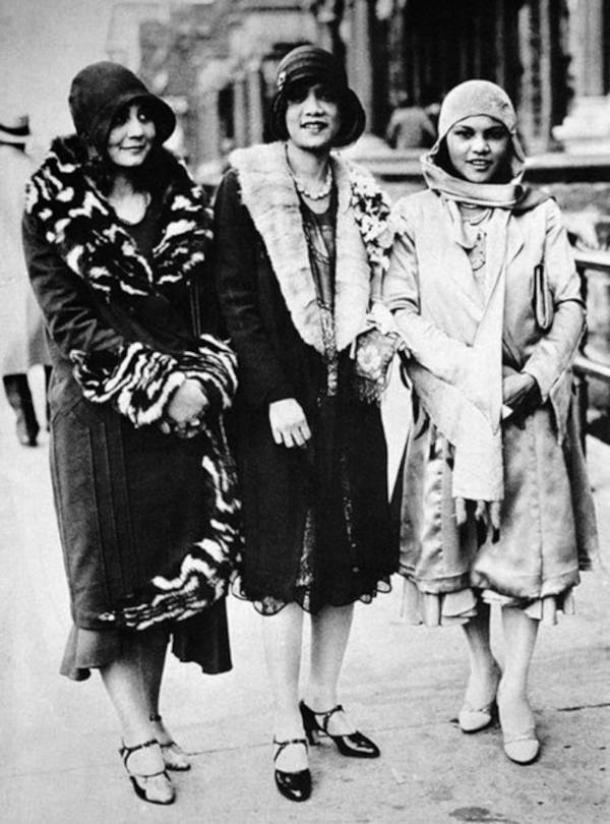
Three African-American women in Harlem in 1925, during the time of the Harlem Renaissance. (Public Domain).
Mythical Notes on Music
Here's what Maestro Robert Butts (composer and conductor of the Baroque Orchestra of New Jersey) wrote to me his observations on myth and American music:
“Ives is THE most important of American composers and holds this kind of mythic aura to those who think that way. However, it's almost more similar to a cult status than actual American Mythic because the percentage of people who feel that way is really quite small...”
Two names come to me immediately and both are relatively recent (mid-20th century) - Leonard Bernstein and Elvis Presley. At one time I think I would have included Louis Armstrong in there, but his name seems to have receded from recognition despite his significance in the jazz/pop world. But, even people who don't like or have no idea about the work of Bernstein and Presley recognize the name and have at least a vague idea of who they were and what they did. Of course, this could all change 50-100 years from now, but now I think those two names still carry a kind of mythic aura. I'd say The Beatles as well, but they're not American.
When I teach my undergraduate classes, I'm still stunned by how many 18-20 year old students have no idea about some names from the 1990s but do know who Bernstein and Presley (and the Beatles) were.
The story goes that blues great Robert Johnson sold his soul to the devil to gain mastery of the guitar. Blues and Jazz heroes loom large with Louis Armstrong, Ella Fitzgerald, John Coltrane and many others. The Rat Pack – with the core of Frank Sinatra, Dean Martin and Sammy David Jr – were legendary for their music and stage antics. The Doors were a major rock and roll band of the 1960s with Jim Morrison as lead singer and lyricist; Morrison wrote poetry about Dionysus, the god of wine and ecstasy. Like The Doors, the Grateful Dead and Jimi Hendrix have legendary and mythic stature. Jerry Garcia is especially legendary. Ritchie Valens and Joan Baez are legends too. Elvis, the king of Rock and Roll, is a larger-than-life entertainer with off the charts fame, charisma and talent – and the endless fascination with his death. His sequined jumpsuits and capes, belts and pompadour, added up to Royal dandyism. Various authors include Elvis in their myth category. Today’s stars (iconic, mythologized) include Taylor Swift, Bruno Mars, Lady Gaga, etc.
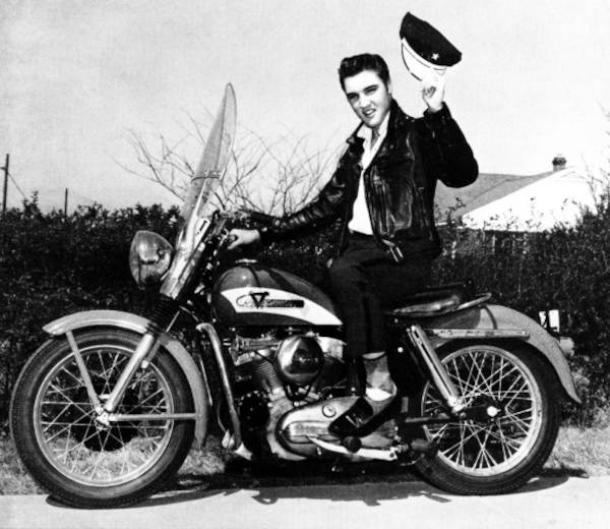
Elvis on his Harley-Davidson, January 2, 1956. (Classic Motorcycle Build/CC0).
It sometimes enhances the legend or mythic glow if the musician, actor or artist passes away early, such as the “27 club.” Forever Young they remain.
Iconic Musical Events
What are some iconic musical events in American history? Let’s mention a few: when Eleanor Roosevelt invited Marion Anderson to sing at the Lincoln Memorial in 1939; Elvis on the Milton Berle Show in 1956; The Beatles appearing on the Ed Sullivan Show in 1964; Bob Dylan going electric at the Newport Folk Festival in 1965; Woodstock in 1969; the release of Michael Jackson’s Thriller 1982; the yearly New Orleans Jazz and Heritage Festival and many others before and after.
Who are your favorite larger-than-life entertainers? Do they reach legendary or heroic status? What about posthumous Elvis and rapper Tupac Shakur sightings? (My wife, child and I once stayed in a small hotel in West Virginia where Elvis had also stayed; I remember saying to my wife, “Wow, I wonder if we’re in his room?”)
Part 1 of this series can be read here …
Top image: Lower Manhattan as seen from Governor’s Island.
Source: Rhododentrites/CC BY-SA 4.0.
By Richard Marranca