There has been a perpetual stream of myth-inspired art throughout human history, stretching all the way back to cave paintings. Because of the power of the large screen and because of their fertile origins in ancient drama and modern novels, movies are perhaps at the apex of mythical depictions. Movies are replete with rags to riches characters, young heroes in need of mending and transformation, fate and destiny, the battle between good and evil, finding oneself and home, etc.
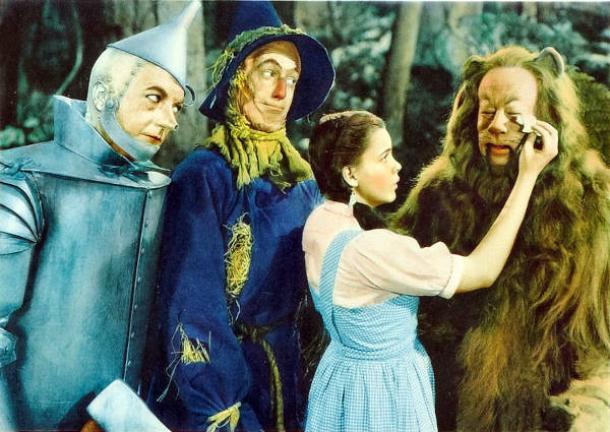
The Wizard of Oz: Judy Garland, Ray Bolger, Jack Haley, Bert Lahr. 1939. (MGM/Public Domain).
Mythic classics (a flexible term – movies with mythological elements) include Citizen Kane, The Wizard of Oz, Casablanca, Grapes of Wrath, The Searchers, Roman Holiday, Moby Dick, Ben-Hur, Easy Rider, Planet of the Apes, 2001: A Space Odyssey, Apocalypse Now, Superman, Rocky, Close Encounters of the Third Kind, Star Wars, Indiana Jones, Mission Impossible, The Matrix, Harry Potter, Tree of Life, Percy Jackson, Tomb Raider, Once Upon a Time in Hollywood, Dracula and vampire movies (many versions), The Brutalist, the Marvel Universe, DC Universe, Disney films and a host of others. (As a sidenote, science fiction often turns out to be myth in outer space.)
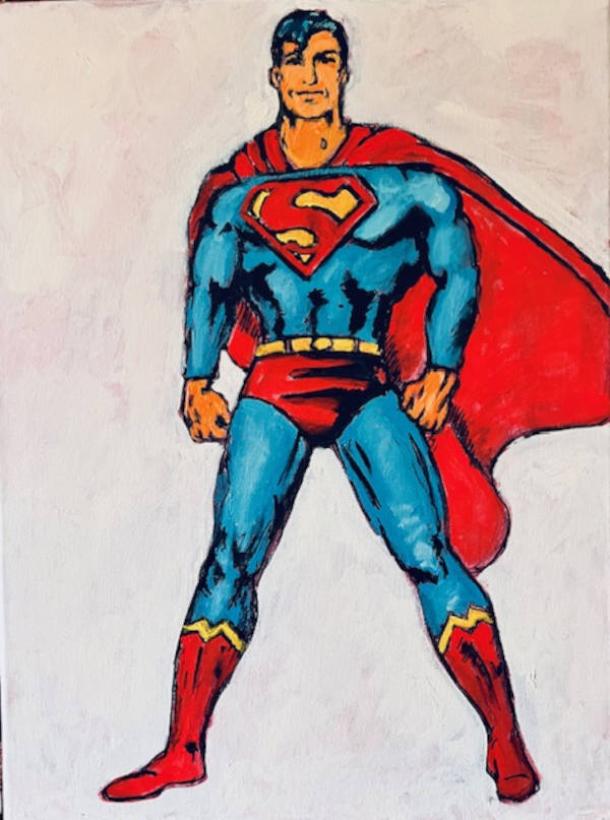
“Superman” by Ed Adler, NYC artist and author.
Prof. Fred Jordan (Associate Professor, Nashville State Community College) mentioned this to me about Easy Rider (1969): “Billy (Dennis Hopper) and Wyatt ‘Captain America’ (Peter Fonda) fit into the tradition of the Quest, as well as the myth of the cowboy – motorized now.”
- 330 Years of Unknown History: The Oldest Road in the US Surfaces
- American Shipwreck Finally Identified – And it’s Revolutionary!
Selected Westerns Movies
The American Revolution opened the floodgate for pioneers venturing west. Thomas Jefferson’s Louisiana Purchase (1803) and the Mexican-American War (1846-1848) added an incredible amount of land to our already vast country, making America a continental power. “Go West, young man,” said New-York Tribune editor and reformer Horace Greeley. Hundreds of thousands of people listened to this and headed for a fresh start on the Oregon, California, Mormon Trails… Of course, going west meant heading into Native American lands – a topic taken up in a big way by Hollywood.
Westerns (such as High Noon, The Searchers, Rio Bravo, High Plains Drifter, Dances with Wolves, Tombstone, The Revenant, Killers of the Flower Moon, etc.) are held in high regard. As a sidenote, John Wayne was the iconic cowboy in many films during Hollywood’s Golden Age. In fact, Wayne criticized High Plains Drifter because it deviated from a romanticized view of the American West.
Around the time of writing this essay, there are many Westerns streaming, such as 1923, Horizon: An American Saga, American Primeval, etc. In the latter, for example, we delve into mythic material: sacred lands of the Native Americans, the Promised Land, New Jerusalem, Manifest Destiny, the cowboy story, sacred Buffalo, the journey, violence as a problem solver, etc.).
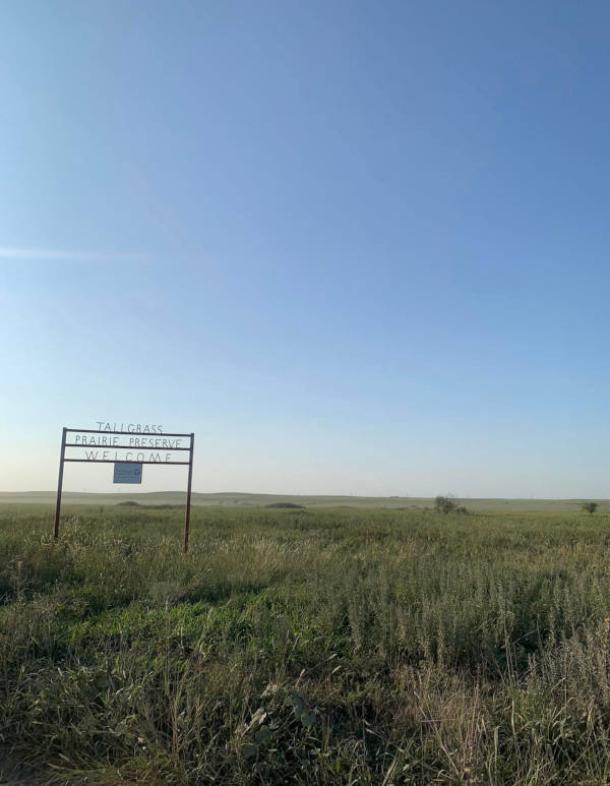
Tall Grass Prairie Preserve. Osage County, Oklahoma. (Renah Marranca).
The Western genre recycles all sorts of archetypes. In Star Trek’s Strange New Worlds (episode one), for example, Captain Christopher Pike (played by Anson Mount) in cowboy garb, escaping his outer space responsibilities, gallops across the snowy Montana countryside. He passes under wind turbines (if there’s a future, it will be green). Next, a spaceship hovers above Pike: the admiral needs him back. Pike, torn between the desire for freedom and the responsibilities of his position, responds as he must.
Pike is not quite the reluctant hero as Star Wars’ Han Solo (Harrison Ford) who wears his heavy blaster like a gunslinger. In a memorable scene, Han Solo blasts the lizard-headed, bounty hunter Greedo, who clunks dead onto the table. And in Raiders of the Lost Ark, Dr. Henry Walton "Indiana" Jones, Jr. (Harrison Ford) is replete with hat, whip and rugged individualism, as he grabs archaeological treasures, fights dreaded Nazis and obtains the preternatural Ark of the Covenant. (Speaking of the Ark, there are many towns and cities named Newark in United States – usually in reference to the Bible’s Ark of the Covenant, which held the Ten Commandments.)
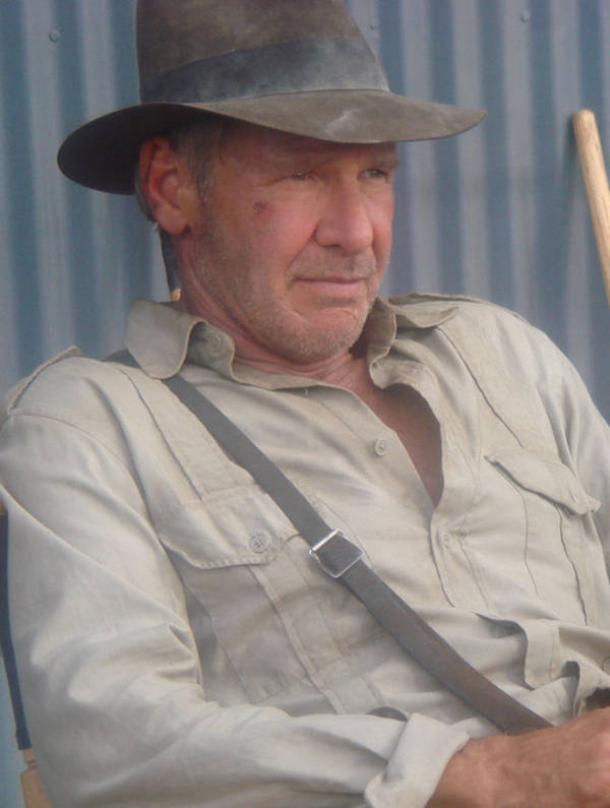
Harrison Ford as Indiana Jones, on the set of Indiana Jones and the Kingdom of the Crystal Skull. (John Griffiths/CC BY-SA 2.0).
Gallery of Sports Heroes
The Olympics, in honor of Zeus and held every four years in Greece, begins (776 BC) the story of competitive sports in the West. In our interview, Prof. Paul Cartledge, author of Alexander the Great and Ancient Greece: A History in Eleven Cities, said, “The Olympics were a religious festival, eventually held over five days… This ‘armistice’ was to enable competitors and spectators to get to and from the Games unharmed. Winners received a laurel and fame; many of them got free food and lodging from their city-state (polis)” (Historical Association: The Voice for History).
The Olympic Games were revived in 1896 – about 1,500 years after being banned by the Roman Emperor Theodosius. One epic and historical Olympics Games was hosted by Germany in 1936, the so-called “Nazi Olympics.” Adolf Hitler’s “Aryan” master race ideology was showcased by instant myth content creators Joseph Goebbels’ shaping of the event and Leni Riefenstahl’s cinematic virtuosity. All this was undermined by Jessie Owens winning four Gold Medals. The US team had 312 athletes, including five Jews and eighteen African Americans.
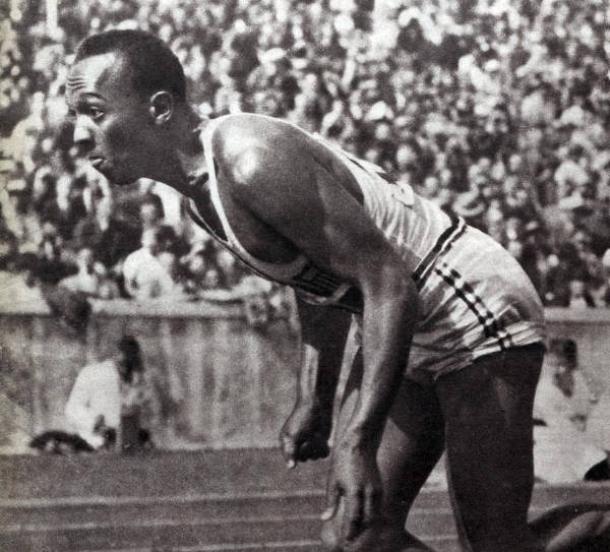
Jesse Owens at the Olympic Games in 1936. (Le Miroir des sports/Public Domain).
Over the 20th century, sports became a professional enterprise. Tennis legend Billie Jean King said that “sports are a microcosm of America.” Still going strong after many decades, baseball is a fun-filled American pastime – and sometimes more than that. The Natural (referring to Barry Levinson movie adaptation of the Bernard Malamud novel) begins in the heartland with a boy and his dad playing catch. A lot happens after that. Near the movie’s end, Roy Hobbs (played by Robert Redford) hits a game-winning home run into the stadium lights, generating joy and a magical light show falling upon players and spectators alike. This is not the trivial plane of existence but something sacred.
Sports stars are of course great athletes, but when they go beyond even that, when they transcend the field of action, they are another order of being. The Greatest – Muhammad Ali – not only stood up for Civil Rights but also announced that he would not serve in the Vietnam War. He knew and felt something that wasn’t registered by “the Domino Theory” and the politicians who had gotten us into that long war. (As an aside, one myth that emerges in times of war is that the war will be a short one. When I was a child, my very old neighbor and friend, Fred Kretchmer, told me that before he headed off to the Great War in 1917, he told his parents that he’d be home before Christmas.)
A small selection of sports heroes include Babe Ruth, Jesse Owens, Jackie Robinson, Babe Didrikson, Jim Thorpe, Joe Di Maggio, Rocky Marciano. Roberto Clemente, Mohammad Ali, Joe Namath, Arthur Ashe, Chris Everet, Jimmy Connors, Michael Jordan, Serena and Venus Williams, Tom Brady, Tiger Woods and many more. Some sports heroes can inspire candy bars: Baby Ruth (Babe Ruth) and The Reggie Bar (Reggie Jackson).
And tarnished sports heroes include some members of the White Socks in 1919 (Fitzgerald refers to them in The Great Gatsby – also a theme in Kevin Costner’s Field of Dreams – but this time they’re given a second chance.).
Multimodal Myth
The New World; The American Dream; Upward Mobility; Streets of Gold; The New Deal (Franklin Delano Roosevelt); The New Frontier (John F. Kennedy); Self Creation; New Identity; Fame; Madison Avenue (advertising); Hollywood (Place and Dream Factory); Native American creation and trickster stories (and more); American Exceptionalism; Founding Fathers/Mothers; the West; Manifest Destiny; myths of the Salem Witch Trials of 1692; sacred documents such as the Declaration of Independence, the Constitution, Abe Lincoln’s Gettysburg Address, etc.; the Melting Pot; sacred places such as Arlington and Punchbowl Cemeteries and the Black Hills and Monument Valley; monuments (Washington Monument, Lincoln Memorial, Ebenezer Baptist Church et al.); myths of war; homes of important personages (Monticello, Mount Vernon, Whitman House in Camden, NJ; Emily Dickinson House, Poe Houses; Emerson’s homes and Thoreau’s family house and cabin and the Alcott Family’s Orchard House – all in Concord, MA; Louis Armstrong House; myths about Speakeasys and historical inns and restaurants; myths about education; the places where George Washington slept, etc.

Alcott Family’s Orchard House. Concord, MA. (Renah Marranca)
There are also legends like Paul Bunyan (fiction) and Johnny Appleseed (kindly planter of apple trees; 1774-1845) and Molly Brown (real) who helped save people on the Titanic; assassinated leaders (myths about then); the Rebel Without a Cause Theme; High School Myths; Alligators in the Sewers (well, sometimes they sneak in); the Jersey Devil (and other X-Files-like material); gangster tales (from Billy the Kid to Bonnie & Clyde to John Dillinger and Al Capone to today’s bad boy luminaries). In our 1980s interview, novelist E. L. Doctorow (Ragtime, The Book of Daniel, etc.) told me that “Americans love gangsters as long as they get punished.”
Other areas deserving of a mention: Conspiracy Theories; Cults (including End of the World Cults, such as the Manson Family, the Branch Davidians, Heaven’s Gate, etc.). Heaven’s Gate leaders, for example, preached that committing suicide allowed everyone to escape their bodies and join an alien spacecraft hidden behind the Hale-Bopp comet. There are many reasons for such cults, one being charismatic leadership and another that America has immense lands in which to hide one’s flock—systems in isolation.
How about various political myths and fake news? How about Orson Welles’ 1938 radio broadcast of War of the Worlds? How about UFOs and Area 51? Have aliens visited us? Are aliens a projection of our hopes, as well as our dread of Mutual Assured Destruction (MAD)? Dr. Carl Jung (who coined the term “archetype”) believed, among other things, that UFOs were a search for wholeness. In the sci fi classic, The Day the Earth Stood Still, Klaatu (Michael Rennie) and his giant robot offer peace to earthlings – or else!
What new myths—from science, culture, human experience—will arise?
Thinking for the Present and the Future
In the New World preference is given to what is new -- away from the cobwebs, royalty, entrenchment and corruption of the Old World (as many Americans believed and some still do). Calling a product or political candidate “new” will help raise money and win elections. Dollar stores, consumerism, online shopping have proliferated. A glamorous new car becomes a used car. According to P&G: “For the First Time in 100 years, Charmin [toilet paper] is Reinventing the Square for a Smoother Tear.” Progress and change and “getting and spending” are vast themes in the modern world. And most of us want to be in tune with progress, not be looked upon as old-fashioned, atavistic or Luddite. You can be the smartest person in the room, but if you don’t know the intricacies of a computer you are screwed; you are yesterday’s news!
Sidenote: If there is a good side to something, there’s quite often a shadow or dark side – as Sophocles’ quote reminds us at the beginning of The Social Dilemma. “Nothing vast enters the life of mortals without a curse.” That’s heavy, karmic. In the early 1800s, the Romantics (such as Mary Shelley in her seminal book, Frankenstein) pointed out plenty about the dangers of hyper-rationalism, industrialism and a lack of feelings. This theme and various warnings pop up in dystopian novels and movies such as Westworld, Logan’s Run, the Giver and others, whereby utopia turn out to be dystopia – seems to be two sides of the same coin. (I remember being enthralled by my late great 11th grade physics teacher, Mr. Saul Keller, at Abraham Clark High School. He told us about the wonders of the cosmos and the great ideas / inventions of science, but I also recall him fretting about garbage mountains and nuclear emissions. Some of the class goofballs used to ask Mr. Keller how to make a bomb, and he’d say “bombs, bombs, bombs -- just blow up the world.”)
- American People Suffering Historical Amnesia With Many Citizens Knowing “Virtually Nothing” About Their History
- Lakota Tribes Inhabited Two Rich Wildernesses, Both were Stolen, But The People Resisted
It’s up to all Americans to discuss, debate and arrive at a holistic understanding of progress – not just the technical, financial and governmental hierarchies. After all, we are a “government of the people, by the people, for the people” (Pres. Abraham Lincoln in the Gettysburg Address). To create safe, sustained and meaningful progress will take big picture thinking – what the Iroquois called Seventh Generation Thinking. How can we mindfully include the distant future, the next seven generations, in our beliefs and actions?
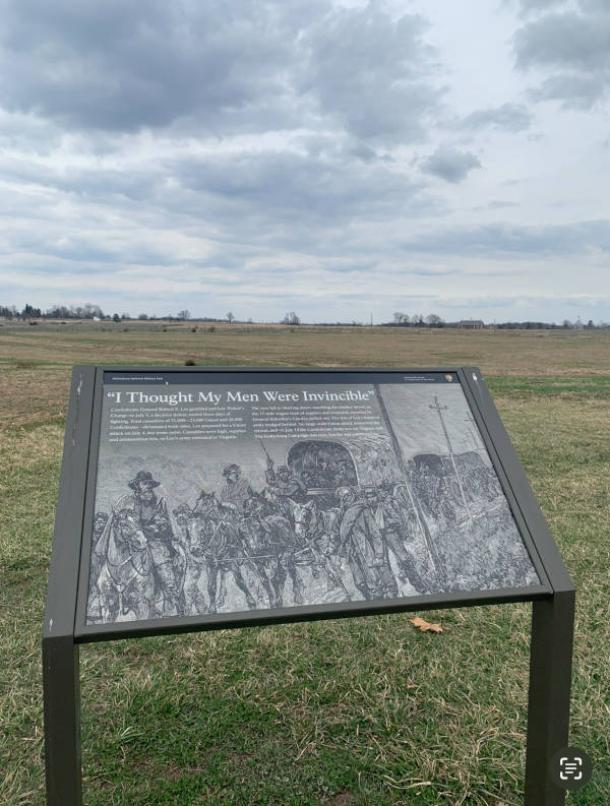
Gettysburg, PA. (Renah Marranca)
The big picture includes the wide spectrum of ideas, subjects and experiences— and what my late great friend Dr. Huston Smith (author of The World’s Religions) called “the wisdom traditions.” Huston emphasized the danger of turning science into religion or scientism – believing that only science has genuine knowledge and is superior to everything else. I think that Dr. Carl Jung’s emphasis on wholeness is essential here too.
How can we achieve our ideals? Is there utopia or a “promised land?” Well, utopia means “no place,” but America (and modern society in general) has achievements that were once thought to be impossibly utopian, such as the abolition of slavery, women’s suffrage, clean drinking water, widespread access to education, animal rights, fewer smokers, etc. If there are no utopias, there are ideals that can be realized (George Orwell, E. O. Wilson, Jane Goodall and others have much to say about this.). But it’s a false view if we think that civilization and civilized behavior are somehow automatic or on an evolutionary continuum. It takes a lot of work on many levels, continued vigilance.
Tapestry of Myth
American Myth is a vast tapestry or mishmash of symbols, stories, rituals, ideas, objects, events, people, places. It reflects who we are and what guides us -- a nation with a vast influence around the globe. For a variety of reasons, it’s good to understand American myth as being both old and new – and merged by belief and ritual. Myth makes the old seem new, the new seem old. (Like the Roman god Janus looking backward and forward at the same time.)
As I wrote this essay in late February & March 2025, there was vast change in America and in the world, accelerated by politics, remnants of the Covid Pandemic, the rise of AI and a plethora of technology, the continuing rise of billionaires and plutocracy, etc. Ideas and policies that guided much of the twentieth century and after (America as the Indispensable Nation; welcoming to Immigration; with a better working relationship among democrats & republicans; more benevolent manifestations of the Social Compact; solid treaties with other nations) have been modified. Let’s see how this plays out.
Prof. Fred Jordan mentioned to me: “Trump and Vance lean into George Washington’s ‘Avoid entangling alliances,’ John Adams’ ‘do not go abroad in search of monsters.’ Endless wars. 100 Years War. Thirty Years War.”
It’s a lot to take in, and sometimes it seems as if there’s only change. Where is change and transformation taking us, and at what point will it be so entangling and dissociative that we don’t recognize ourselves and our children—with the slower, serene life far back in the rearview mirror? Do we have free will and, if so, how much of it? Is technology both a blessing and a curse—how so and what’s next? Is that part of civilization to have all those nukes aimed at our children? (There never was nor can there be a complete defense against it.)
Are poetry, love and rainforests of less importance than excess consumption and home additions? What if your cell phone is indistinguishable from your self? And what’s the point of living a Blue Zone lifespan if we spend much of it plastered to dots transmitted by plastic boxes? (Over eight hours a day screen time for the average teen.) Can we use these devices / gadgets without them using us? At what point do we become Cyborgs? (Note: I would have found it nearly impossible to write this essay without the Internet to obtain— and verify— all sorts of information, plus get emails from friends for quotes and such! Well, we all know the vast and instant benefits of connection and technology.)
Labyrinth of Myth
In The Matrix, Morpheus (Laurence Fishburne) offers Neo (Keanu Reeves) a choice of the blue pill (imagined reality) or the red pill (reality, the hero’s journey; to know who you are, to become yourself). Perhaps that’s a little like the vision and hard choices we always have. Myth partakes of the real and of the imagined. Perhaps we partake of both pills: dreaminess mixed with reality. As with any desire or dream, it’s important to have grounding, to know ourselves and be mindful, to have rationality and wisdom, to have good relationships and high ethics.
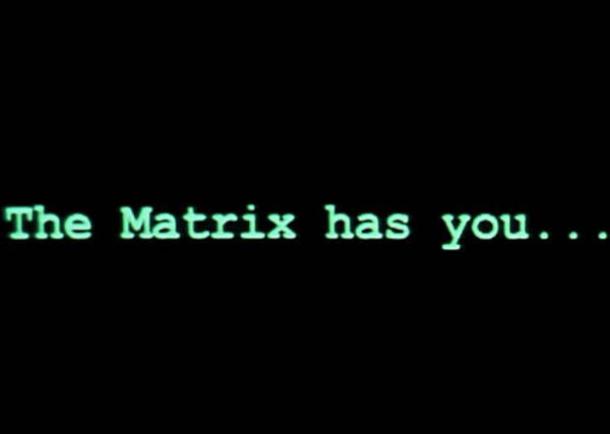
From The Matrix. (Public Domain).
If progress is really progress, it must include active wisdom and compassion and “the land ethic” (to borrow the term from Aldo Leopold). Reason without compassion will bring us to the brink and then over. The good life is based on virtues and balance in ourselves and in our family and community and nation and among nations and with earth itself. More and more we value, we understand, the sublime magic show of earth’s inhabitants on land and in the air and in the sea. We know that species that have existed for millions of years can be extinguished in a short time. Even before they’ve been discovered.
The more we are open to spontaneity and the full range of our senses, the more amazing and brilliant everything feels and looks. In The Power of Myth: The Hero’s Adventure, mythologist Joseph Campbell said to Bill Moyers: “I mean, the whole thing is consciousness. I begin to feel more and more that the whole world is conscious.” It’s beside the point whether you are a creationist or evolutionist; life is really a miracle, there’s nothing else like it in the universe, until we find what’s like it in the universe -- and it’s vast & endless out there, the reason we use light-years to measure the cosmos.
But let’s return to earth: dominion over the planet is archaic language; stewardship of the planet is language from the soul. “As any gardener knows, the vitality of a garden does not end with a harvest,” my late great professor Dr. James Carse wrote in Finite and Infinite Games. Jim often expressed how it’s better if we control our instincts and allow nature to win, so that we all win.

Famous 1907 Magneta Grandfather Clock, Westin San Francisco Hotel. The hotel hosted 27 delegations at the founding meeting of the United Nations, April 1945. (Richard Marranca, April 26, 2025).
People and cultures are endlessly complex and paradoxical; the ones that flourish hold together and have the strength, ingenuity, innovation and institutions that bring it forward. They have a past, present and future, seemingly all at once.
There are two paths for each of us and for society in general—we get better or we get worse. Maybe it’s true to say that both are happening—evolution of consciousness and entropy.
*Questions: What is our level of trust and our ability to work with others? How can we achieve greater harmony with ourselves and with life on the planet? Can the will to power of people and nations be turned toward peaceful coexistence and ultimate survival? Are our best days behind or ahead of us?
Since most of us are concerned about AI, I asked it for a futuristic “reflection” and this was the reply: “The lack of world peace is a complex issue with no single answer.” Who can argue with that Spock-like reply? We could finish here with magisterial documents like George Washington’s warning about factionalism in his Farewell Address, or James Madison’s Federalist No. 51 on checks and balances in government, or the United Nations Charter of 1945 on friendly relations between nations—but it’s perhaps better to return to those documents on our own.
We began this study with the meaning of myth, continuing with themes and examples from American history and culture. To ourselves and others, we are all storytellers & mythmakers. What we do with this material is open to interpretation and revision. Myth is an expression of life as much as anything. In the newest Star Trek series, Strange New Worlds, Captain Christopher Pike says: “The future is what we make it.” We make it – those are magical words, empowering words, much needed to face the journey ahead.
This essay turned out to be more expansive than the five-page essay I had originally planned. I wish to thank friends who helped me. Professors Ed Adler (Superman image), Paul Cartledge (quotes), John Fruncillo (early reader of first part), Frank Korn (quotes), Emil’ Keme (quotes and ideas), Salima Ikram (quotes), Fred Jordan (quotes and editing), Alan Mitnick (quote); Maestro Robert Butts (quote); Xenia Melzer (quote); Thomas Pranio (editing); and Retired Police Detective/PCCC Public Safety Team Member Lamont Garnes (relating to Star Trek).
Late friends included in this essay are Professors James Carse, Berndt Ostendorf and Huston Smith; and I wish to thank the brilliant, wide-ranging Nathan Falde and Ancient Origins for the opportunity to reach out to others on a vital topic – the aliveness of myth.
I’ve been fortunate to have been given incredible opportunities from the United States government that have helped immensely with this essay, teaching and life in general: a Fulbright Award to teach American Literature / Culture at LMU Munich; and National Endowments for the Humanities Summer Seminars to study Andean Worlds in Peru and Bolivia; Transcendentalism in Concord, MA; the Alamo in Texas; High-Plains Indians in Nebraska; World War II in the Pacific at the East-West Institute in Honolulu, Hawaii; plus other NEH summer seminars less directly related to my three-part American myth essay.
Parts I and II of this essay can be read here and here ...
Top image: Participants in the 1986 Memorial Day event Hands Across America, designed to raise money to fight hunger in the United States, lined up along and near the Benjamin Franklin Parkway in Philadelphia.
Source: Sam Cali/CC BY-SA 3.0.
By Richard Marranca