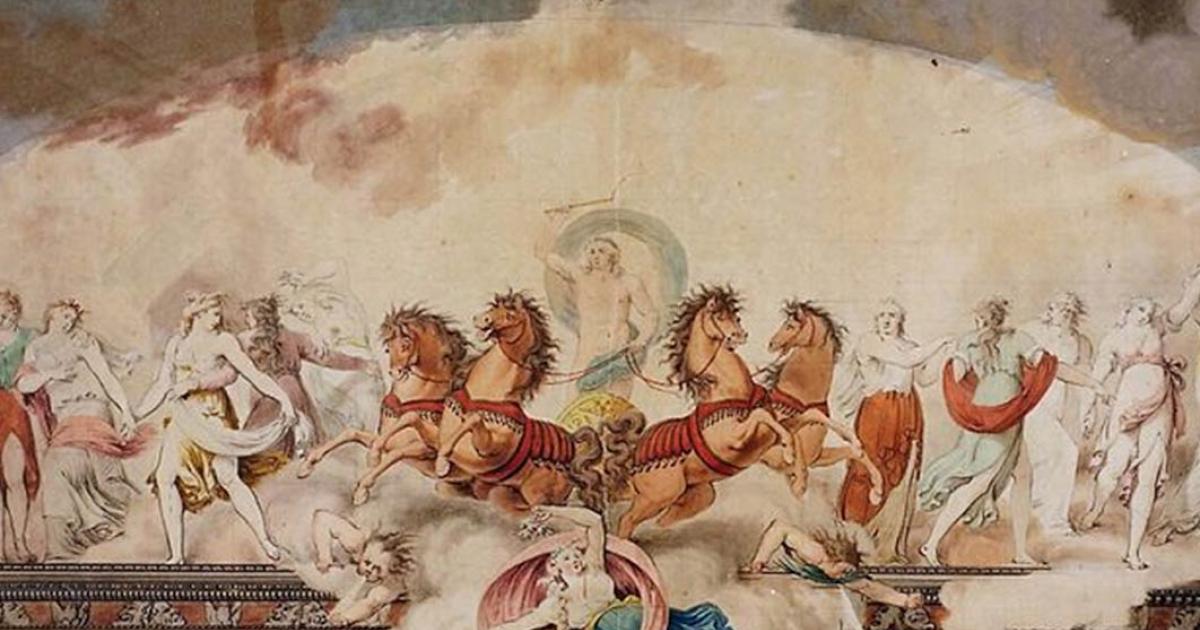

The sun god Apollo has been identified as the embodiment of the Hellenic spirit, by Scottish classical scholar W.K. C. Guthrie in his 1950 book, The Greeks and their Gods. An eternally youthful deity and a favorite among later poets, Apollo is usually depicted as crowned with laurels that symbolize victory and his attire of a purple robe symbolizes his nobility. A god of multiple roles and significance, as Apollo Pythios he serves as the patron deity of Delphi, an oracular god, as well as the patron of sailors and seafarers, refugees and fugitives. As kourotrophos (the guardian of young people), Apollo oversees children's health and education, as well as their rites of passage to adulthood. Apollo also presides over all music, songs, dance and poetry as the founder of string-music and is revered as the constant companion of the Muses, acting as their chorus leader in festivals.
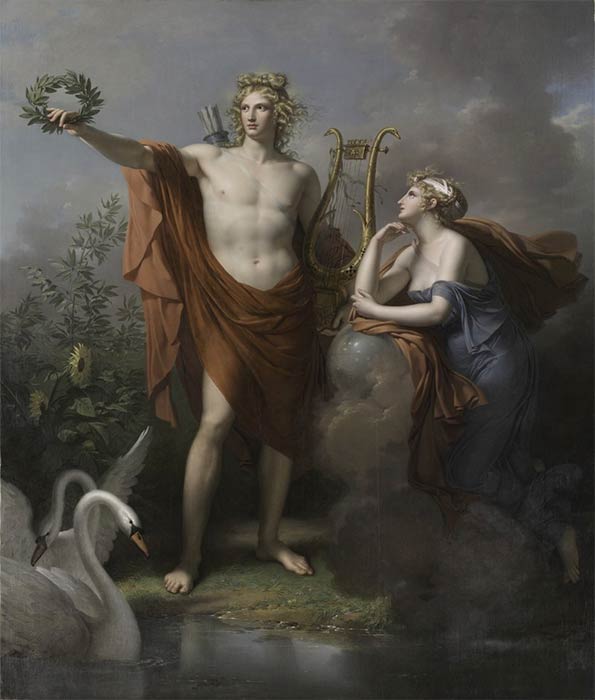
Apollo, God of Light, Eloquence, Poetry and the Fine Arts with Urania, Muse of Astronomy by Charles Meynier (1798) Cleveland Museum of Art (Public Domain)
Apart from his diversity of functions, there is still more to Apollo than meets the eye. Apollo is also an important pastoral deity as the patron of herdsmen and shepherds. His primary duties included protecting herds, flocks and crops from diseases, pests and predators. Apollo also promoted the formation of new cities and the development of a civil constitution. He was looked upon as the law-giver as his oracles were consulted in a city before laying down any laws and regulations.
Ambivalent Apollo
Despite all his wonderful functions and qualities, ancient Greek tragedies portray Apollo with a completely different characterization. Although the chorus praises him in cultic scenes, the voice of tragic characters usually portray him as an awful god who lacks the very measures generally attributed to his Delphic aspect of moderation (µ???? ????, “nothing in excess”, is even inscribed in the temple of Apollo at Delphi). At the very least, as are all the gods portrayed in tragedy, Apollo is portrayed as ambivalent. Standing beyond the sphere of humanity, these ambivalent gods cannot be comprehended within human categories as they are neither “good” nor “bad”. As a result, instead of being the one to turn to for help in the tragic play, the ambivalent god tends to become a terrible threat to mankind. Apollo in particular forces some characters into tragic situations and then, even when he is the antagonist, seems to be strangely detached, remaining as ever the god who only watches from afar without really participating in the event.