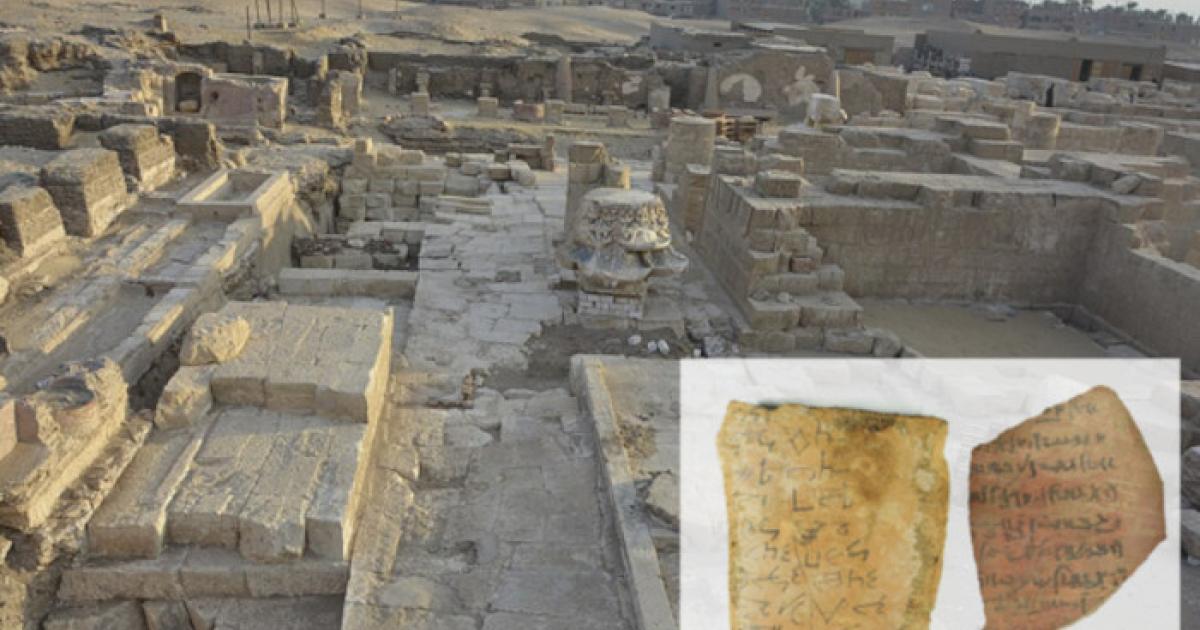

An Egyptian-German archaeological mission has unearthed a staggering 13,000 inscribed pottery fragments, known as ostraca, at the ancient site of Athribis in Sohag, Upper Egypt, including over 130 texts related to ancient astrology. This latest discovery brings the total number of ostraca found at the site to approximately 43,000, making it the largest collection of its kind ever recovered from a single location in Egypt, and offering an unprecedented window into the daily life, administration, and celestial beliefs of its ancient inhabitants, reports Ahram Online.
The joint team from Egypt's Supreme Council of Antiquities and Germany's University of Tübingen has been excavating at Athribis since 2005. The sheer volume of material, with over 42,000 fragments uncovered in just the last eight years, surpasses even the famous collection from Deir el-Medina, the village of the artisans who built the royal tombs in the Valley of the Kings, long considered the most significant ostraca archive in Egypt after more than two centuries of archaeological exploration. These ostraca - essentially the notepads and scrap paper of antiquity - were used for over a millennium, providing a continuous record of life in the city.
- Ostraca: An intimate glimpse into New Kingdom Egypt
- Scribes in Ancient Egypt: Custodians of the Voice and Masters of the Words
A Hub of Ancient Astrology
Among the most remarkable finds are over 130 ostraca related to ancient astrology, including horoscopes and zodiacal signs. These texts, primarily written in the Demotic and Hieratic scripts, confirm that Athribis was a significant center for astronomical and astrological activity in the ancient world. While astronomy in ancient Egypt focused on observing and measuring celestial bodies, astrology sought to interpret their meaning and influence on human affairs. The horoscopes found at Athribis recorded the positions of stars and planets at the moment of a person's birth, providing a basis for divination and character analysis.
The discovery sheds new light on the integration of celestial observation into the spiritual and daily life of the city. Athribis was a cult center for the lioness goddess Repyt, a local form of Ta-Repit, (regarded as the Eye of the Sun God), who was worshipped alongside the fertility god Min of Akhmim and the child-deity Kolanthes. The presence of so many astrological texts suggests that the sky was seen as a canvas upon which divine will was written, a belief that parallels concepts found in many other ancient cultures, including the zodiac carvings at the Temple of Esna and the famous Dendera Zodiac.
- Archaeologists Discover Rare Zodiac Carvings at Egypt's Temple of Esna
- A Circular Egyptian Mythology: Does the Dendera Zodiac Represent the Most Ancient Sky Map?
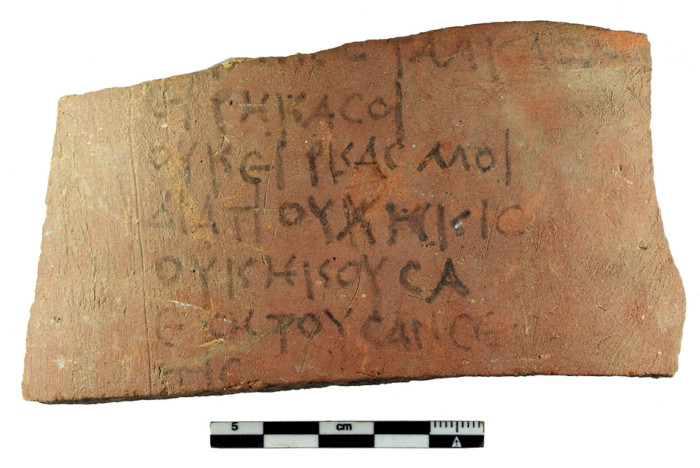
One of the ostraca with Greek script found at Athribis. (Ministry of Tourism and Antiquities)
A Millennium of Daily Life in Pottery and Ink
The ostraca cover a vast timeline, with the oldest being Demotic tax receipts from the 3rd century BC and the most recent being Arabic jar labels from the 9th to 11th centuries AD. The vast majority of the texts are in Demotic (60–75%) and Greek (15–30%), but the collection also includes inscriptions in Hieratic, Hieroglyphic, Coptic, and Arabic, reflecting the multicultural history of the site through the Ptolemaic, Roman, and Islamic periods.
The content of these ancient texts is remarkably diverse. Archaeologists have found administrative records, including tax receipts, delivery orders, and financial accounts. A significant portion of the find appears to have originated from an ancient school, containing writing exercises, lists of months, numbers, and arithmetic problems - and even evidence of lines being copied out repetitively, suggesting a form of punishment for wayward students. Religious texts such as hymns, prayers, and notes on temple offerings have also been identified, reflecting the spiritual life of the community that once thrived here.
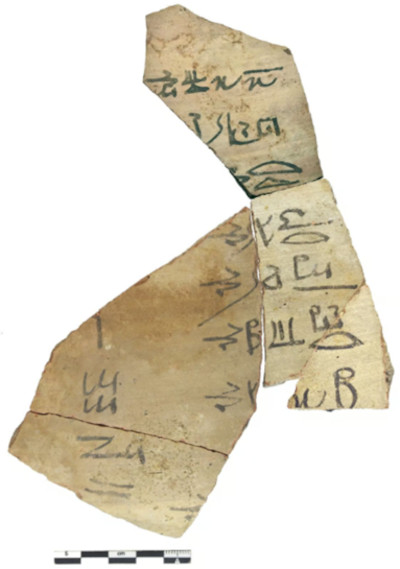
Fragmentary school text ostracon with hieratic script, dated to the late Ptolemaic period. (Ministry of Tourism and Antiquities)
Decoding the Past: The Ostraca d'Athribis Project
To manage the study of this enormous collection, reports La Brujula Verde, an international, interdisciplinary research group called "Ostraca d'Athribis" has been formed. Coordinated by Professor Sandra Lippert in Paris, the team of more than twelve specialists is meticulously analyzing the inscriptions and the pottery itself, bringing together experts in ancient languages, scripts, and ceramics. Their work is expected to reconstruct a highly detailed picture of the economic, social, and religious life of ancient Athribis across many centuries.
"The discovery is a significant scientific addition to our understanding of Egypt's social and economic history across multiple historical periods," said Sherif Fathy, Egypt's Minister of Tourism and Antiquities. Hisham El-Leithy, Secretary-General of the Supreme Council of Antiquities, added that the Athribis collection now surpasses the total number of inscribed fragments discovered anywhere else in Egypt in more than two centuries of archaeological excavations. The ongoing analysis of these remarkable fragments promises to reveal even more secrets hidden within these invaluable pieces of the ancient world.
Top image: Athribis temple in Sohag, Egypt. Inset; Ostraca discovered at the Athribis archaeological site in Sohag, Egypt. Source: Christian Leitz/CC BY-SA 4.0, Inset; Ministry of Tourism and Antiquities
By Gary Manners
References
Carvajal, G. 2026. Another 13,000 inscribed ostraca found at Athribis, now the largest Egyptian site of ceramic fragments related to astronomy. Available at: https://www.labrujulaverde.com/en/2026/03/another-13000-inscribed-ostraca-found-at-athribis-now-the-largest-egyptian-site-of-ceramic-fragments-related-to-astronomy/
El-Aref, N. 2026. 13,000 ostraca discovered at Athribis archaeological site in Sohag. Available at: https://english.ahram.org.eg/NewsContent/9/40/563811/Antiquities/Ancient-Egypt/,-ostraca-discovered-at-Athribis-archaeological-si.aspx
McCormick, L. K. 2026. Treasure Trove of Ancient Astrology Unearthed in Egypt. Available at: https://www.biblicalarchaeology.org/daily/ancient-cultures/ancient-egypt/treasure-trove-of-ancient-astrology-unearthed-in-egypt/
Zahid, N. 2026. 13,000 Ancient Texts Found on Pottery Fragments at Egypt's Athribis. Available at: https://greekreporter.com/2026/03/12/ancient-texts-pottery-fragments-egypt-athribis/