
Editors' Note. The scientific study that this article reported on has now been redacted by its publisher due to concerns regarding referencing, methodology, and data reporting. See notes on the study published on PLOS One here.
Deep beneath the frigid waters of Baffin Bay near Greenland, microscopic grains of alien dust have been discovered that provide startling new evidence for one of archaeology's most controversial theories. A study published in PLOS One has uncovered geochemical signatures of a comet explosion that rocked Earth 12,800 years ago, offering the second major scientific validation in recent weeks for the Younger Dryas Impact hypothesis. This ocean-floor evidence adds to the growing body of terrestrial impact markers found worldwide.
- The Younger Dryas Impact Debate - Is It Settled Yet?
- Louisiana Crater Supports Younger Dryas and Hancock's Lost Civilization Theory
Revolutionary Ocean Floor Discovery
Led by geoscientist Dr. Christopher Moore from the University of South Carolina, an international research team has achieved what many considered impossible - finding definitive comet impact evidence in deep ocean sediments. The researchers analyzed four cylindrical sediment cores extracted from Baffin Bay's seafloor, each preserving thousands of years of accumulated material in precisely dated layers. Using advanced techniques including single-particle inductively coupled plasma time-of-flight mass spectrometry, they discovered microscopic metallic particles with compositions consistent with extraterrestrial origins, reports Science Alert.
"We chose to analyze marine cores from Baffin Bay to determine if Younger Dryas impact proxies reported from dozens of terrestrial sites globally were present in ocean cores," Moore explained. The locations were strategically selected for being far from potential human contamination and containing highly laminated sedimentary records indicating minimal disturbance over millennia. Radiocarbon dating confirmed that impact markers occurred precisely at the Younger Dryas Boundary, 12,800 years ago.
- Fire in the Sky: Cosmic Impact Obliterated Prehistoric Settlement
- Many Ancient Civilizations Destroyed by Catastrophes - What Can We Learn?
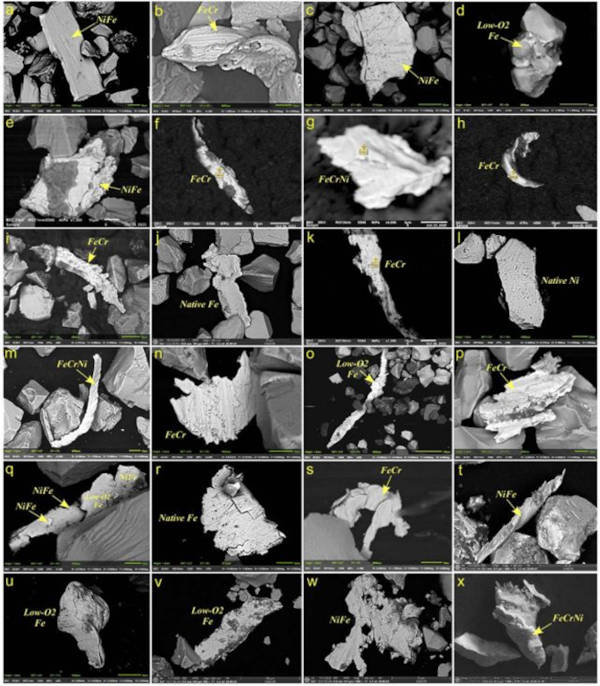
Metallic dust particles extracted from the Baffin Bay cores showing comet impact signatures (PLOS One)
Microscopic Evidence of Catastrophe
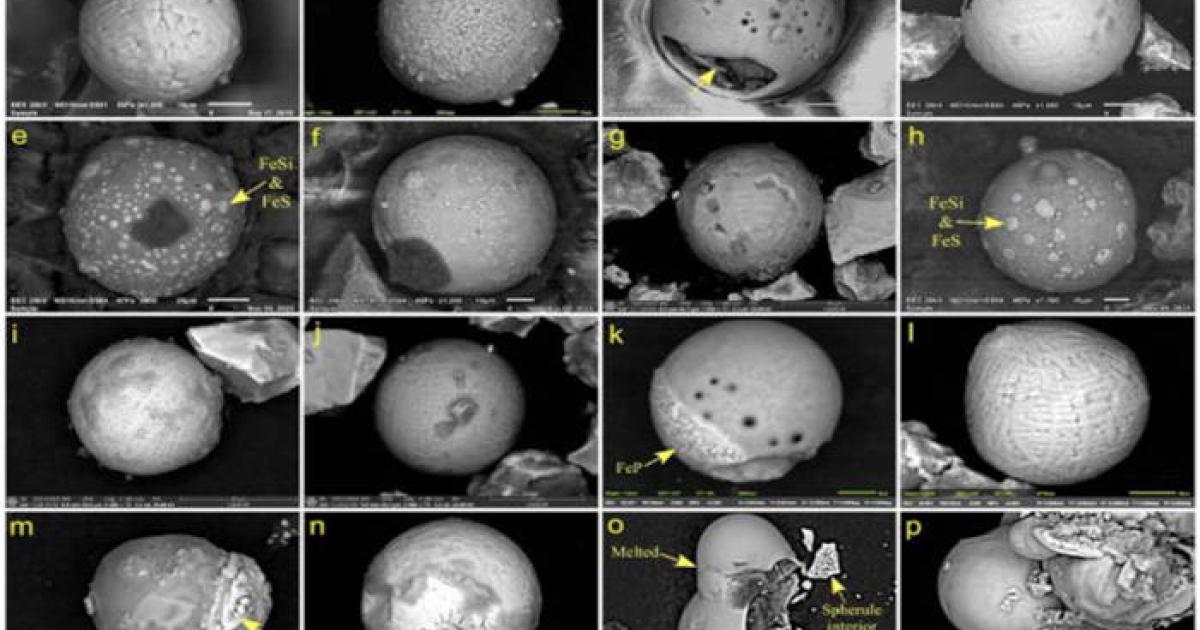
The Baffin Bay cores revealed multiple impact markers that paint a picture of unprecedented cosmic violence. Researchers identified iron-rich microspherules formed under extreme heat, twisted metallic dust particles with low oxygen and high nickel content typical of cometary material, impact meltglass fragments, and elevated concentrations of platinum and iridium, rare elements abundant in asteroids and comets but scarce in Earth's crust. These findings represent the first discovery of Younger Dryas impact proxies in marine sediments, addressing a major criticism of the hypothesis.
"The Younger Dryas sediment layer in the Baffin cores contains multiple proxies consistent with an impact event," Moore stated. "Microspherules, twisted and deformed metallic dust particles with chemistry consistent with comet or meteoritic material, meltglass, and identification of nanoparticle peaks in key elements suggest an impact event. This evidence is supported by the findings on terrestrial sites on multiple continents in both hemispheres."
The microspherules themselves tell a remarkable story of destruction. These tiny glass beads consist primarily of Earth materials but contain traces of impactor material, suggesting they formed when comet fragments exploded in the atmosphere, creating intense heat that melted terrestrial rock and incorporated alien particles. The discovery in ocean sediments far from land confirms that the impact effects were truly global in scale, not limited to terrestrial sites as skeptics had argued.
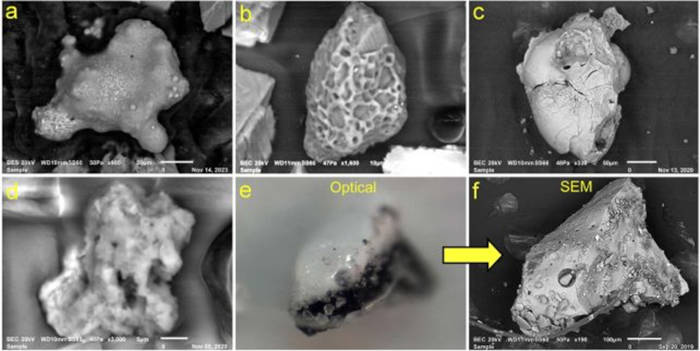
Impact meltglass particles found in the Baffin Bay cores, formed by intense cosmic heat. (PLOS One)
Validating Graham Hancock's Vision
This ocean-floor evidence provides crucial support for theories long championed by bestselling author Graham Hancock (and others) whose controversial books have argued for the existence of a sophisticated Ice Age civilization wiped out by cosmic catastrophe. Hancock's 1995 work "Fingerprints of the Gods" proposed that fragments of a massive comet bombarded Earth around 12,800 years ago, causing the Younger Dryas cooling period and devastating any advanced human societies that existed at the time.
The Baffin Bay discovery comes just weeks after another landmark study identified a comet airburst crater in Louisiana, also dating to 12,800 years ago. Together, these findings lend considerable weight to the Younger Dryas Impact hypothesis, which was first proposed scientifically in 2006 but faced intense skepticism from mainstream archaeology and geology. Critics argued that no impact craters had been found and that the evidence was limited to isolated terrestrial sites.
Moore's team has effectively addresses these objections by demonstrating that impact markers exist in pristine marine environments far from potential contamination.
"This work builds on other evidence that the Younger Dryas impact event was likely global in scale," Moore emphasized. The research provides the missing oceanic component that skeptics demanded, showing that comet debris settled not just on land but across Earth's entire surface.
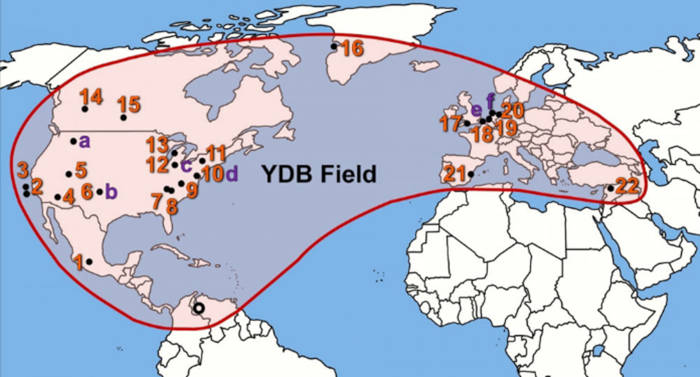
Visualization showing how comet fragments would have spread debris globally during the Younger Dryas impact. (Richard B. Firestone/ Capeia)
Global Climate Catastrophe
The timing and scale of the Younger Dryas impact had profound implications for Earth's climate and ecosystems. The event coincided precisely with a dramatic return to near-glacial conditions after thousands of years of gradual warming. This abrupt cooling, known as the Younger Dryas period, lasted over 1,200 years and caused widespread environmental disruption. The comet impact theory provides a compelling explanation for this mysterious climate reversal that orthodox theories struggle to address.
The cosmic bombardment would have injected massive amounts of dust and debris into the atmosphere, blocking sunlight and triggering rapid cooling. This environmental catastrophe contributed to the extinction of North American megafauna including mammoths, giant ground sloths, and saber-toothed cats. Archaeological evidence suggests human populations also suffered severely, with the mysterious disappearance of the Clovis culture occurring at exactly this time.
If advanced civilizations existed as Hancock proposes, they would have faced unprecedented challenges. Coastal settlements would have been devastated by massive tsunamis generated by ocean impacts, while inland areas experienced dramatic temperature drops and failed harvests. Only scattered survivors would have preserved fragments of advanced knowledge, passing it down through oral traditions and eventually influencing the construction of mysterious ancient monuments like Göbekli Tepe.
Expanding Scientific Investigation
Moore's team plans to broaden their investigation by examining sediment cores from other ocean basins around the world. If similar impact markers are found in marine sediments from the Atlantic, Pacific, and Indian Oceans, it would provide definitive proof that the Younger Dryas event truly was a global catastrophe of unprecedented scale. Such evidence would fundamentally reshape our understanding of both Earth's cosmic environment and human civilization's deep history.
The implications extend beyond archaeology and geology into planetary defense. The Younger Dryas impact demonstrates that Earth regularly encounters dangerous cosmic debris, challenging assumptions about the rarity of major impact events. Recent studies suggest that destructive airbursts like the 1908 Tunguska event and 2013 Chelyabinsk explosion may be more common than previously believed, making the ancient catastrophe eerily relevant to modern concerns about asteroid and comet threats.
For Graham Hancock and supporters of the lost civilization theory, the Baffin Bay discovery represents a watershed moment. After decades of academic rejection, mounting scientific evidence is validating a core aspect of their controversial hypothesis.
Top image: Silica and iron-rich microspherules discovered in Baffin Bay sediment cores, providing evidence of comet impact 12,800 years ago. Source: PLOS One
By Gary Manners
References
Moore, C. et al. (2025). A 12,800-year-old layer with cometary dust, microspherules, and melt glass in Baffin Bay marine cores. Available at: https://journals.plos.org/plosone/article?id=10.1371/journal.pone.0328347
ScienceAlert. (2025). Evidence of World-Changing Comet Explosion 12,800 Years Ago Found in The Ocean. Available at: https://www.sciencealert.com/evidence-of-world-changing-comet-explosion-12800-years-ago-found-in-the-ocean
SpaceDaily. (2025). Comet debris signs found in Baffin Bay sediments linked to Younger Dryas cooling. Available at: https://www.spacedaily.com/reports/Comet_debris_signs_found_in_Baffin_Bay_sediments_linked_to_Younger_Dryas_cooling_999.html