
Warriors’ belts worn by soldiers from the so-called “barbarian” cultures, found at first millennium AD archaeological sites in northern Europe, often featured small, spoon-shaped objects fastened to their ends. These items have puzzled scholars for quite some time, but a trio of experts from Poland have come up with an intriguing theory to explain these odd attachments. They theorize that these ancient utensils were actually used to help barbarian warriors consume mind-altering stimulants, which would have been taken either during or right before battle.
Stimulant Use in the Ancient World
In a new article appearing in the journal Praehistorische Zeitschrift, archaeologist Andrzei Kokowski from Maria Curie-Sklowdowska University in Lublin, Poland and two of his colleagues introduce the results of their analysis of the spoon-shaped artifacts, which have been collected by archaeologists over the past few decades.
These objects have handles that are between 1.5 and three inches (40 mm and 70 mm) long and concave or flat end disks that measure in the .5 to .75 inch (10 mm to 20 mm) range, making it clear that they were intended to be used just as spoons are used now. They were firmly attached to the belts of barbarian soldiers in every instance, presumably so they wouldn’t be lost during a conflict.
For the purposes of their study, Kokowski and his research partners identified and categorized 241 of these curious ancient artifacts, which were recovered from 116 sites dating to the Roman period. These were primarily graves and marshes in the lands of Germany, Poland and Scandinavia, locations where barbarian invaders collided with Roman warriors in conflicts that ultimately helped end the dominance of the Roman Empire in Europe.
In each instance, these objects with found along with different items connected to warfare. This strongly suggests that they had a specific purpose related to battlefield performance, and giving their carriers an opportunity to use stimulants that would increase their energy, endurance and even their courage during conflicts would explain why the spoons were a common addition to collections of combat equipment.
Throughout history, there have been ample examples of soldiers using stimulants to boost their efforts on the battlefield. So even though there is no way to prove exactly what the spoon-shaped artifacts were designed to hold, the conclusion that it was most likely liquid or powdered stimulants derived from plants is consistent with a known historical pattern.

Drawing of Germanic warrior taking stimulants, by Stanislav Kontry for Praehistorische Zeitschrift. (Photo: Praehistorische Zeitschrift)
It should be noted, however, that this idea is at odds with previous beliefs about “barbarian” peoples, which in Roman times would have referred mainly to Germanic and Celtic tribes that originated in northern Europe. While the widespread use of mind-altering substances like opium in ancient Greece and Rome has been established through archaeological finds, evidence of similar activity on the part of the so-called barbarians has been missing.
On the other hand, traces of the stimulants they might have been using would not have remained present on the surfaces of the spoons after the passage of much time. So direct evidence showing that Germanic or Celtic warriors were consuming stimulants on the battlefield would inevitably be extremely difficult to find.
To establish the legitimacy of their hypothesis, Kokowski and his colleagues took a closer look at the types of stimulants that might have been available in Germanic territories during the Roman period. This would have included plant-derived substances sourced locally, along with those that might have been acquired through trade.

Barbarians carved into the surface of a Roman marble sarcophagus around 250 AD, on display at the National Roman Museum. (Egisto Sani/CC BY-NC-SA 2.0)
What they discovered is that there would have been a cornucopia of potentially mind-altering substances available to barbarian warriors at this time. The list of available plants their natural pharmacists could have used to produce stimulating concoctions included poppies, hemp, belladonna, hops, henbane, and different types of fungi (mushrooms).
The methodologies required to make liquid or powdered substances for altering moods and energy levels were well-known at this point in history. The Germanic peoples might have suspected that their Roman enemies were already using such substances to increase their stamina and alertness, so responding in kind could have been seen as a necessary defensive measure.
A Stimulating Study of the True “Barbarian” Culture
While emphasizing the importance of stimulants to ensure military success, the Maria Curie—Sklowdowska University researchers believe ancient Germanic people would have used these preparations in other ways as well.
For example, they could have been consumed for ritual or ceremonial purposes, by people seeking the support of their deities to ensure a successful harvest or victory on the battlefield. At least some of these natural compounds may have been seen as sacred, meaning their use would help align the user with beneficial universal forces. And some stimulants were probably used for medicinal purposes as well, just as such substances are now.

Photoshopped digital image of Barbarian warriors in battle. (Cotari/Carlos Arana/CC BY-NC-SA 2.0)
Given how frequently the spoon-shaped objects have been found at barbarian archaeological sites, it is clear that whatever they were using them for was a common practice. This suggests that it if was really going on, the consumption of stimulants had deep roots in the so-called barbarian culture, and the system of distribution of these substances must have been highly organized to ensure there was enough to go around.
According to Kokowski and his colleagues, the realization that barbarian soldiers were using stimulants on a wide scale nearly 2,000 years ago offers new insights into how their societies functioned socially, culturally and economically during the Roman period, from which they ultimately emerged triumphant.
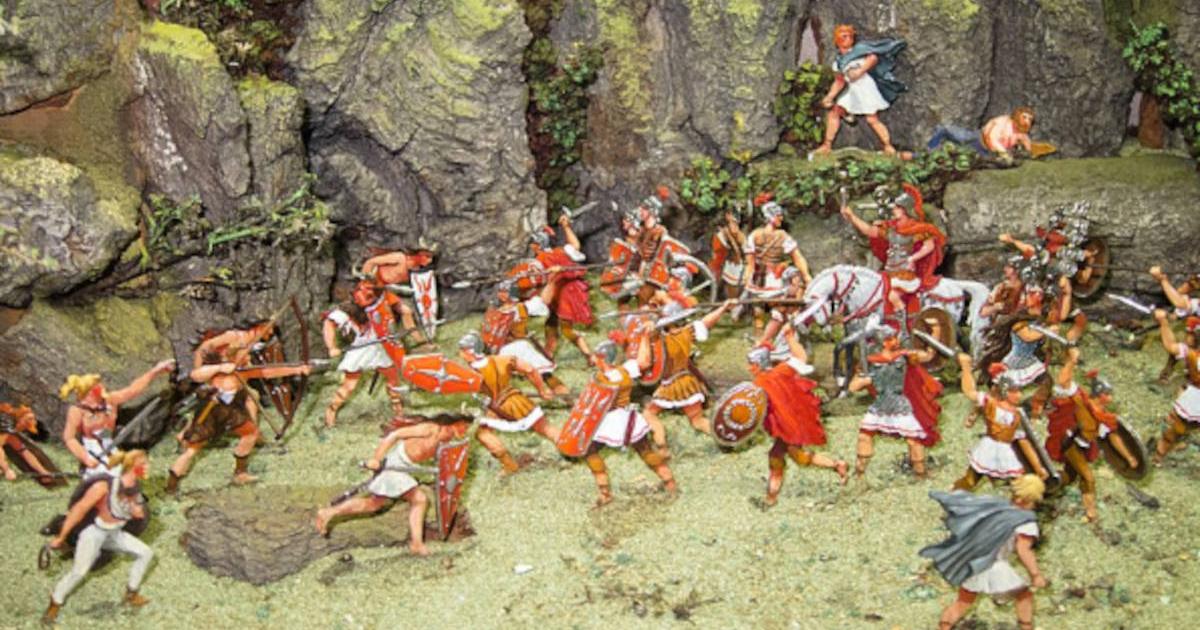
Top image: Part of exhibit at the Plassenburg Zinnfiguren Museum in Kulmbach, Germany, depicting warfare between Romans and Barbarians with hand-painted tin soldiers. Source: Thomas Quine/CC BY-NC-SA 2.0.
By Nathan Falde