Charles the Great, known as Charlemagne and the father of Europe, created an empire which would last for 1,000 years. To secure it he fought continuously, on multiple fronts, throughout his long reign, relentless in his drive and determination to preserve his legacy.
Charlemagne came to power at a time when Europe was made up of many small kingdoms and principalities. Since the fall of the Roman Empire in the 5th century, it had also faced invasion from various peoples who had established kingdoms of their own, such as the Visigoths and Muslims in Spain. There were also new peoples on the outskirts of Europe who were either asserting themselves for the first time, such as the Danes and Norse, or intent on breaking into Europe itself such as the Avars. Europe also clung to the past and saw itself as a continuation of the Western Roman Empire.
Throughout his reign (768-814), Charlemagne, his sons and commanders fought almost continuous wars of expansion and aggression. By the end of his reign he had created an empire which bore his name (Carolingian) which reached from Spain to the Balkans, Italy to the Baltic.
t members of the Frankish aristocracy. The Vascones melted away so quickly that Charlemagne could not exact revenge.
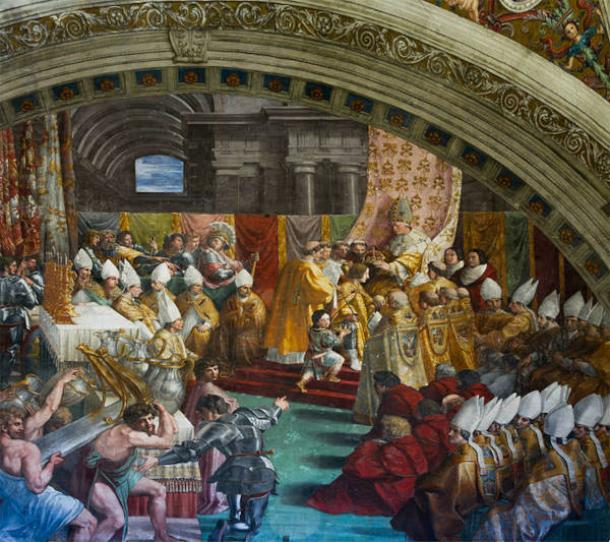
Painting by Raphael from 1515, showing coronation of Charlemagne as Holy Roman Emperor by Pope Leo III. (Public Domain).
First Lessons in War
Charlemagne’s age is one of many areas of controversy in the sources for his reign. The most probable date of his birth has been established as April 742 (making him 26 when he acceded to the throne). This, however, would mean he was born two years before his parents were married. One source (the Annales Petaviani) claims he was born in 747 – but this would have made him only 21. No source names the place of his birth and there are several candidates.
Charlemagne became co-king of the Franks with his brother Carloman in 768. He was 26 and his brother 17. Despite his young age he was already an experienced commander, with more than a decade of experience having fought in the wars of his father, Pepin the Short. Our major source for his reign is the Vita Karoli Magni written by Einhard in the 9th century. This tells us that Charlemagne was 70 when he died in January 814. Einhard was an eyewitness to Charlemagne’s reign and wrote under his son, Louis the Pious. This source gives us remarkable and reliable insights but Einhard also wrote to show Charlemagne in the best possible light and so he omits or slants several episodes which would not have suited that purpose.
Einhard wrote that:
Charlemagne was by far the most able and noble-spirited of all those who ruled over nations in this time. He never withdrew from an enterprise which he had once begun and was determined to see through to the end, simply because of the labour involved; and danger never deterred him.
Although these are presented as noble and good traits, we see a glimpse of Charlemagne’s determination and even his aggression. The large number of sieges he undertook may also be a testament to his determination and tenacity.
At the age of fifteen, Charlemagne’s father had given him the command of duchies in Austrasia whose loyalty was suspect. He was also involved in military expeditions in Aquitania against the rebellious lords there who had resisted Pepin’s rule for 20 years. They were assisted by the Vascones (Basques).
Usually a Carolingian ruler commanded in person, and so we can expect that the military training of Charlemagne began at an early age. He may have accompanied his father on campaign as young as thirteen. If the king could not be present, then he would be represented on the field by his mojordome. Command in frontier regions was given to loyal vassal subjects and so there was an opportunity for mobility and reward if you proved yourself reliable.
Success in the Aquitania campaigns finally came in 768, shortly before Pepin’s death. Frankish law demanded that the empire be divided between Pepin’s sons and so the empire was divided between Charlemagne and Carloman. (This law would cause great problems for Europe in the time of Charlemagne’s grandsons).
The duke of Aquitania lost no time in rebelling again. Charlemagne marched against him and asked for support from his brother but they argued and Charlemagne was forced to fight alone. He did so and won a swift victory. There was tension between the brothers as each jockeyed for position. On December 4, 771, Carloman died, probably of natural causes despite his young age (he was 21). This left Charlemagne as sole ruler.
Assuming Leadership
Charlemagne needed to assert his dominance over his (already large) domain and he spent a decade aggressively bending his subjects to his will. His first act was to ensure that all his brother’s followers swore allegiance to him.
Charlemagne was an imposing figure, estimated at six feet tall, one of the tallest men of the age. But he needed to prove himself to the kingdom at large as well and so, war was not far away.
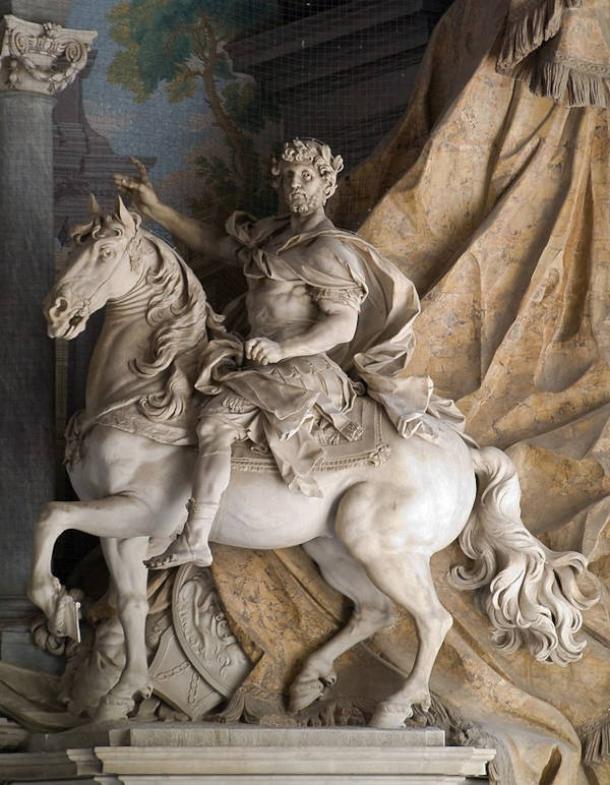
Equestrian statue of Charlemagne, by Agostino Cornacchini (1725) — St. Peter's Basilica, Vatican. (Myrabella/CC BY-SA 3.0).
The Saxons, pagans who lived between the Oder and Elbe rivers had been pushing southwards. In 772 Charlemagne launched an unprovoked attack on the Saxons to show his mettle to his followers and prove his stature to his subjects. He may also have sought to ‘solve’ the Saxon problem decisively. He warred with the Saxons for 30 years and fought 18 battles. Charlemagne’s determination, tenacity and success regardless of the effort required in his campaigns against the Saxons, reveals (and revealed) aspects of his personality which his contemporaries could have learned from.
Read more ...
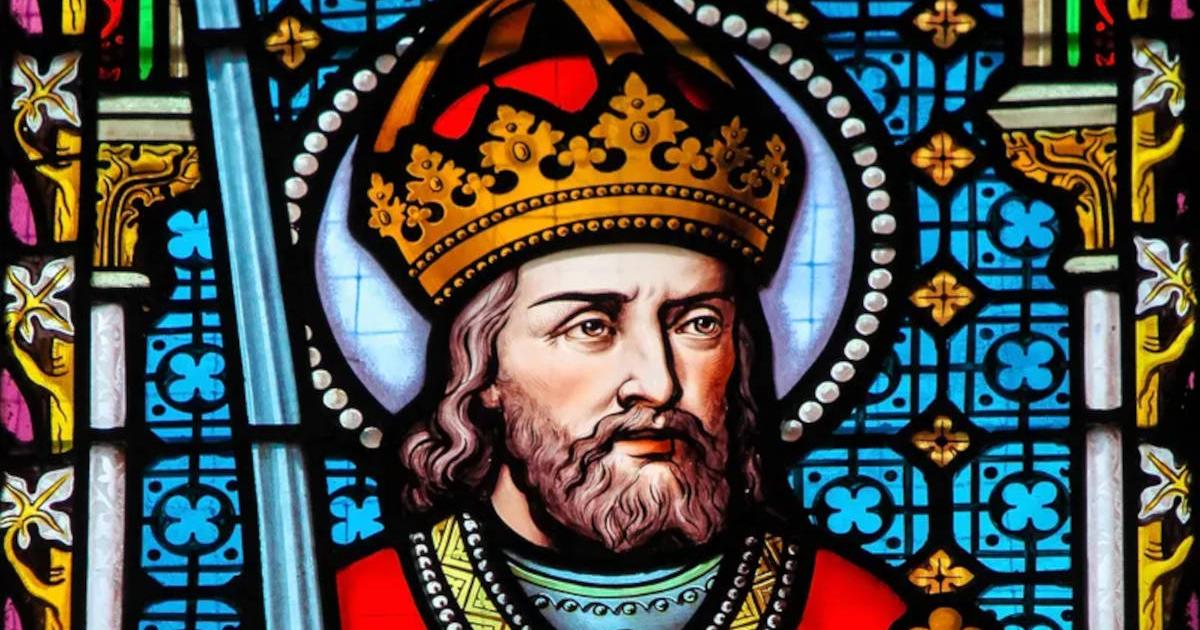
Top image: Charlemagne (Charles the Great), Holy Roman Emperor.
Source: Encyclopedia Britannica.
By Murray Dahm
Murray Dahm is an ancient and medieval military historian and the assistant editor of Ancient Warfare Magazine. He is the author of Finis Britanniae. A Military History of Late Roman Britain and the Saxon Conquest.