
At some point between stone crashing on stone and the murmur of words by a Paleolithic fire, something shifted.
In a brand new study, a multidisciplinary group of researchers has mapped the deep prehistory of human cultural transmission — not only what our forebears created, but how they instructed one another to do so. What they found was a gradual, transformative transition: from passive imitation to formal instruction, with language and purpose as the bridges of what came to be civilization.
Published in PLoS One, the researchers include cognitive archaeologist Ivan Colagè (Pontifical University of the Holy Cross) and paleoanthropologist Francesco d'Errico (University of Bordeaux), who describe this transformation taking place over 3.3 million years, the same span that saw the human branch of the family tree develop everything from hand axes to symbolism.
But instead of happening in one great bound, the team discovered, the emergence of teaching was the result of a layered, accumulative process tightly intertwined with the increasing complexity of human society.
- Neolithic Revolution Spurred Mental and Physical Growth of Europeans
- Cooperation Between Hunter-gatherers Accelerated Human Evolution
Knappers, Not Teachers: The First Million Years
The scientists combined and examined 103 Paleolithic innovations — from mere stone tools and the use of ochre to sequencing blade manufacturing — and matched them to 19 specific modes of social learning. These varied from simple imitation and spatial proximity-based learning to more advanced behaviors such as verbal instruction and modular, stepwise instruction.
During the earliest phase (before 2 million years ago), most of this learning appears to have occurred through what they call "distal observation": the occasional observing from afar of another's behavior. Imagine: a young hominin seeing an elder crack open a nut or craft a rough flake. This wasn't a classroom, but a random bit of proximity — and it put bounds on what could be learned.

Correlation analysis of the 19 modes of cultural transmission considered in this study. (Ivan Colagè, Francesco d’Errico for PloS One, 2025)
But about 2 million years ago, something new is seen: deliberate demonstration. This is where a toolmaker would slow down an action or deliberately overstate a strike to enable easier imitation. It is not exactly teaching in the way we understand it, but it is the first sign of performance with intention — an early spark of pedagogy.
The Emergence of Intentional Teaching and Proto-Language
By 400,000 years ago, indications are that explanations — perhaps by gesture, intonation, or early speech — came into play. The toolmaker no longer merely indicated, but explained. Picture a knapper nodding toward a particular edge before chopping, or signaling the next move in a procedure.
And then, between 200,000 and 100,000 years ago — exactly the same period when Homo sapiens was on the rise and the initial symbolic burials and pigments emerge — came a burst of new instructional strategies.
First among these were selective teaching and modular instruction (the division of a task into teachable modules). Knowledge was no longer dispensed to the masses but conferred. Certain people — possibly kin, apprentices, or those deemed worthy — were designated to learn complicated skills. This type of instructional selectivity is suggestive of the earliest precursors to specialization and even social hierarchy, explains a press release.
It is here, the authors contend, that language is not merely convenient but indispensable. To teach in modules is to order ideas. To teach selectively is to label connections. And to teach by explanation is to depend on intersubjective symbols — the lifeblood of spoken language.
A Slow-Burning Revolution, Not a Sudden Spark
Notably, the research discovered that the new ways of learning did not supplant the old. Even now, imitation and nearness are strong tools of learning — from a child copying parents to a beginner painter emulating a master. Human transmission of culture, then, developed in much the same way that the layers of a palimpsest do: fresh habits inscribed over old, each adapted and reutilized in new contexts.
The statistical model of the study also demonstrates a close match between trait complexity and the complexity of transmission. An edge-scraper might have been picked up by observing. But a multi-step process — such as preparing a core, flaking off, and retouching edges — frequently needed sequencing, feedback, and possibly a shared lexicon.

An empirically-based scenario for the evolution of cultural transmission in the human lineage during the last 3.3 million years. (Ivan Colagè, Francesco d’Errico for PloS One, 2025)
The Teacher as the First Shaman
So in one way, this work recasts the notion of cultural inheritance. The greatest member of early human society perhaps wasn't the strongest hunter or fastest sprinter — but the best demonstrator, the most natural explainer. The earliest teachers were not just keepers of knowledge; they were makers of culture.
- Human Evolutionary Theory Needs Updating, Again
- Advanced Amazonian Agriculturalists Intentionally Created ‘Terra Preta’ Thousands of Years Ago
And as d'Errico says, "The way we teach—who we teach, how we structure it—is what turned culture from a spark into a fire."
So when you next watch a tutorial, sit in a classroom, or follow a grandmother's recipe, you're not only learning. You are staging a drama that went back over a million years ago, when one ancestor slowed down their hands and said, in their native language of grunts and signs and tried to communicate with a ‘watch this.
These results counteract the notion that language ignited culture. Instead, they indicate that the desire to instruct culture — to protect and transmit it — assisted in driving language evolution.
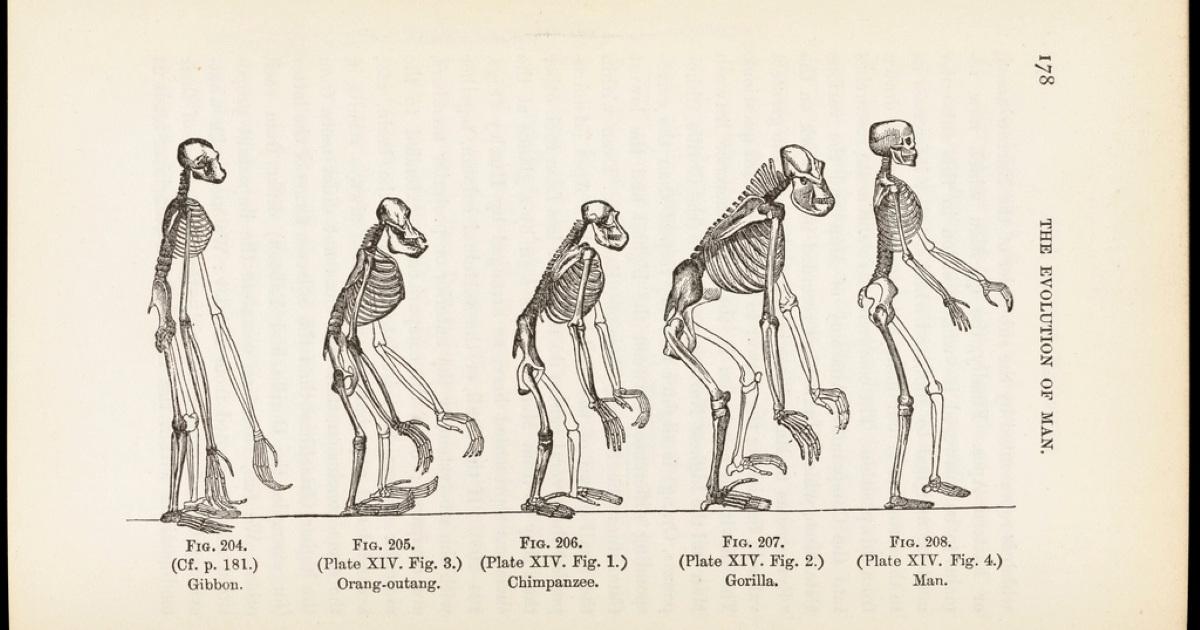
Top image: The Evolution of Man. Source: Public domain
By Sahir
References
Colage, I., d’Errico, F. 2025. An empirically-based scenario for the evolution of cultural transmission in the human lineage during the last 3.3 million years. PLoS One 20(6). Available at: https://doi.org/10.1371/journal.pone.0325059.