A vivid digital reconstruction has brought to life the face of a Mycenaean woman who lived over 3,500 years ago, offering an unusually poignant glimpse into the world of ancient Greece, from long before the time of Homer or the Trojan War.
This ambitious project was launched at the initiative of Dr. Emily Hauser, a historian and lecturer in Classical Studies at the University of Exeter. The final image, she said, was both “incredibly exciting” and “unexpectedly modern.”
“For the first time, we are looking into the face of a woman from a kingdom associated with Helen of Troy—Helen's sister, Clytemnestra, was queen of Mycenae in legend—and from where the poet imagined the Greeks of the Trojan War setting out,” Dr. Hauser explained in an interview published in the Daily Mail.
- The Fall of a Civilization: The Mysterious Collapse of the Mycenaean Bronze Age
- Archaeologists discover Mycenaean palace and treasure trove of artifacts in southern Greece
Technology Reveals Ancient History, in Vivid Detail
The lifelike reconstruction is rooted in forensic science and archaeology. It began with a clay replica of the woman’s skull, crafted in the 1980s by researchers at the University of Manchester, one of the early pioneers of facial reconstruction. Spanish digital artist Juanjo Ortega G. used this model as the foundation for the most recent depiction, refining the details with the help of contemporary DNA findings, skeletal analysis, and data from the tomb itself.
Recent breakthroughs in genetic testing clarified that the two skeletons discovered in a single burial chamber belonged to siblings, overturning earlier assumptions that the pair were husband and wife. Their resemblance had previously fueled the belief that they were a couple, but DNA evidence told a different story. “The traditional story is that, if you have a woman next to a man, she must be his wife,” Hauser explained.
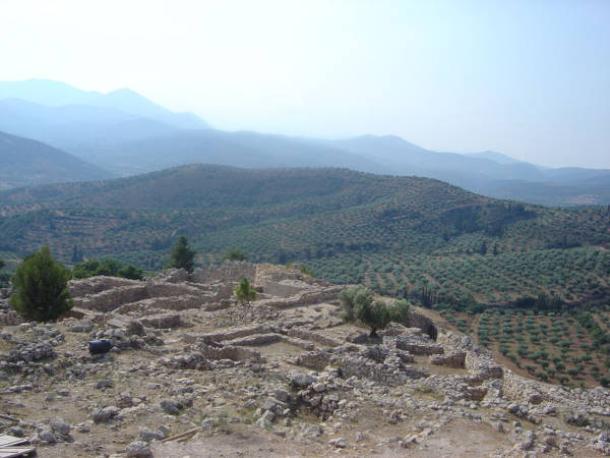
Ruins of the ancient city of Mycenae, on the Argolid Plain in Peloponnese, Greece. (David Manniaux/CC BY-SA 3.0).
The woman, who died at approximately 35 years old, was interred in a royal Mycenaean cemetery between the 17th and 16th centuries BC. Her burial included high-status grave goods such as a gold mask made of electrum and three swords. Originally attributed to the man beside her, these items are now thought to belong to the woman herself.
“This finding strengthens the idea that the woman had a prominent social position or perhaps a military role, causing a radical rethinking of views on women's relationship to war during that period,” said Hauser.
Recent findings suggest that Late Bronze Age tombs actually contain more weapon collections beside women than men, challenging long-held assumptions about gender and warfare.
- Agamemnon: Greek King, Trojan War Leader and Man of Power
- Setting the Story (Mostly) Straight: Archaeological Experiment Shows How Mycenaean Stone Masons Cut Stone
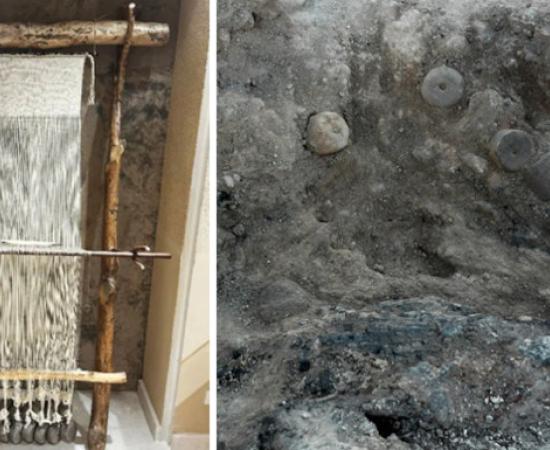
The woman’s skeletal remains also revealed evidence of arthritis in her spine and hands, which researchers believe was likely caused by extensive weaving—one of the most labor-intensive yet common tasks for women at the time.
Hauser drew a connection to the epic poetry of the Iliad, noting, “It is a reminder of the physical strain on women of that time, like Helen in the Iliad, who is described as weaving.”
Myth, Memory, and Modern Science
Dr. Hauser is preparing to publish her latest book, Mythica: A New History of Homer’s World, Through the Women Written Out of It, which focuses on reclaiming the stories of ancient women long overshadowed in traditional history.
“Through technology, the sciences, and historical imagination, these women are coming out of the shadows. And when we look at them, we realize that they are not just legends—they were people, with faces, roles, and stories that we can now tell again,” she said.
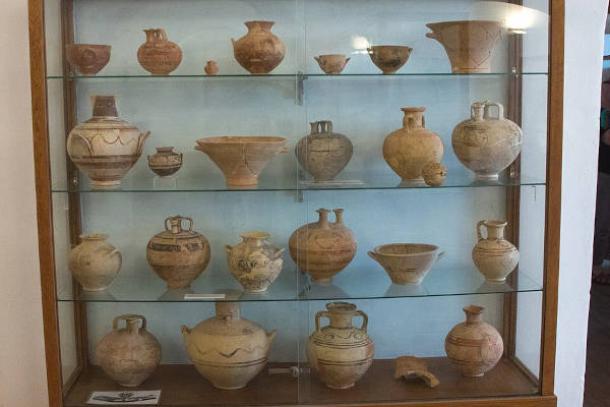
Some of the beautiful pottery associated with the ancient Greek Mycenaean civilization. (Zde/CC BY-SA 4.0).
The reconstructed face that emerged from this effort is that of a poised, commanding woman whose image invites a reconsideration of female agency in the ancient world. “This is a face that could have inspired legends—a woman worth remembering, not as a shadow of the men of her time, but as the protagonist of her own story,” Hauser said.
Though the tomb was first excavated in the 1950s, only now—with the benefit of modern tools—has it become possible to "see" the person behind the remains. Digital tools and scientific advances are helping scholars like Hauser bridge the gap between myth and history.
"Such digital reconstructions persuade us that these were real people," she noted. “So this is such a wonderful way to connect real women's experiences to the ancient myths and tales.”
Mycenae itself looms large in Greek mythology. According to Homer, the city was ruled by King Agamemnon, the leader of the Greek forces during the Trojan War. Located on a modest hill between two larger ones on the Argolid Plain in Greece’s Peloponnese region, the site was once the heart of a powerful Bronze Age civilization.
Thanks to recent progress in forensic anthropology, genetic sequencing, radiocarbon dating, and 3D rendering, researchers are now able to reconstruct faces—and lives—with a clarity never before possible. Hauser sees this as more than a technical achievement: it’s a way of rewriting history. “This approach brings us closer to the real women of antiquity, beyond stereotypes or mythological abstractions.”
With her face now seen for the first time in millennia, the Mycenaean woman demonstrates the combined power of science and storytelling to revive the past in a way that is more realistic and compelling than ever before.
Top image: Digital reconstruction of Mycenaean woman who lived more than 3,500 years ago.
Source: Juanjo Ortega G.