

According to the information gleaned from numerous historical sources, the territories of ancient Azerbaijan, known as Caucasian Albania (not to be confused with the modern-day Albania in Europe) covered a wide area and was populated by many prehistoric tribes.
This ancient territory which lasted between the 2nd century B.C to the 8th century, spread in the south, from Araz River to The Major Caucasus, and in the east, from the west coast of the Caspian Sea to the lands located in the west of Goycha Lake.
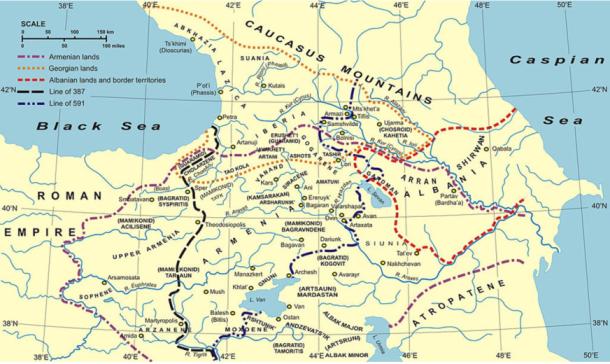
The borders of ancient Caucasian Albania (red dashed line), now largely the Republic of Azerbaijan. Wikimedia, CC
In the 5th century, Greek historian Herodotus provided information about the Alban tribes living under the name Kaspi, north of the Araz River. Roman author Pliny the Elder also confirmed the early existence of Alban rule, in the time of Alexander the Great.
Caucasian Albania was formed approximately in the 3rd to 4th century B.C., and Christianity established itself early. Centuries later there was an Islamic conquest, and the territory was occupied by the religious and political rule of Arab caliphate in the 7th century. The capital city was originally Qabala in the north, but eventually shifted to the more centralized Barda.
According to Greek geographer and philosopher Strabo, the populations of ancient Caucasian Albania consisted of many tribes speaking 26 languages.
From the introduction of Christianity in Caucasian Albania, the ideology persisted until the shift to Islam in the mid-7th century. A large part of the population accepted Islam, yet this did not cause an abolition of Alban-Christian ideology or national and cultural values. On the contrary, Islam put responsibility and liability on the shoulders of every Muslim to protect ancient Alban historical and cultural monuments, and the traditions of the ancient tribes of Azerbaijan.
One of the ancestor tribes of the Azerbaijani people, the Albans originated in the area and established a rich and unique culture. The Chairmen of Public Association for Protection of Historical and Cultural Monuments in the Occupied Territories of Azerbaijan, Faiq Ismayilov has stated that the importance of native Alban sources is very crucial in the study of ancient and Middle-Ages history and culture of Azerbaijan.
Starting from the first century, Christianity spread to the South Caucuses where the empire had economic and cultural relations. After a declaration of Christianity as the official state religion by Caucasian Albanian King Urnayr, new temples and churches started being built in the country.
The majority of these Alban monuments have survived till modern times in a state of good preservation. The oldest Christian church in the Caucuses is located in Kish, of the Sheki region of Azerbaijan. Although there is no epigraphic writing on the temple, the architecture and planning features, construction style and the technology used to create it strongly suggest it was created by Alban architects.
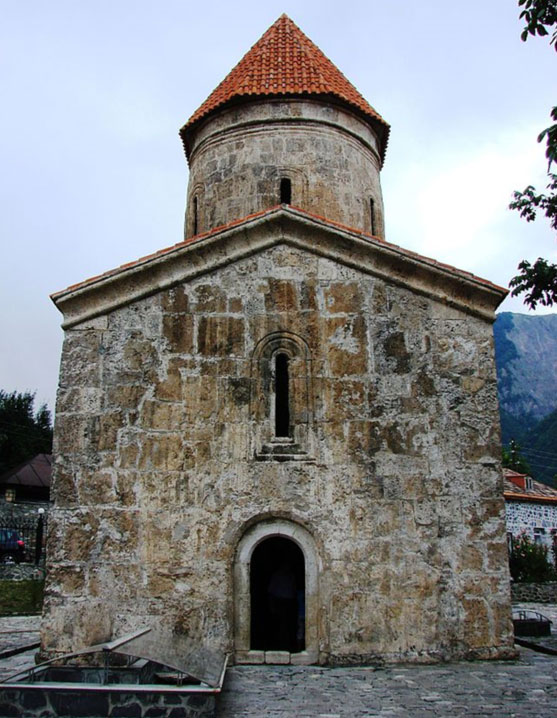
The Church of Kish, Church of Caucasian Albania, Azerbaijan. Wikimedia, CC
Analysis of objects found beneath the alter date the cultic site to about 3,000 B.C. The church was founded on the 1st century. Passed five stages of construction from the twelfth century.
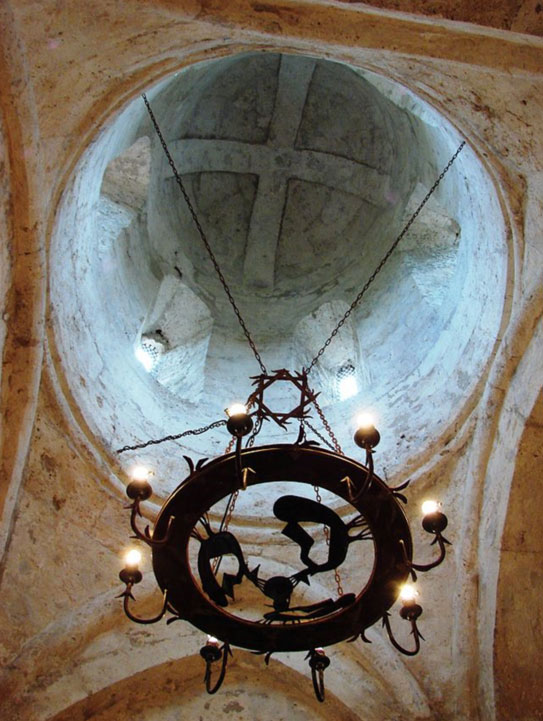
Dome interior of the Church of Kish, with ancient chandelier. Wikipedia, CC
After the final Caucasian Albanian King, Vachagan III held an ecumenical council in the town of Aluen in 488, with the participation of prominent religious and state figures, construction in the Christian architectural style became popular. During Vachagan’s reign (487-510) more than 300 churches and temples were built in Albania. There were more than 30 monasteries in the country until the middle of the 8th century. The Christian temple in the Qum village of Qakh District of Azerbaijan is seen as a work of art, attracting the attention of specialists with its form and construction. The temple which is situated in Lakhik village was built with an archaic style. Both of these ancient temples date to the 5th and 6th centuries.
The popular Avey Temple is located on the top of a high mountain in Kazakh District of Azerbaijan. According to research scientists C.Rustamov and F. Muradov, ShishGaya Temple and other artificial cave temple complexes are from the first century, created upon the spread of Christianity.
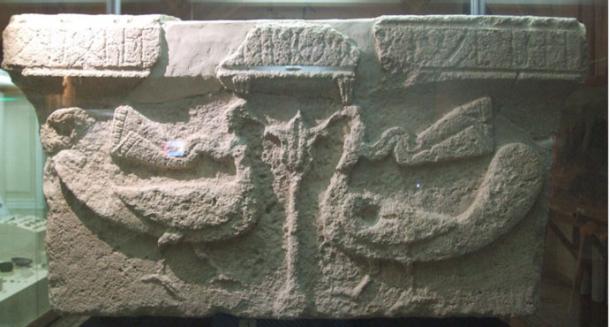
A column capital of a 7th-century Christian church with an inscription in Caucasian Albanian. Public Domain
Many samples of Alban architecture dating to between 4th and 16th centuries remain standing to this day, including: the Agoglan temple in Kosalar village of Lachin district of Azerbaijan, Amaras monastery in Sos village of Xocavand District, Gavurdara temple in Qubadli District of Azerbaijan, Arakel temple in Magadiz village of Agdam district of Azerbaijan, Khansikh and Khacmac temples in Khojali Districts of Azerbaijan, Red temple in Tukh village of Khocavand District of Azerbaijan. These, and the Agtala temple, Arcivang temple, Uzunlar temple, Yenivang temple, and the Sanain temple in Western Azerbaijan are the most beautiful samples of Alban architecture that have reached to our times.
Several temples have been built in honor of Apostle Yelisey, who is credited with spreading Christianity in Albania, and the creation of the Church of Kish, the oldest Christian church in the Caucuses. The most interesting of the temples is the Yelisey Complex in Agdara District (Karabakh).
Popular Gancesar Monastery erected in Vangli village on the banks of the Khachin River, as well as Qoshavang temple, and Dadavang Temple, are the most prominent monuments of Christian architecture.
The ‘God temple’ Monastery Complex is located on the banks of the Tartar River in the Kalbajar District. It was the religious center of the Khachin Alban state, created in the mountainous part of Karabakh in the 9th century – one century after Caucasian Albania collapsed. It has since become a religious and education center for the locals.
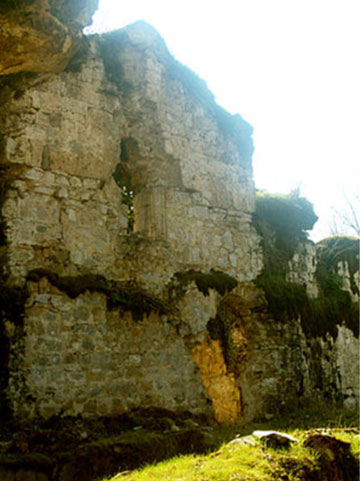
Seven Church monastery complex is one of the oldest Christian monasteries in Azerbaijan and in Caucasus, and is an Caucasian Albanian Apostolic monastery. Wikimedia, CC
According to scientists who have researched the architectural monuments of Caucasian Albania for many years, these monuments differ totally from Armenian and other Caucus regions religious temples with their characteristic features and architectural planning styles.
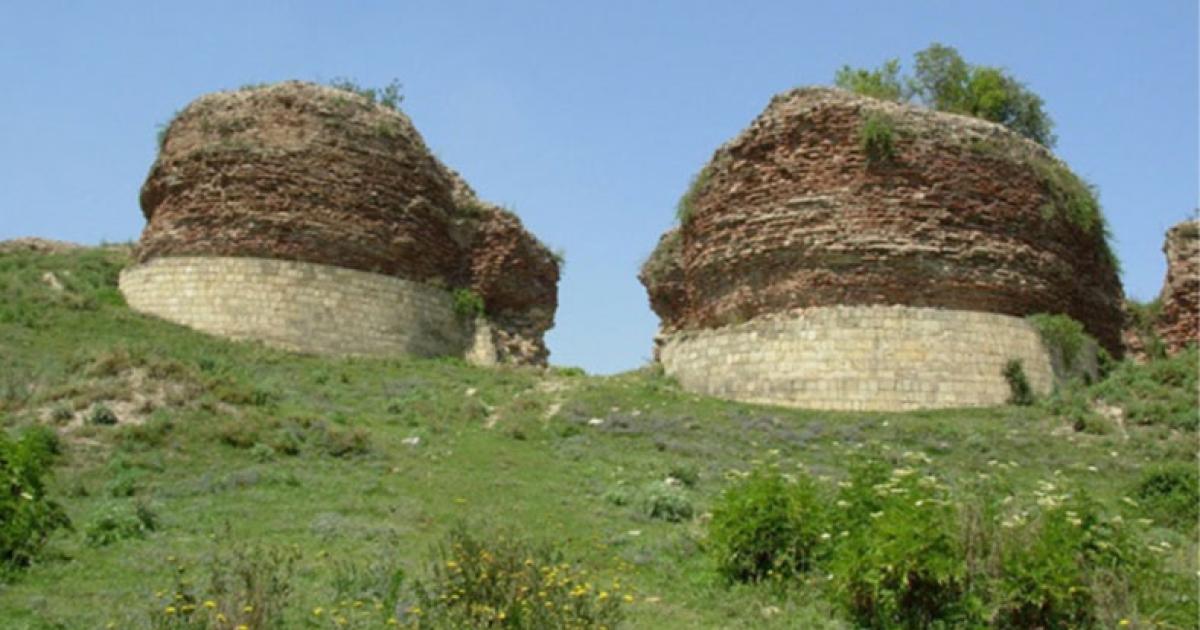
Featured image: The ruins of the gates of Albanian capital Qabala in Azerbaijan. Wikimedia, CC
References
Church of Caucasian Albania – Wikipedia. http://en.wikipedia.org/wiki/Church_of_Caucasian_Albania
Church of Kish – Wikipedia. http://en.wikipedia.org/wiki/Church_of_Kish
Caucasian Albania – Wikipedia. http://en.wikipedia.org/wiki/Caucasian_Albania
By Fuad Huseynzadeh, the Chairman of Diaspor Journalists’ Community.
![The Great Pyramid Of Giza Top image: The Great Pyramid of Giza under a starlit sky, highlighting the North Face. Source: [Pixabay/Creative Commons] Image](https://www.ancient-origins.net/sites/default/files/styles/article_featured_big/public/field/image/Great Pyramid Of Giza_0.jpg?itok=yavsyDqT)
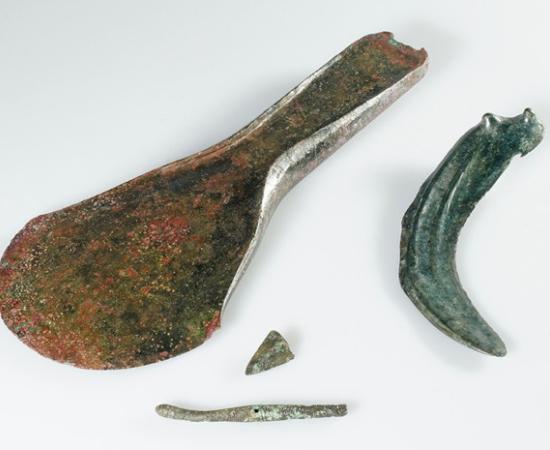






Ancient Caucasus architecture and peoples
Permalink
Just curious, but why is the 9th-10th century in the Caucasus/Caspian area so difficult to research in historical records and architectural structures? When I wrote my paperback novel about a fictional 10th century Caucasus family, which you can check out at: http://www.amazon.com/Adventures-Beloved-Medieval-Alania-Beyond/dp/1440…
Facts about this part of the Caucasus were difficult to find when I was searching for descriptions of ancient structures, lives of women, and other anthropological/historical details. So I turned the time-travel novel into an adventure of a family and their teenage kids walking towards a new future outside of the mountains, etc. It seems so difficult to find articles in English about the lands between the Caspian and the Black Sea in early medieval times. Just curious. I did find early Byzantine studies that mentioned some details...but it's much easier to write adventure time-travel novels about Western Europe in those times, even though it's more fascinating to explore the less-traveled in writing roads when writing historical fiction.
The Early Temples & Monuments of the Alban People in Ancient Az.
Permalink
Sir,
In the title of the above mentioned article posted on 22 January 2105, the writer refers to Ancient Azerbaijan as the region north of the Arax River and in the last paragraph he/she mentions the Christian monuments located there, which are said to belong to the ancient Alban people.
It is correct that the Albanian tribes lived in the area in pre Christian times but during the the 7-9th centuries AD they converted to Islam. The region was ruled at medieval times by various Seljuk and Oghuz Turkic and Mongol rulers until the 17-19th centuries when Muslim Khans ruled it under either to Ottoman or Persian rule. During this time some of the Armenian Meliks (Landowner families) living in the inaccessible regions of Karabagh retained their relative independence. During this period the region was known as the Khanates of Shaki, Gyanja, Talish, Salian, Baku etc., under the generally known name of Shirvan. The name Azerbaijan was given to the region in 1918, under pressure from the Ottomans and the Ultra Nationalistic Musavat party leader A. Rasulzadeh.
Therefore I suggest you note the following and erroneous and misleading information in your article.
1 - From ancient times until 1918, the name Azerbaijan referred to the Persian north-western province, located south of the Arax River. In no document or map the region north of the Arax river has ever been named Azerbaijan. A quick look into ANY map or history book will confirm this.
2 - In the last paragraph the writer mentions the names of the churches of Agoglan (correct Armenian name is Tsitsernavanq), Agtala temple (Monastery of Akhtala), Yenivang temple (Monastery of Noravanq), Sanain temple in Western Azerbaijan (Sanahin Monsatery and University, north Armenia), Gancesar Monastery (Gandzasar- the seat of the Armenian Catholicos), Qoshavang temple (Goshavanq Monastery and University, west of Lake Sevan in Armenia) and Dadavang Temple (Dadi Vanq Monastery). These are listed as Albanian Temples and not churches and monasteries.
Please note that all of these monuments were built during the 11th to 18th centuries, when the Albanians people had already accepted Islam. The question arises - WHY WOULD MUSLIM ALBANS BUILD CHRISTIAN CHURCHES AND MONASTERIES?
Would it not be proper to provide the name of the people who actually built and maintained them and left hundreds of inscription on the stone walls of these buildings? The Armenians?
Regards,
Rouben Galichian - Guest
PS - For further detailed analysis please the following books available form Amazon etc.
Rouben Galichian - The Invention of History, London. Gomidas Inst., 2009 and 2010
Rouben Galichian - Clash of Histories in the South Caucasus. London, Bennett and Bloom, 2012
Rouben Galichian - Countries South of the Caucasus n Medieval Maps, London, Gomidas Inst., 2007
It is clear that not ALL
Permalink
In reply to The Early Temples & Monuments of the Alban People in Ancient Az. by Rouben Galichian (not verified)
It is clear that not ALL Albanians converted to Islam at once (naturally) -- the Church of Caucasian Albania continued to exist until the 1830th, by the end as part of the Armenian Church, however with distinct identification from it, with its seat being the Gandzasar monastery. Its abolishment by the Russian authorities gave Armenians a free pass in claiming the vanished nation's heritage as their own, in a speculative manner typical for Armenians, particularly as most of the remaining Christian Albanians (from Karabakh) began to identify as Armenian.
History of Albanian Christians
Permalink
In reply to It is clear that not ALL by Javanshir0101 (not verified)
Yes, not All the Albanian tribes converted to Islam. Some kept their Christian religion, they are the present day Udis, who lived in the villages of Nij (Nic) and Vardashen in the present-day Republic of Azerbaijan. However, they were and are prevented from practising their religion and many have left for Georgia. The monastery of Gandzasar, according to all old historians was the seat of the Catholicos of the Armenians and the bringer of Christianity to Albania, Grigoris, is buried in the village of Amaras, whose tombstone was broken to pieces by the Azerbaijani army.
Back in 2004 a Norwegian charity allocated finds for the renovation of the Udi church in Nij, but some of the funds were used to obliterate the Armenian inscriptions in the church. Steiner Gil, the Norwegian Ambassador of the time in Azerbaijan protested against this barbaric act and no European Ambassador attended the opening of this church. See copy of the his letter and other facts in my book "The Invention of History" 2009/2010 available from my site on the web www.roubengalichian.com.
So much for the tolerance and the ethnic Christians fate in Azerbaijan.
The Early Temples and Monuments of the Alban People in Ancient A
Permalink
I have read the article by the Azerbaijani journalist Faud Huseynzade and the comment by Rouben Galchian. Both of them seem to have missed to mention a very unique source.
The principal source for the history of the Caucasian Albanians is the Armenian historian Movses Dasxurantsi or Kaghankatvatsi, Պատմութիւն Աղուանոց Աշխարհի,which fortunately has a complete translation into English, with excellent introduction and notes by late Calouste Gulbenkian Professor of Armenian Studies at Oxford, Prof.C.J.F.Dowsett( formerly Lecturer in Armenian at the School of Oriental and African Studies, University of London) The work was published by Oxford University Press,in 1961.
The History is the main source of information on the affairs of the Aghvank’ ( the Albani of Classical writers) from the 4th to the 10th century. The work concerns the ancient Albanian branch of the Armenian Orthodox Apostolic Church.
The Caucasian Albanian Church was one of the churches that rejected the Council of Chalcedon held in 451 and was under the jurisdiction of the Armenian Catholicate at Holy Echmiadzin. In 506 and 555,at the Council of Dvin the Church of Albania rejected the doctrine of the Fourth Ecumenical Council and brroke all relations with the Greek/Byzantine church recognising the ‘spiritual leadership of the Armenian church. Their head of church also adopted the title Kat’oghikos [ Catholicos= կաթողիկոս] hence the title “Աղվանից Կաթողիկոսութիւն = Catholicate of Caucasian Albanians”.
The seat of the Catholicate was in Ganjak. The line of the Catholicoses starts with Abas (551-595) and ends with Sargis II( 1810-1828).
Մովսէս Կաղանկատուցի, Պատմութիւն Աղուանից Աշխարհիշ ,Քննական բանգիրը եւ ներածությունը Վարագ Առաքելյանի,1983.
Rev. Dr. Vrej Nerses Nersessian
Formerly Curator in charge of the Christian Middle East Section in the British Library 1975-2012.