



One of the most enigmatic and unusual type of artifact to be recovered from ancient times, the Roman dodecahedron is a small, hollow object made of bronze or (more rarely) stone, with a geometrical shape that has 12 flat faces. Each face is a pentagon (a five-sided figure), embellished with a series of knobs on each corner point of the pentagons, and the pentagon faces in most cases contain circular holes as well.
The first of these enigmatic objects was unearthed in 1739, in a field in the English countryside alongside a collection of ancient Roman coins. It was presented to the Society of Antiquaries in London in that year, and no one had any idea about what it represented or how it might have been used.
Since that original discovery, more than 100 similar objects have since been found at archaeological sites in northern Europe, in Great Britain, Belgium, Germany, France, Luxembourg, Netherlands, Austria, Switzerland, and Hungary. They have all been dated to the first through the fifth centuries AD, although most were made in the second and third centuries. Ranging from golf-ball-sized to baseball-sized, each has 12 equal faces with holes of varying diameter. The objects themselves are hollow, making them rather light-weighted.
Dodecahedron means “12 faces” in Greek. These strange objects are on display in dozens of museums and archaeological collections throughout Europe, with explanatory labels that are almost devoid of any specific inforamation, since the origin and purpose of the objects has still not been determined—although there are dozens of theories about that, as might be imagined.
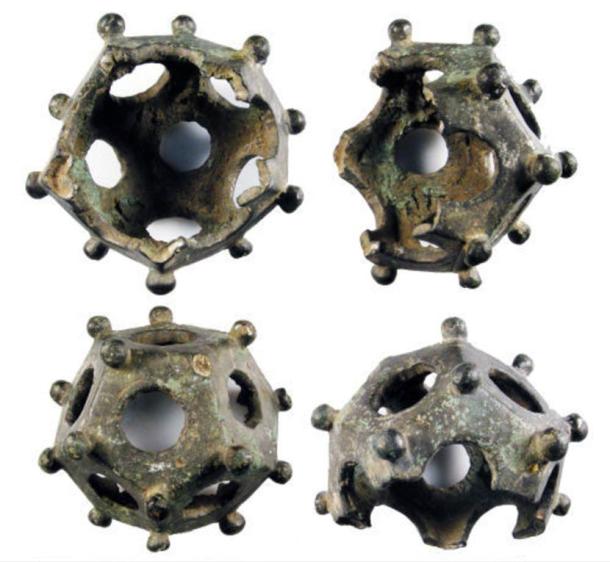
An incomplete cast copper alloy dodecahedron (1 – 400 AD), discovered by a metal detectorist in Yorkshire, England. (Portable Antiquities Scheme/CC BY SA)
What Were Roman Dodecahedra Used For?
The great mystery is: how do they work and what do they do? Unfortunately, there is no documentation or notes about them from the time of their creation, so the function of the dodecahedra has not been determined. Nevertheless, many theories and speculations have been put forward over the centuries: candlestick holders (wax was found inside one example), dice, survey instruments, devices for determining the optimal sowing date for winter grain, gauges to calibrate water pipes or standard army bases, staff or scepter decorations, a toy to throw and catch on a stick, or simply a geometric sculpture. Among these speculations, some deserve attention.
- Footprints, Fairies and even a Foreskin: 9 Bizarre Relics from History
- Jewelry from Outer Space: Hopewell Culture Made Beads from Meteoritic Iron
A popular hypothesis these days for the purpose of the dodecahedra is that they were used as knitting tools to make gloves. Whether it solves the mystery or not, the YouTube video by Martin Hallett, who tested his idea with a 3D printed replica of a Roman dodecahedron and some experimental archaeology, has inspired others to try out this knitting method to make their own hand warmers. This idea could explain the different sizes of the dodecahedra – making gloves of different sizes - and the purpose of the holes – to form the glove’s fingers.
However, one of the most accepted theories is that the Roman dodecahedron was used as a measuring device, more precisely as a range measuring object on the battlefield. The hypothesis is that the dodecahedron was used for calculating the trajectories of projectiles. This could explain the different sized holes in the pentagrams.
A similar theory involves dodecahedra as a surveying and levelling device. However, neither of these theories has been supported by any proof and exactly how the dodecahedron could be used for these purposes has not been fully explained.
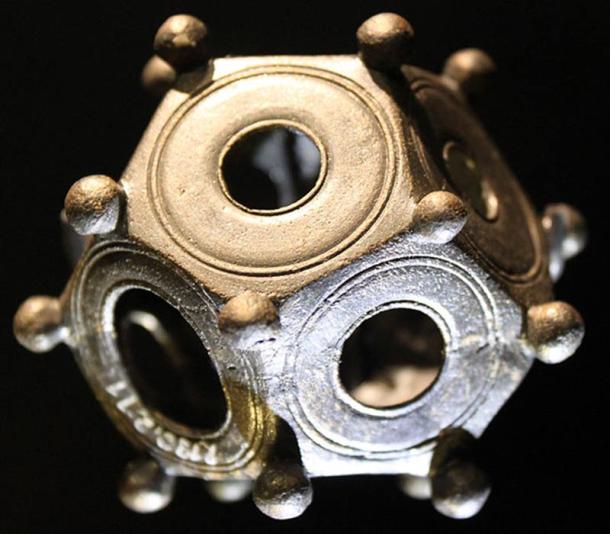
Dodecahedron from the region of Stuttgart; 2nd to 3rd Century, shown at the Württembergisches Landesmuseum, Stuttgart, Germany; Approximately 60 such dodecahedra from this region and time are known, however their function is not clear. (Anagoria/CC BY 3.0)
Or Maybe They Were Astronomical Tools, Religious Relics or Toys?
One of the more interesting theories is the proposal that dodecahedra were astronomic measuring instruments for determining the optimal sowing date for winter grain. According to G.M.C. Wagemans , "the dodecahedron was an astronomic measuring instrument with which the angle of the sunlight can be measured and thereby one specific date in springtime, and one date in the autumn can be determined with accuracy. The dates that can be measured were probably of importance for the agriculture".
Nevertheless, opponents of this theory have pointed out that use as a measuring instrument of any kind seems to be prohibited by the fact that the dodecahedra were not standardized and come in many sizes and arrangements.

A Roman dodecahedron found in Bonn, Germany. (Hadley Paul Garland/CC BY SA 2.0)
Another unproven theory claims that the dodecahedra are religious relics, once used as sacred tools for the druids of Britannia and Caledonia. However, there is no written account or archaeological evidence to support this view. Could it be that this strange item was simply a toy or a recreational game for legionnaires, during the war campaigns?
Some sources suggest they were the central objects in a bowl game similar to that of our days, with these artifacts used as markers and the players throwing stones to land them in the holes within the dodecahedra.
- Scythian Gold: The Rich Legacy of an Ancient Culture
- Lost Artifacts of the Great Pyramid: The Mysterious Case of the Dixon Relics
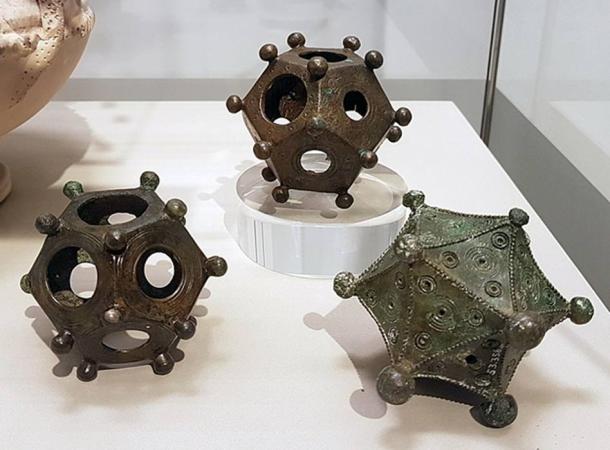
Two ancient Roman bronze dodecahedrons and an icosahedron (3rd c. AD) in the Rheinisches Landesmuseum in Bonn, Germany. The dodecahedrons were excavated in Bonn and Frechen-Bachem; the icosahedron in Arloff. (CC BY SA 4.0)
A Roman Icosahedron Adds to the Mystery
Another discovery deepens the mystery about the function of these objects. Some time ago, Benno Artmann discovered a Roman icosahedron (a polyhedron with 20 faces), misclassified as a dodecahedron on just a superficial glance, and put away in a museum's basement storage. The discovery raises the question about whether there are many other geometric artifacts of different types – such as, icosahedra, hexagons, octagons – yet to be found in what was once the significant Roman Empire.
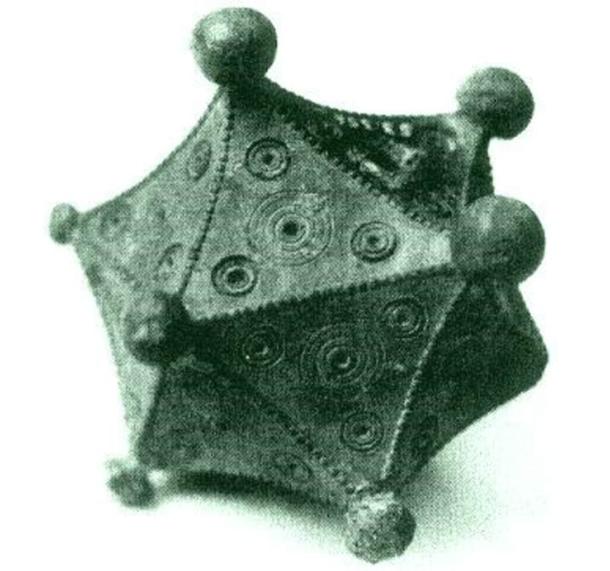
The Roman icosahedron found by Benno Artmann. (georgehart.com)
Despite the many unanswered questions, one thing is certain, the Roman dodecahedra were highly valued by their owners. This is evidenced by the fact that a number of them were found among treasure hoards, with coins and other valuable items. We may never know the true purpose of the Roman dodecahedra, but we can only hope that advances in archaeology will unearth more clues that will help solve this ancient enigma.
Top Image: A structural replica of the Roman dodecahedron from the Schwarzenacker Roman Museum in Homburg, Germany.
Source: Lokilech/CC BY-SA 3.0.
References
The Roman dodecahedron – Legends and Chronicles. Available from: http://www.legendsandchronicles.com/ancient-artifacts/the-roman-dodecahedrons/
Roman dodecahedra – George Hard. Available from: http://www.georgehart.com/virtual-polyhedra/roman_dodecahedra.html
Has The Roman Dodecahedron Mystery Been Solved? – Red Ice Creations. Available from: http://redicecreations.com/article.php?id=30435
Has The Roman Dodecahedron Mystery Been Solved? – Gralien Report. Available from:
http://www.gralienreport.com/ancient-mysteries-2/man-solved-roman-dodecahedron-mystery/
The Roman Pentagon Dodecahedron: An Astronomic Measuring Instrument for Determining the Optimal Sowing Date for Winter Grain – By G.M.C. Wagemans. Available from: http://www.romandodecahedron.com/the-hypothesis













Just a guess
Permalink
Chastity belt?
Oh. My. Goodness. I better
Permalink
In reply to Just a guess by Rene P (not verified)
Oh. My. Goodness. I better not have nightmares because of that comment!
intresting
Permalink
intresting
ENIGMA
Permalink
do we have any date when it was made...??
every object the archaeologist see and could not explain the fonction
they are saying astronomical tool could they just say that they do not know...???
so first find when it was made with what material from which mines
i will not be surprise that there is a lot of unknow object in museum that they hide because
they are not able to tell the function of the object
dodecahedra
Permalink
In reply to ENIGMA by LOUIS MILLETTE
Items such as these, are numerous, many of which are not catloged yet, being so many artifacts, Not nearly enough workers who desire to bother doing the paper work and tagging. So many want to dig, find something, get famous or similar. I wonder why one was found with wax in it, what purpose would wax have inside these ? very valued by many in their treasures, perhaps they had a ongoing game, of vast members who lived far apart, (their found all over) just as we do similar thing with online gaming, playing with others far apart. One needs to be found; still in the box :) so to speak ! No date made, found all over, if dates were known, dates made would vary perhaps over few hundred years. and that would be, and actually is, another clue. they look bronze, copper. Different sized holes are clue also. and all those round balls, feet ? like dice, but more sophistication. But to romans, simple !