
Revolutionary analysis of animal remains from Abrigo de la Malia rock shelter reveals sophisticated hunting strategies employed by the first modern humans in central Spain 36,000 years ago. The discovery also challenges long-held assumptions about population dispersal of modern humans in the region during the early Upper Paleolithic and demonstrates remarkable adaptability to harsh climatic conditions.
The understanding of early Anatomically Modern Humans’ settlements in the interior regions of the Iberian Peninsula has historically been limited by sparse evidence and long-held assumptions. For decades, scholars have posited that following the extinction of Neanderthals, the Iberian Plateau was largely deserted and remained uninhabited until the conclusion of the Last Glacial Maximum. This perspective has directed the bulk of archaeological attention toward coastal zones, where the majority of known sites exist and where extensive investigations into subsistence strategies have been prioritized. However, the groundbreaking discovery of the Abrigo de la Malia rock shelter in Tamajón, Guadalajara, has fundamentally disrupted this conventional narrative, unveiling compelling evidence of human occupation in Central Iberia spanning the Aurignacian and Gravettian cultural periods, dated between 36,200 and 26,260 years before present.
Researchers from the Centro Nacional de Investigación sobre la Evolución Humana (CENIEH) have published groundbreaking findings that fundamentally challenge our understanding of early human settlement patterns in the Iberian Peninsula's interior. The study, led by Edgar Téllez and published in Quaternary Science Advances, examines animal remains from Abrigo de la Malia in Tamajón, Guadalajara, revealing sophisticated subsistence strategies that enabled human survival in what was previously considered an uninhabitable region during the Aurignacian and Gravettian periods (36,200–26,260 cal BP).
The analysis demonstrates that these early modern humans possessed extensive environmental knowledge and developed highly effective hunting techniques focused on medium and large ungulates. The evidence shows recurrent occupations spanning at least 10,000 years, during which human groups successfully hunted deer, wild horses, bison, and chamois across diverse ecological niches including forests, mountains, and grasslands.
- The Lady of Arlanpe: First Paleolithic Venus of the Iberian Peninsula?
- Paleolithic Stone Slab in Spain May be the First Map of a Hunter-Gatherer Campsite
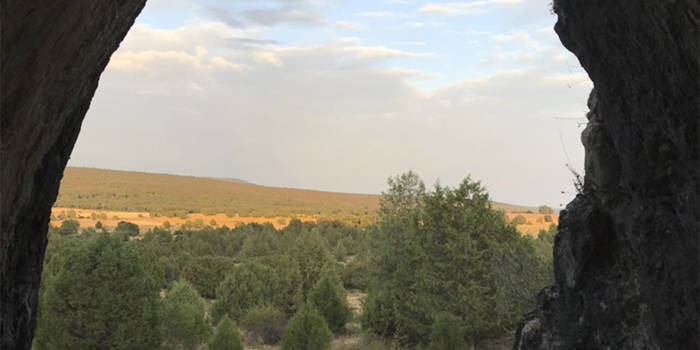
The Tamajón cave system in Guadalajara province where Abrigo de la Malia rock shelter provided crucial evidence of early human occupation. (Ayuntamiento de Tamajón)
Sophisticated Hunting Strategies in Challenging Environments
The research reveals remarkable evidence of strategic hunting behaviors that allowed these populations to thrive despite facing severe climatic fluctuations during Marine Isotope Stage 3 (MIS-3). Analysis of cut marks on animal bones indicates systematic butchering practices and efficient resource processing, while the absence of significant carnivore interference suggests these humans dominated their territorial landscape. The site served as a temporary hunting camp rather than a permanent settlement, indicating highly mobile groups who possessed intimate knowledge of seasonal animal movements and optimal hunting locations.
- Ancient Hunters Strategically Targeted Reindeer-rich Territory
- Researchers Discover Evidence That Humans Hunted Two Million Years Ago
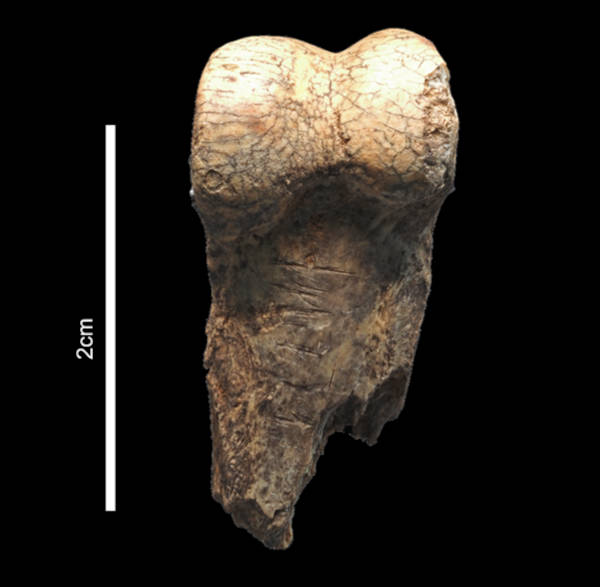
Phalanx bone with cut marks from Abrigo de la Malia showing evidence of systematic animal processing by early modern humans. (CENIEH)
The faunal assemblage includes remains from various species that inhabited different ecological zones, demonstrating the hunters' ability to exploit diverse environmental resources effectively. Deer bones show evidence of selective hunting of prime-aged individuals, while horse and bison remains indicate coordinated group hunting strategies necessary to take down large prey. The presence of chamois bones suggests these hunters were comfortable operating in mountainous terrain, further highlighting their environmental versatility and advanced hunting techniques.
Rewriting Settlement Patterns of Early Iberia
For decades, archaeological consensus maintained that the Meseta Central remained largely uninhabited following Neanderthal extinction, with human reoccupation not occurring until approximately 20,000 years ago during the Late Glacial period. This paradigm concentrated research efforts along Mediterranean, Cantabrian, and Atlantic coastal regions where numerous Upper Paleolithic sites provided extensive evidence of human occupation and cultural development. The Abrigo de la Malia findings fundamentally challenge this model by providing direct evidence that anatomically modern humans successfully established themselves in central Iberia much earlier than previously believed.
The successful adaptation demonstrated at this site reveals that interior Iberian environments offered sufficient resources to sustain human populations despite harsh climatic conditions. These findings align with broader European patterns showing that early modern humans possessed remarkable adaptability and could exploit diverse ecological niches effectively. The research suggests that gaps in the archaeological record may reflect research bias toward coastal areas rather than actual population voids, encouraging renewed investigation of interior regions that may hold similar evidence of early human occupation.
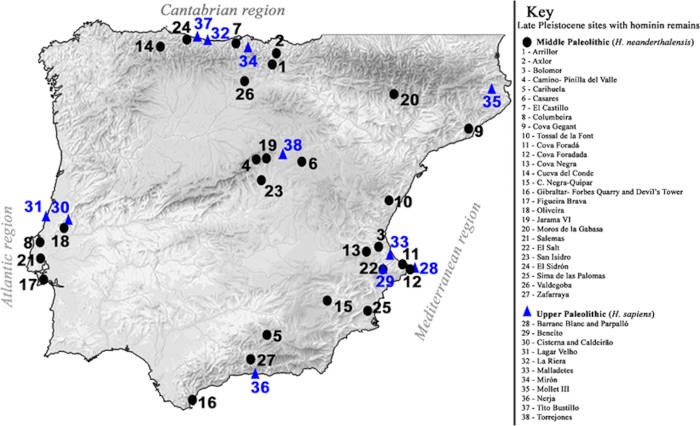
Distribution of main archaeological sites with Upper Paleolithic human remains across the Iberian Peninsula (ResearchGate)
Environmental Mastery and Cultural Continuity
The evidence from Abrigo de la Malia demonstrates that these early inhabitants possessed sophisticated environmental knowledge enabling them to predict animal behavior, identify optimal hunting seasons, and select strategic locations for temporary camps. The site's position within the broader landscape suggests careful territorial planning, with groups likely coordinating movements across multiple locations to maximize resource acquisition throughout annual cycles. This level of environmental mastery indicates well-developed cultural transmission systems that preserved and enhanced hunting knowledge across generations.
The 10,000-year occupation span reveals remarkable cultural continuity despite significant climatic fluctuations during MIS-3. Archaeological layers show consistent tool technologies and butchering practices, suggesting stable cultural traditions that successfully adapted to changing environmental conditions without fundamental behavioral shifts. This stability contrasts with the dynamic climate record and demonstrates the effectiveness of flexible subsistence strategies that could accommodate varying resource availability while maintaining core cultural practices.
The research team's findings contribute to growing evidence that Upper Paleolithic populations possessed greater environmental adaptability than traditionally recognized. As Edgar Téllez notes, the discovery "questions the idea of a population void in the interior of the peninsula and challenges us to rethink the mobility, occupation, and adaptation patterns of the first Homo sapiens in the region." Future excavations planned for the Tamajón cave system promise to reveal additional evidence of these remarkable early inhabitants and their sophisticated adaptation strategies.
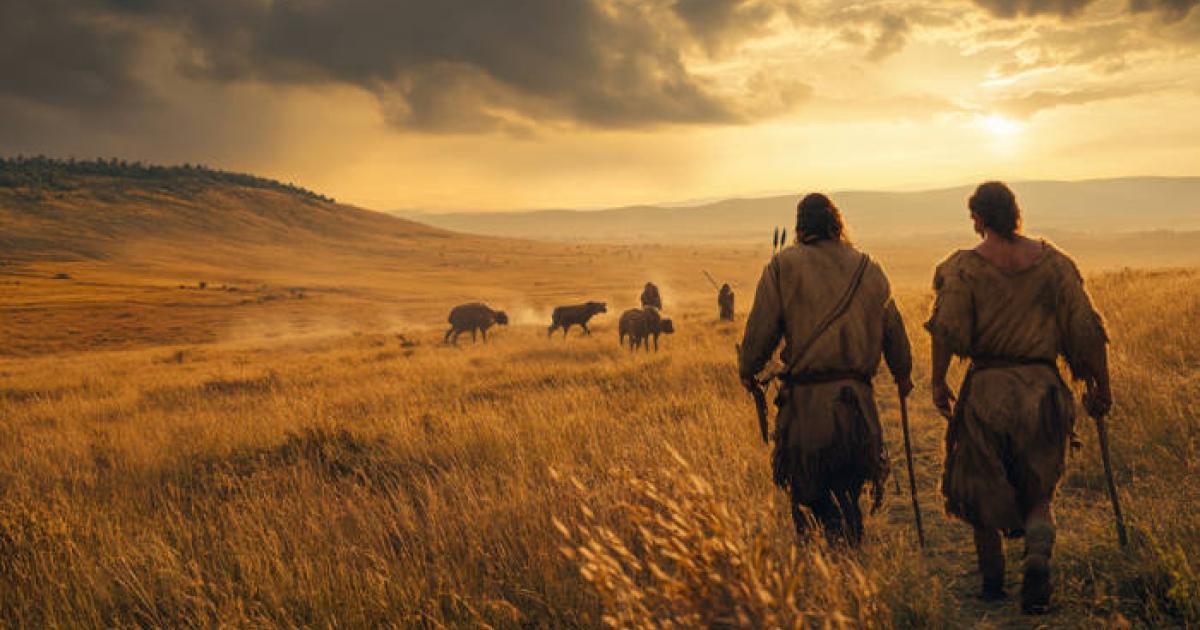
Top image: Prehistoric Hunters Sunset Journey Bison Grassland Ancient Spears, AI generated image Source: dominic/Adobe Stock
By Gary Manners
References
CENIEH. (2025). The first modern humans in the interior of the Iberian Peninsula were expert hunters. Available at: https://www.cenieh.es/en/press/news/first-modern-humans-interior-iberian-peninsula-were-expert-hunters
Téllez, E. et al. (2025). Subsistence strategies in the early upper Paleolithic of central Iberia: Evidence from Abrigo de la Malia. Quaternary Science Advances. Available at: https://www.sciencedirect.com/science/article/pii/S2666033425000334?via%3Dihub