

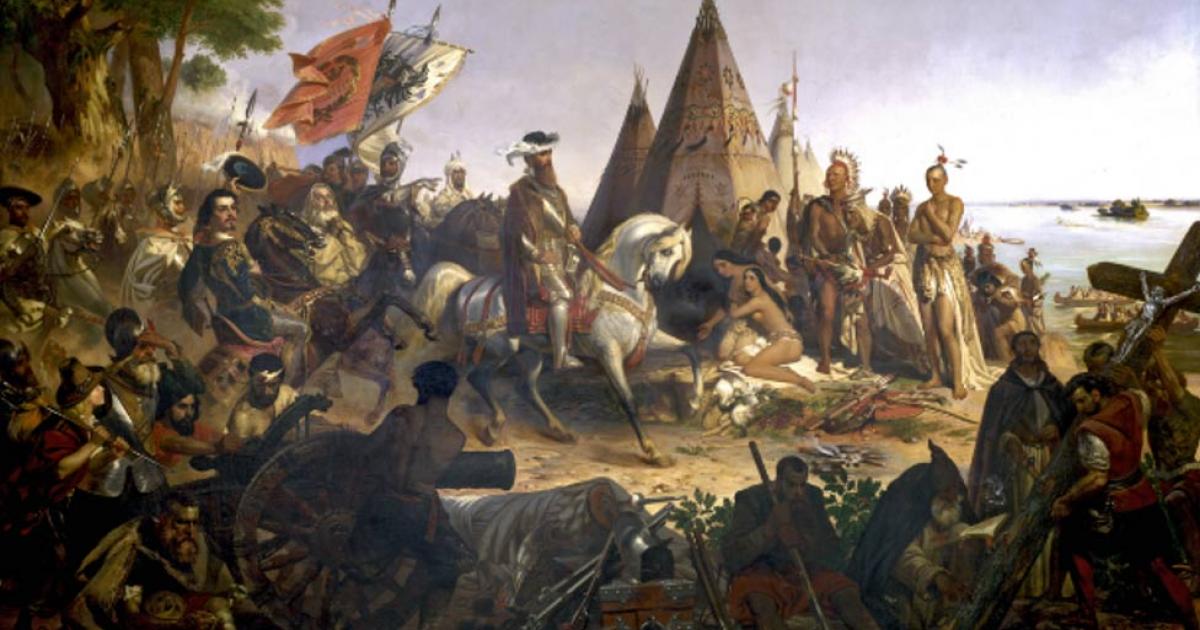
Official history says that the Spanish colonizers in America were focused on the territory from Mexico to the end of South America. For centuries, there was the question of why the Spaniards didn't decide to try to conquer further north. Artifacts from the 16th, 17th and 18th centuries bring a new light to this topic.
It is known that the Spanish claimed territories in what is today part of the United States of America. In the 16th century, they had explored the southern area of the country. For example, in Florida, the St Augustine fort was established by the Spanish in 1565. The impact of the Spanish way of understanding Roman Catholicism is evident in this region. The Spanish also influenced the economy in this area and attacked local Native Americans.
There are three known conquerors who explored the southern parts of the USA: Juan Ponce de Leon, Hernando De Soto and Francisco Vazquez de Coronado. It seems unbelievable that the Spanish, known as great conquerors and wanderlusts, stopped exploring the continent due to the British domination. Or perhaps they did?
A Spanish Galleon in Oregon
The greatest mystery comes in the form of a Spanish galleon wreck discovered on the Oregon Coast, near Nehalem Bay. There are no official Spanish reports about lost expeditions or ships in this area. Although legends speak of additional lost ships in the region and even closer to Alaska, only one has been confirmed through archaeological evidence.
The confirmed shipwreck is believed to be the Santo Cristo de Burgos, which was lost in 1693. The Spanish galleons of the Manila trade sailed the Pacific beginning in the mid-16th century, traveling between the Philippines and Mexico. However, these were trading vessels that occasionally went off course, not exploratory expeditions to the Pacific Northwest.
- The Many Burials of Hernan Cortes: Locating the Gravesite of a Conquistado
- The Search for Cibola, the Seven Cities of Gold
- Lone Archaeologist Discovers First Multi-Year European Settlement in the U.S.
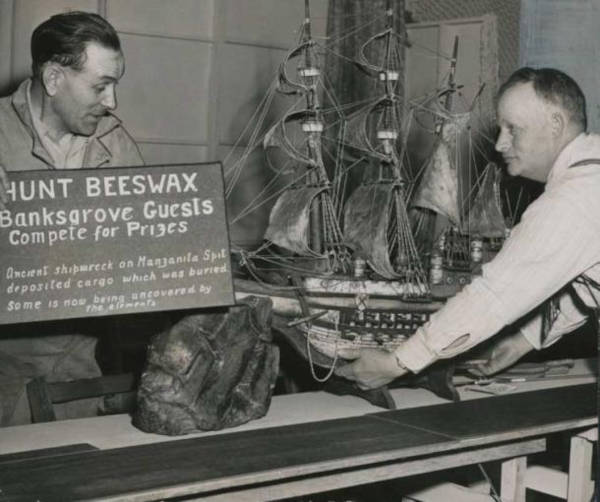
A model of the Santo Cristo de Burgos Spanish galleon that was on its way from the Philippines to Mexico in 1693 when it was blown off course and sunk in Oregon coastal waters. Manzanita Mayor Ben Lane with a model of the Santo Cristo de Burgos in a photo from 1951. (Oregon Historical Society Research Library)
Spanish exploratory expeditions to British Columbia and Alaska didn't begin until much later - starting in 1774. Between 1774 and 1793, Spain sent numerous expeditions from New Spain to present-day Canada and Alaska to strengthen their territorial claims against British and Russian interests. They explored areas including Nootka Sound on Vancouver Island, Prince William Sound, Cook Inlet, and reached as far as what is now Sitka, Alaska. Place names like Quadra Island, Cortes Island, and Valdez still reflect this Spanish legacy.
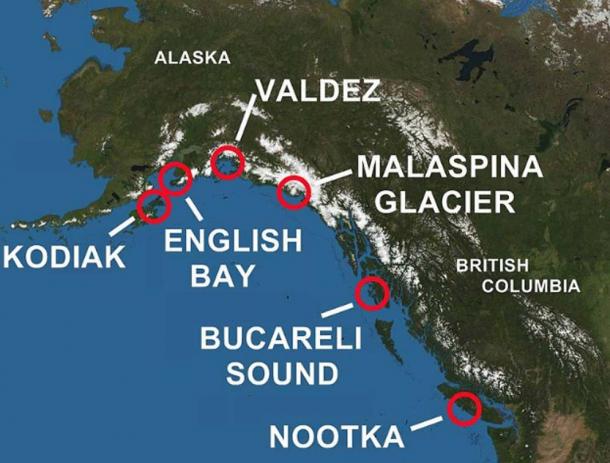
Areas of Alaska and British Columbia Explored by Spain. (CC BY-SA 3.0)
The Beeswax Wreck
The Oregon shipwreck is well known because of the huge blocks of beeswax which were part of its cargo. The wax was likely intended to be turned into candles in Spanish colonial churches in Mexico, but the ship never completed its journey. Beeswax has been dug out of the sand on beaches near Nehalem Bay for over two centuries.
The discovered galleon is remarkably well preserved, with timbers finally recovered from sea caves in 2022. According to research by maritime archaeologists, only two Manila galleons went missing in the late 17th century that could account for the Oregon wreck: the Santo Cristo de Burgos (1693) and the San Francisco Xavier (1705). Based on the dating of Chinese porcelain shards and other evidence, researchers now believe the wreck is the Santo Cristo de Burgos, which left Manila in 1693 carrying silk, porcelain, and beeswax.
Local oral history from the Tillamook and Clatsop peoples includes accounts of Spanish survivors from a shipwreck, though specific details remain difficult to verify through documentary evidence. Early written references date to 1813, when fur trader Alexander Henry noted that local tribes had "great quantities of beeswax" from a shipwreck near Nehalem Bay.
A Legendary Battle
In British Columbia, a legend is still alive connected with the territory of the southern part of the Okanagan Valley. It talks about a fight between Spanish soldiers and natives in the Similkameen Valley. According to the official history books, the first time when the people of the Valley saw Europeans was around 1811 AD.
However, local oral history describes white men with strange helmets and armors, riding something that they called ''elk''. (Horses were unknown for people who lived in Similkameen Valley during those times.) The new people are said to have set up camp near the native village, which is known as Keremeos nowadays. The local history places this event before the middle 1700s. It says the white people killed several natives and tried to make others their slaves.
In 1863, a wooden construction which was judged to be over 100 years old was discovered by explorers in the place of a possible Spanish camp. It looks like a space the Spanish used to shelter men and their horses. Burials of dogs with large mouths and teeth, traditionally used by Spanish to guard prisoners, were also discovered.
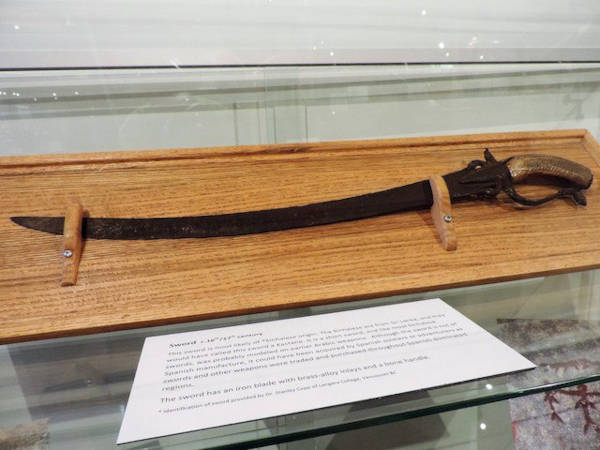
Kastane Sinhalese sword from Sri Lanka, found in the Keremeos region, British Columbia, Canada. (Penticton Museum/Archives)
The Mysterious Sword
In Penticton Museum, one can find artifacts discovered locally in the Keremeos region, including a ceremonial sword, a spearhead, and a helmet. The sword has been identified by experts as a Sinhalese ceremonial sword from Sri Lanka, dating to the 16th century. While this type of sword is not Spanish in origin, it could have belonged to a Spanish sailor who had been to Asia, as Spanish expeditions to Asia through the Pacific were very common during the Manila galleon trade era.
- Conquistadors caused Toxic Air Pollution 500 years ago by changing Incan Mining
- Archaeological site in Mexico reveals sacrifice and cannibalization of Spanish conquistadors
- Juan Ponce de León and his Search for the Fountain of Youth
In local legend, the sword belonged to the "Turtle People," which was the name used by locals for armored explorers. However, without definitive proof connecting these artifacts to Spanish presence in the interior of British Columbia, these remain intriguing possibilities rather than confirmed historical facts.
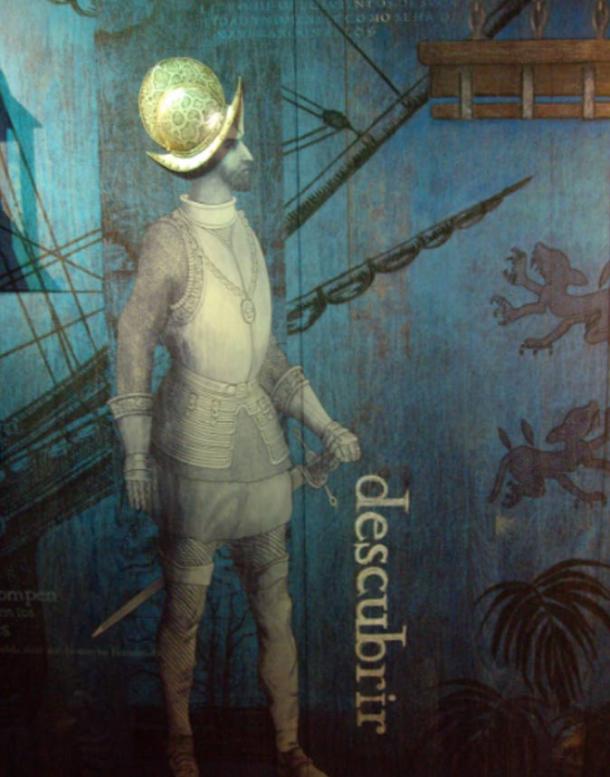
Armor worn by the Spanish conquistadors. (CC BY-SA 3.0)
Other weapons that may be Spanish are located in Vernon Museum in Canada. The collection of the Kamloops Museum also contains a head of a half-pike, the type of weapon used by Spaniards in the mid-17th century, though dating of these artifacts remains uncertain. It is still difficult to confirm if the Spanish sword is just a local tale or real proof of Spanish appearance in this area.
Unprepared Attempts to Obtain Land?
With archaeological discoveries and historical documentation, researchers have confirmed that the Spanish actively explored the Pacific Northwest coast—but primarily in the late 18th century (1774-1793), not earlier. They established temporary settlements like Santa Cruz de Nuca at Nootka Sound and conducted extensive surveys of the coastline from California to Alaska. They likely were not well prepared for the reality of the colder parts of the continent, and eventually ceded their claims to the region to the United States in the Adams-Onís Treaty of 1819.
The story of potential Spanish presence in the interior of British Columbia remains largely in the realm of local legend and oral tradition. While the confirmed Manila galleon wreck in Oregon and the documented Spanish coastal explorations of the late 18th century prove Spanish mariners did reach these northern latitudes, the question of whether Spanish soldiers ever traveled inland to places like the Okanagan Valley remains unanswered. The artifacts in local museums are intriguing, but without additional archaeological evidence—such as a burial site or documented settlement—these stories remain tantalizing mysteries rather than established historical fact.
The rising number of coastal discoveries has confirmed Spanish maritime activity along the Pacific Northwest coast. However, claims of interior exploration and settlement require further archaeological investigation before they can be accepted as historical fact rather than local legend.
Top image: Hernando De Soto and Spanish Conquistadores seeing the Mississippi River for the first time. Source: Public Domain
This article was updated in Dec 2025 with latest findings.
References
Davis, Harold E., The Americas in History, 1953.
Vickers, Daniel, A Companion to Colonial America, 2003.
Boff, Leonardo, Quinientos años de evangelización. De la conquista espiritual a la liberación integral, 1992.
Globe and Mail. "B.C. artifacts could rewrite history of Spanish presence in North America." February 5, 2016.
Williams, Scott S. "Beeswax shipwreck." The Oregon Encyclopedia, 2022.
La Follette, Cameron, et al. "Oregon's Manila Galleon." Oregon Historical Quarterly 119.2 (2018).






On the Atlantic coast, the
Permalink
On the Atlantic coast, the Spanish had seen the Chesapeake Bay in the early 1500s which they named Bahia de Santa Maria. North of St. Augustine, they tried settlements in the Carolinas. In 1561 the Spanish captured a Virginia Indian, took to him Spain and baptised him as Don Luis de Velasco. In 1570 the Spanish attempted a colony in Virginia, called Ajacán in "North Florida." All the colonists were killed but one, who was rescued the following year.
The Beeswax Wreck
Permalink
The ship carrying the beeswax put aground just south of Manzanita, Oregon and is well known in the area. Several books have been written about it. It was heading for the Philippines when a storm put it aground. It is rumored to have had some treasure and there have been plenty of searches for it. The blocks of beeswax have been found up until about 1930. It is likely that the ship was the one depicted in the movie "Goonies".
Definitely! It's been a
Permalink
In reply to The Beeswax Wreck by Steven Jones (not verified)
Definitely! It's been a frequently reacquainted tale. The 1870s treasure hunter Pat Smith is said to have fount evidence, and in the 1930s two treasure hunters died in their attempt to find the lost treasure. They even made a movie about it in 2006, The Tillamook Treasure. And those blocks of beeswax are more like chunks, in addition to shards of china and wood.
At the point when the Spanish
Permalink
At the point when the Spanish touched base at the outskirts of the Inca Empire in 1528, it crossed a significant separation. Augmenting southward from the Ancs Maya, which is currently known as the Patía River, in southern Colombia to the Maule River in Chile, and eastbound from the Pacific Ocean to the edge of the Amazonian wildernesses, the domain secured the absolute most rocky territory on earth.