


According to the Gospel of John, Jesus was stabbed in his side by a lance whilst hanging from the cross. As a result, this weapon is believed to possess supernatural powers and it became an important and much sought after Christian relic. Over the centuries, a number of churches have claimed to possess this sacred object, known variously as 'The Holy Lance', 'The Spear of Destiny', and the 'Spear of Longinus' (named after Saint Longinus). One such claimant is the Geghard Monastery, or Geghardavank (meaning ‘Monastery of the Spear’). But is there any real evidence for the claim?
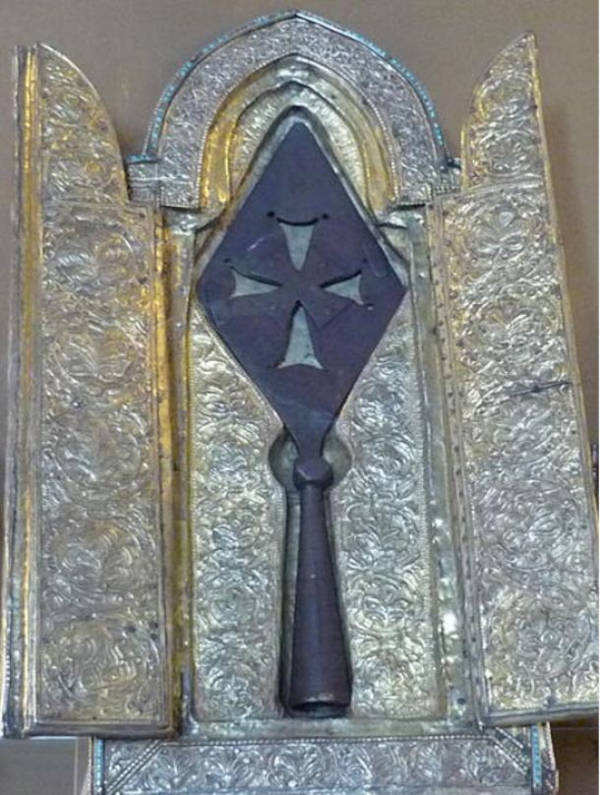
The lance, currently kept in Echmiadzin, Armenia. It was discovered during the First Crusade in St. Peter's Cathedral in Antioch. Photo by Emanuele Iannone - Museum of Echmiadzin, Armenia. 2009. (Public Domain)
The Foundation of Geghard Monastery
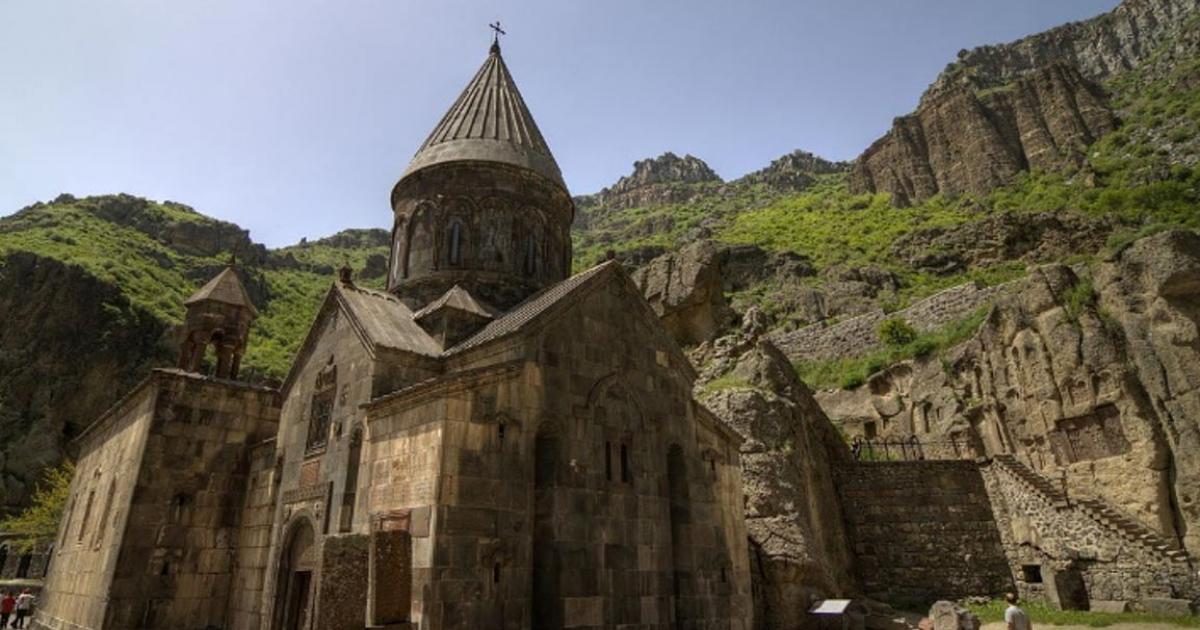
The Geghard Monastery is located in Kotayk, a province in the center of Armenia. Situated at the head of the Azat Valley, the monastery is surrounded by towering cliffs. In fact, part of the monastery is carved out of the adjacent mountain. According to tradition, the Geghard Monastery was founded in the 4th century AD by St. Gregory the Illuminator. The site where St. Gregory chose to build the monastery was a spring arising in a cave that was regarded as sacred prior to the arrival of Christianity. Thus, the Geghard Monastery was known in earlier times as Ayvirank (meaning ‘Monastery of the Cave’)
- Inside mystery stone coffin at ancient monastery is… another mystery lead coffin
- The Early Temples and Monuments of the Alban People in Ancient Azerbaijan
- Archaeologists in Turkey Claim to Have Discovered Piece of Jesus’ Cross

Detail of the famous cave inside the Geghard Monastery. (Arabsalam/CC BY 3.0)
Rebuilding the Monastery
Nothing remains of this first monastery, as it was destroyed in the 9th century AD by the Arabs. At the end of Muslim rule in Armenia, however, the monastery was re-established. The most ancient part of the present monastery is the Chapel of St. Gregory the Illuminator. The earliest inscription on its external wall has been dated to 1177 AD. This small chapel is located to the east outside of the main monastery complex. Carved directly into the rock of the mountainside, this project was abandoned before it was completed. By the first half of the 13th century, another building project was underway, thanks to the patronage of the brothers Zakare and Ivane, who were generals of the Georgian Queen Tamar.
- Mount Popa Monastery and the Mythology of the Thirty-Seven Spirit Guardians
- Largest Byzantine monastery in Istanbul to be converted into mosque
- Ancient manuscript returns home to Greek monastery on Mount Athos
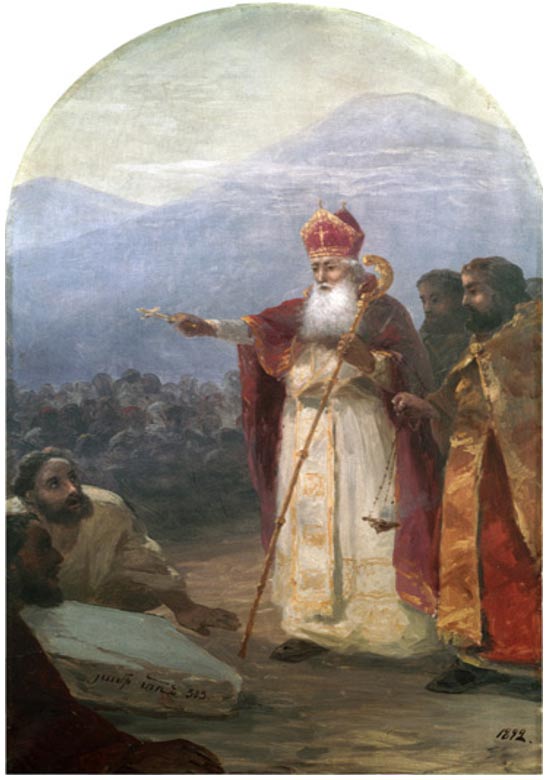
"The Baptism of the Armenian People. Gregory the Illuminator" by Ivan Aivazovsky, 1892. (Ivan Aivazovsky/Public domain)
Under the two generals, the Kathoghikè (the main church) was built. According to an inscription, this church was built in 1215. Prior to 1250, the first cave church was also built.
Not long after, the monastery was bought by the princes of the Proshyan dynasty. Under the patronage of this Armenian noble family, the monastery was further developed. Over a short period of time, a second cave church, a hall for gathering and studies, as well as numerous monastic cells were also built. Furthermore, the family sepulchre of the Proshyan dynasty can also be found in the monastery. This is indicated by their coat of arms – two chained lions, between which is an eagle with half-spread wings, whose claws grasp a calf, carved in the rock.

Chapel at Khor Virap, Armenia. Inside there's a cave where Gregory the Illuminator was imprisoned for about 13 years, Photo by Heretiq, 2005. (Public Domain)
It was also during the 13th century that the monastery gained its present name. When the monastery was re-established, it was first given the name ‘Monastery of the Seven Churches’. It was also known as the ‘Monastery of the Forty Altars’. In time, however, the name of the monastery was changed to Geghard Monastery. This was due to a legend, which claimed that the lance that pierced the side of Jesus was brought to Armenia by the St. Jude the Apostle, known also as Thaddeus, and was stored in the monastery.
Christian Relics Linked to the Unique Armenian Monastery
In addition to this lance, the monastery was said to have housed a number of other Christian relics, including relics of the Apostles Andrew and John. It was these relics, the Holy Lance above all, which drew pilgrims to the Geghard Monastery. In the following centuries, numerous grants of land, money, manuscripts and other valuables were donated to the monastery. The internal walls of the Kathoghikè provide many inscriptions recording the donations made by pilgrims.
The gathered evidence regarding the authenticity of this as the lance that stabbed Jesus is primarily based on tradition and legend, rather than contemporary historical records from the time of Christ. So there's a significant gap between the 1st century AD (when the crucifixion occurred) and the 12th to 13th century (when the first written mentions appear).
According to multiple sources, no modern scientific examinations have been conducted on the Armenian lance kept at Echmiadzin, and no carbon dating or metallurgical analysis has been performed which might tie its origins to the time of Christ's death. What's more, ceertain experts note that the spearhead appears "purely ceremonial" and "so unlike a lance that most likely it couldn't pierce anything." Due to this, the authenticity of the spear is subject of debate.
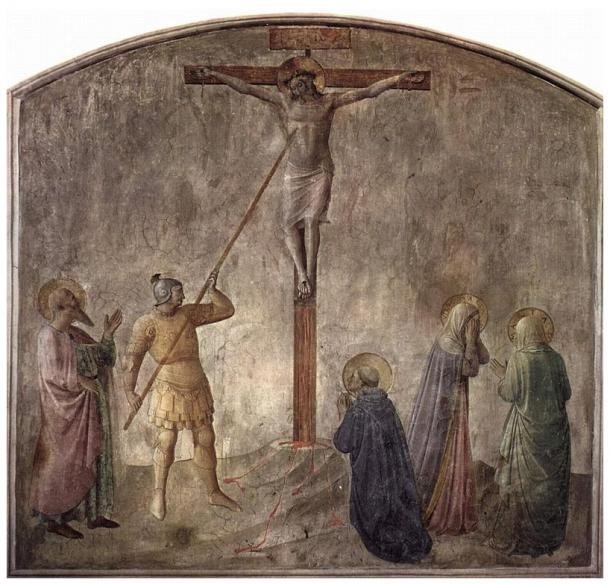
Fresco by Fra Angelico, Dominican monastery at San Marco, Florence, showing the lance piercing the side of Jesus on the cross (c. 1440) (Public Domain)
An Unproven Legend
Historians and the Vatican acknowledge that at least four major relics claim to be the Holy Lance, located in Rome, Vienna, Vagharshapat (Armenia), and Antioch. The Catholic Church does not officially authenticate any of these claims. The Vienna lance, which has been scientifically tested, dates to approximately the 8th century. The authenticity of all existing Holy Lance relics remains a subject of scholarly debate and faith rather than historical certainty.
As of today, the Holy Spear can no longer be seen in the Geghard Monastery, as it is now resides in the museum of the Echmiadzin Monastery in the spiritual capital of the country. It is held in a special case of gilded silver made in 1687. Nevertheless, Geghard Monastery is still a popular tourist destination for local and foreign visitors alike. The site was even inscribed as a World Heritage Site in 2000, a testament to its importance in the history of Armenia and the world.
UNESCO Recognition and Modern Access
Geghard Monastery's extraordinary cultural and architectural significance earned it UNESCO World Heritage status in 2000. UNESCO recognized it as "an exceptionally well-preserved and complete example of medieval Armenian monastic architecture and decorative art, with many innovatory features which had a profound influence on subsequent developments in the region."
In June 2017, Geghard became one of several Armenian archaeological sites featured in the 360GreatArmenia VR project, as reported by Smithsonian magazine. This initiative makes virtual tours available from anywhere in the world. The experience combines drone footage and ground-level photography, allowing viewers to navigate through interiors, switch between aerial and street views, and examine historical art and relics in detail.
A Living Monument
Today, Geghard Monastery remains a popular destination for both pilgrims and tourists, continuing its centuries-long role as a bridge between Armenia's ancient spiritual traditions and its vibrant present. Whether or not it once housed the actual spear that pierced Christ's side, the monastery stands as an authentic testament to Armenia's pioneering role in Christian history and its remarkable architectural achievements carved literally from the living rock of its mountainous landscape.
And Now You Can Visit Geghard Monastery Virtually
Geghard Monastery also became accessible to worldwide pilgrims and others interested in the site in 2017. That’s when the monastery joined several other archaeological sites in the country in the 360GreatArmenia VR app and website. The project has the goal of “making virtual tours available from anywhere.”
A report on the project on Smithsonian.com explains what you can see if you check out the 360 degree virtual experience: “The resulting stitched images, taken both by drones and photographers on the ground, allow viewers to switch from aerial to street views, navigate through interiors and view relics and historical art.”
Top image: Wide view of Geghard monastery from within the monastic walls. Photo by Serouj Ourishian. 2011. Source: en.wikipedia.org)
This article was first published in Nov 2018 and has been updated with new information.
By Ḏḥwty
References
Armenian Travel Bureau, 2010. Geghard Monastery. [Online]
Available at: http://www.atb.am/en/armenia/sights/christ/geghard/
serflac, 2015. Geghard Monastery. [Online]
Available at: http://www.atlasobscura.com/places/monastery-of-geghard
UNESCO, 2015. Monastery of Geghard and the Upper Azat Valley. [Online]
Available at: http://whc.unesco.org/en/list/960
www.armeniapedia.org, 2010. Geghard Monastery. [Online]
Available at: http://www.armeniapedia.org/index.php?title=Geghard_Monastery
www.lonelyplanet.com, 2015. Introducing Geghard Monastery. [Online]
Available at: http://www.lonelyplanet.com/armenia/geghard-monastery






The lance that stabbed Jesus in the side.
Permalink
The spear was also called 'The Spear of Destiny' and at one time Adolf Hitler claimed to have it. In the book by Trevor Ravenscoft named 'The Spear of Destiny.
Except that Trevor
Permalink
In reply to The lance that stabbed Jesus in the side. by Gracie Gragg (not verified)
Except that Trevor Ravenscroft admitted dreaming the conversations with Stein..... furthermore that spear is now in Vienna. There must have been many christs many spears and many longinius.
Trevor Ravenscroft
Permalink
In reply to Except that Trevor by Georges Slowik (not verified)
And many gods, and many lies and many more stories. Sure took you long enough to reply!
Unless they find a living
Permalink
Unless they find a living Jezus that can prove he's 2000 years old can we stop with the religious twabble?
Is that really what Roman
Permalink
Is that really what Roman lance heads looked like? Why would they have a cross in them if they weren't Christian?