

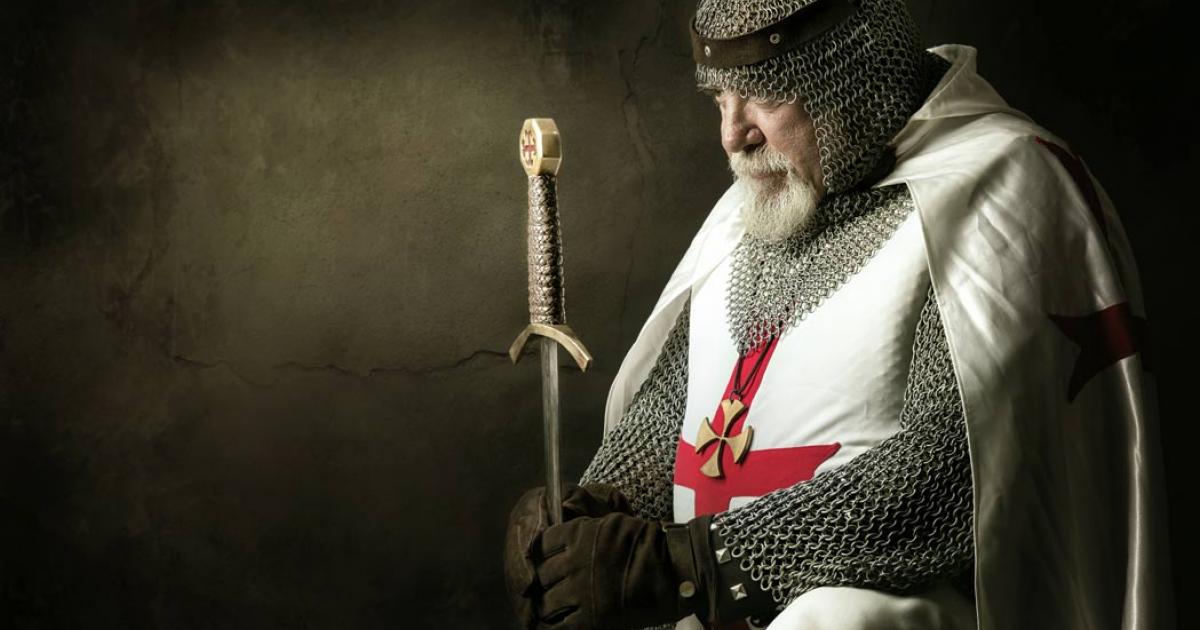

The ‘Poor Fellow-Soldiers of Christ and the Temple of Solomon,’ more commonly known as the Knights Templar, or the Templars, was one of the most renowned military orders during the Middle Ages. The source of their fame came not only from their prowess on the battlefield, but also from the wealth they amassed during the Crusades. These riches eventually led to their downfall, and became the so-called ‘Treasure of the Templars’ in the popular imagination.
The Finances of the Knights Templar
The Knights Templar were not only great warriors, but formidable financiers as well. One of the two ranks of non-fighting men, for instance, was known as the farmers, who were responsible for the administration of the Order’s worldly possessions. The other rank was the chaplains, which tended to the spiritual needs of the Order.
As they had the official endorsement of the Church, the wealthy of Europe provided the Templars with a large amount of donations in the form of money, land, and fighting men. Additionally, they were exempted from all taxation, including the ecclesiastical tithes that were due to the clergy. Thus, the Knights Templar became one of the most affluent institutions during the Middle Ages.
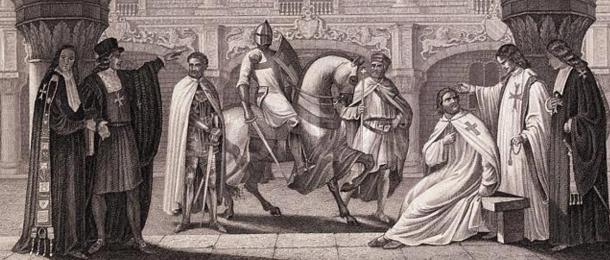
Members of the Knights Templar in discussion. (Public Domain)
The Downfall of the Templars
It was during the early 14th century that the Knights Templar officially came to an end, with the execution of its last Grand Master, Jacques de Molay. The dissolution of the Order was related to its vast treasury.
The man responsible for the downfall of the Templars was the king of France, Philip IV, called the Fair. The French king, it has been claimed, was heavily in debt to the Templars due to his war with the English, and he was eyeing the wealth of the Templars for himself.
In 1305, Pope Clement V sent letters to de Molay and the Grand Master of the Hospitallers, requesting them to come to France to discuss the possible merger of the two Orders. de Molay arrived in early 1307, though the meeting was delayed for some time.
- Mystery of the Knights Templars: Protectors or Treasure Hunters on a Secret Mission?
- The City of Caesars
- The Intriguing Carvings of Rosslyn Chapel
- The Grail Cypher: A radical reassessment of Arthurian history
Nevertheless, the Grand Master was able to discuss other matters with the Pope, one of which concerned some charges made a few years earlier by an ousted Templar, regarding impropriety in the Knights Templar initiation ceremony. Some believe that the Pope was in collusion with the French king, though others claim that the Pope was a weak character who served as a pawn of Philip.
A royal enquiry was set up to look into the matter of the Templars, and Philip saw this as an opportunity to get rid of the Knights Templar. On the 18th of March 1314, almost seven years after the Templars were first arrested throughout France, de Molay and three other top-ranking Knights were burned to death as heretics in Paris.
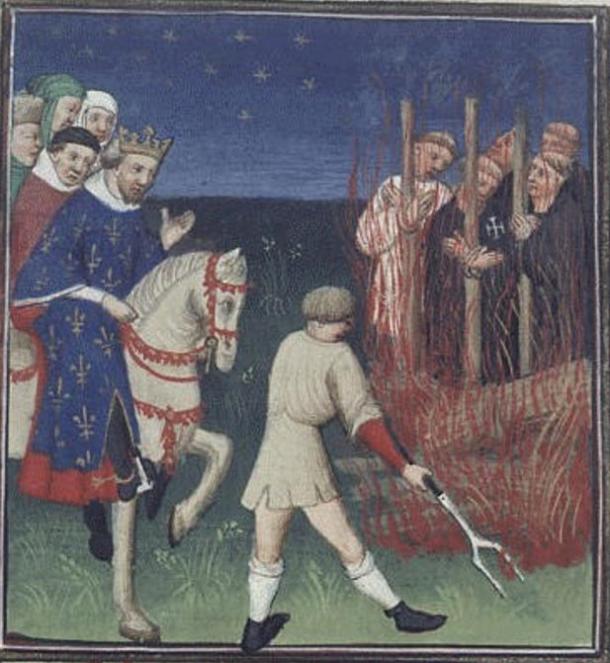
Execution of Templars in front of Philip the Fair. (Circa 1415-1420) (Public Domain)
Philip freed himself from his monetary debts to the Knights Templar, and seized their treasury as well. The king, however, would not enjoy his new-found wealth for long, as he died on the 29th of November 1314, less than a year after de Molay’s execution.
Some believe that the Templars managed to hide some of their wealth from the French king. This became the foundation for the legend of the Templar’s treasure, and many have since speculated on the location of their richness.
Contents of the Knights Templar Treasure
It has been claimed that the Knights Templar treasure contained more than common material wealth. It is believed that the Templars had collected a number of sacred relics during their time in the Holy Land as well. For example, one of the charges levelled against the Templars was that they were idolaters who worshipped the image of a ‘bearded man.’
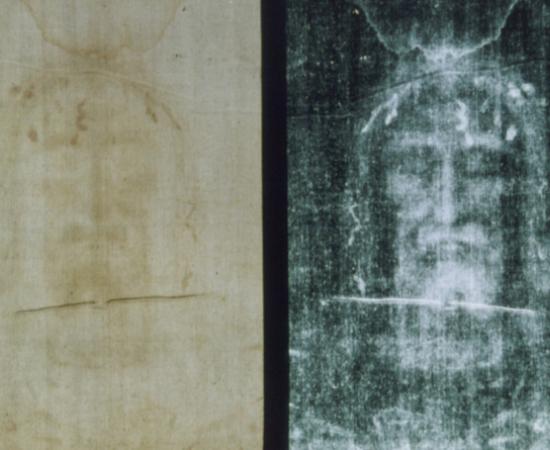
An unpublished account of the initiation of a young Frenchman, Arnaut Sabbatier, into the Order, which was found by a historian doing research in the Vatican Secret Archives, has helped to shed light on this claim. It is reported that Sabbatier was “shown a long piece of linen on which was impressed the figure of a man and told to worship it, kissing the feet three times”. It has been suggested that this was one of the relics in the possession of the Templars, the Shroud of Turin.
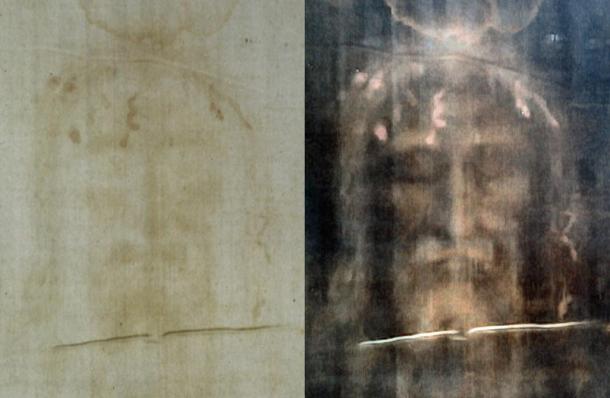
Positive and negative images of the Shroud of Turin. (CC BY SA 3.0)
While the Shroud of Turin is kept in the royal chapel of the Cathedral of Saint John the Baptist in Turin today, the location of other purported Templar relics is harder to pin-point. These supposed relics include the Treasure of Solomon, the Ark of the Covenant, the Holy Grail, lost teachings of Jesus, and even the mummified head of Christ.
Even though some experts assert that the treasure was taken by the French king and the Templars’ property was mostly given to the Hospitallers, there are still many people who disagree and believe that at least some of the Knights Templar treasure has been hidden. The possible locations for the treasure vary, ranging from Rosslyn Chapel in Scotland to Oak Island in Nova Scotia, Canada, and even a remote Danish island in the Baltic called Bornholm. It is certain that treasure hunters looking for the wealth of the Knights Templar will be kept busy for some time to come.
Top Image: A solemn looking Knights Templar. Source: Luis Louro /Adobe Stock
By: Ḏḥwty
Updated on June 30, 2020.
References
BBC, 2015. From Jerusalem to Rosslyn?: The Templars in Scotland. [Online]
Available at: http://www.bbc.co.uk/legacies/myths_legends/scotland/lothian/
Haagensen, E. & Lincoln, H., 2006. The Templars' Secret Island. London: Phoenix.
Hooper, J., 2009. Turin Shroud link with Templars proved by archives, claims historian. [Online]
Available at: http://www.theguardian.com/world/2009/apr/06/turin-shroud-templars
istina.rin.ru, 2005. The Lost Treasure of the Knights Templar. [Online]
Available at: http://istina.rin.ru/eng/ufo/text/180.html
Lovgren, S., 2004. "National Treasure": Freemasons, Fact, and Fiction. [Online]
Available at: http://news.nationalgeographic.com/news/2004/11/1119_041119_national_treasure_2.html
Moeller, C., 1912. The Knights Templars. [Online]
Available at: http://www.newadvent.org/cathen/14493a.htm
Selwood, D., 2014. A stain on history: the burning of Jacques de Molay, Grand Master of the mysterious Knights Templar, 700 years ago today. [Online]
Available at: http://blogs.telegraph.co.uk/news/dominicselwood/100263362/a-stain-on-history-the-burning-of-jacques-de-molay-grand-master-of-the-mysterious-knights-templar-700-years-ago-today/
www.crystalinks.com, 2015. The Knights Templar. [Online]
Available at: http://www.crystalinks.com/templars1.html







The Templars
Permalink
In reply to The Templars by john bentley (not verified)
An interesting comment, John. I will read your book. The man you speak of must be Sir Francis Bacon? I've researched the subjects you outline for many years and what seems to be sound evidence confirms that Lord Enki first conceived of the New World Order, as set out on the cuneiform Mesopotamian clay tablets. Groups serving him have advanced down the ages with his honourable purpose as their goal, but a mirror group came into existence at their outset, determined always to wrong-foot the good groups. They infiltrated and in some cases corrupted them. Their dark aim was to uphold the sinister power of the evil cabal that sits behind the scenes at the potent centre of global control. It is very ancient indeed and it is this dark cabal that holds sway today. However, the good groups are very much still in existence and are about to play a major trump card! This will be revealed in the coming weeks and months and will astonish everybody. It will succeed in throwing the dark cabal into utter confusion, and from then on the good groups will emerge once more to help humanity to claim its true status and heritage. Now this is a prophecy, so we will have to see if it holds water.
Knights Templars
Permalink
For an interesting look at the Templars' supposed 'guilts', I suggest folks look up the 'Chinon Parchment', which was found in 2001, among a group of papers called 'Processus Contra Templarios" ( The Trial of The Templars) , & were found to have been stuffed into other very old books, long ago, in the 'Vatican Secret Archives'. The original papers were published in 1308. The new publication in 2007, by the Vatican Secret Archives .The limited publication of 799 was made available- at exorbitant cost. The information is a complete & separate investigation by Pope Clement into the charges brought by Phillip-who indeed, did desire their wealth. The Pope's findings determined they were not guilty of heinous acts against the church & he found them not guilty. Phillip pressed forward regardless. The lot of the Templars who went to Paris were interred, & tortured for 7 years. Some, including De Molay, had their feet held to the fire until they burned off. ( the bones were mockingly returned to them in a bag). De Molay, chained to the post-the fire lit- declared the curse against both the King & the Pope, & both died in short order, whether form the curse or the poor sanitary/living conditions of the times. Phillip didn't get much of the wealth as the Templar's ships in the harbors 'mysteriously/ disappeared before he could act. He did get many lands & other resources however. The order went 'underground' as a matter of course. They went to many lands, Scotland among them & figured in the decisive Battle of Bannockburn, in support of the Scots, fighting the English machine. The Templars are credited with creating a banking system, whereby pilgrims to the Holy Lands could deposit their monies in their localized Templar banks & 'traveler's checks' could be written on their journeys. They did hold land, lots of it, as the support for their missions to protect, defend the Holy Lands, & feed their soldiers, required much money. You could call all of it 'liquid assets' that could be traded for other necessities. If one is inclined to study & see some light into the dark past, the last I looked, the translation of the Chinon Parchment itself could be found at; http://www.inrebus.com/chinon.php . i will warn anyone on one thing; the legalese languages used in court haven't changed much, no matter how 'advanced' we think the systems are today! When I read a portion of the Parchment, I couldn't tell how anyone would determine if anyone else was innocent-or guilty! Over time, much valuable knowledge has been lost, or misconstrued. ( Think about how far along all
mankind would be, today, if the library at Alexandria hadn't been burned!). I feel it is encumbent upon folks who desire the light of knowledge, to look (or dig!) for Truth. If Templar history is interesting to you, I invite you to dig! Thanks,Mike
Thank you.
Permalink
In reply to Knights Templars by Mike Mccloud (not verified)
I found the link and translation interesting Mike.
Templars
Permalink
In reply to Knights Templars by Mike Mccloud (not verified)
Mike thank you for that link
Templar decline
Permalink
I’ve heard that some of the Templars escaped to Switzerland. The history I’ve read said that in the early 1300’s the Swiss banded together to defend one of their passes, winning the battle with tactics previously unseen in the area. Everyone knows about the Swiss banking prowess. Is there a connection? Also, the Swiss flag is quite similar to the Templar cross, though the colors are reversed. Any thoughts?