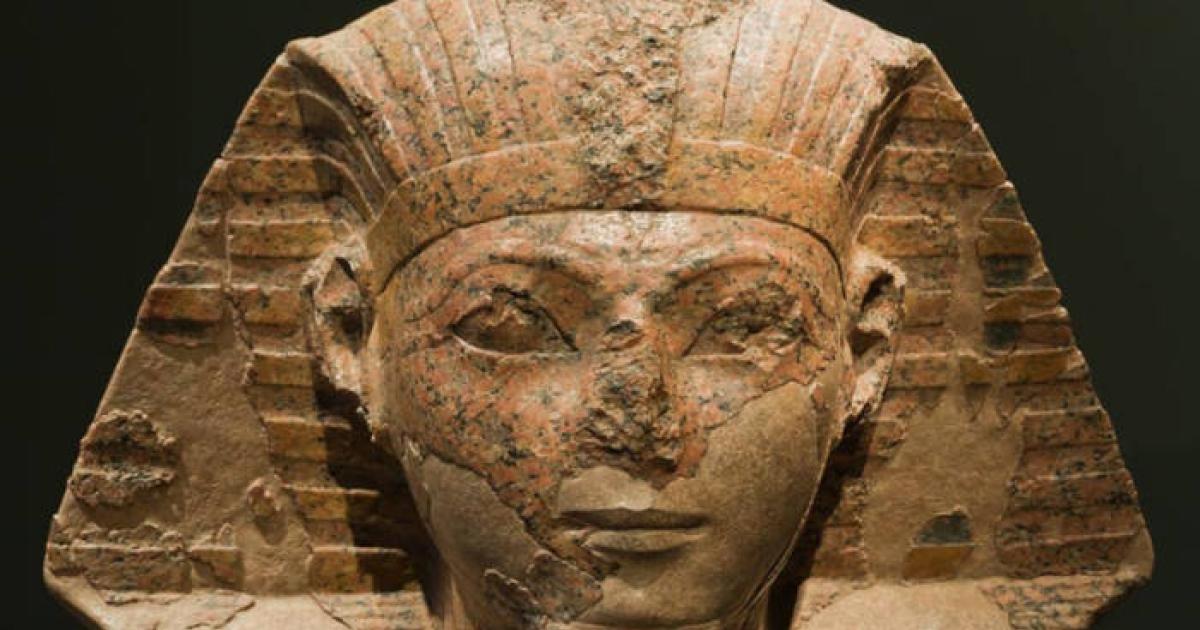

The iconic image of the shattered statues of Queen Hatshepsut has long been interpreted as evidence of political vengeance - an aggressive attempt by her successor, Thutmose III, to erase her memory. But new research, drawing on previously unpublished excavation records and archival materials from the Metropolitan Museum of Art's 1920s fieldwork at Deir el-Bahri, is challenging that story. Instead, it proposes a far more complex, ritualistic, and pragmatic explanation for the damage inflicted on Egypt's most famous female pharaoh's statuary.

Fragments from an indurated limestone statue of Hatshepsut (approximately life size) (MMA 29.3.2) (photograph by Harry Burton, 1929; © The Metropolitan Museum of Art, Department of Egyptian Art Archives (M10C 71)). (Antiquity Publications Ltd)
Who Was Hatshepsut?
Hatshepsut was the longest reigning female pharaoh. Under her reign, Egypt prospered. Known as “The Woman Who Was King,” the Egyptian economy flourished during her time as pharaoh. She directed the construction and repairs of many buildings, memorials, and temples. However, upon her death, it seemed that Hatshepsut’s successors tried to erase any memory of her. While the goal may have been to eradicate her from memory, these attempts only fueled the desire of modern civilizations to know more about her.
This desire has now led to a study which is challenging this prevailing narrative regarding the treatment of Hatshepsut’s memory, and whether there really was an attempt to remove her from the historic record.
Reassessing the Evidence
Jun Yi Wong of the University of Toronto has conducted a comprehensive reassessment of the thousands of Hatshepsut statue fragments excavated from her mortuary temple and surrounding areas. His findings, recently published in Antiquity, reveal that many of the statues were not defaced with malice, but were instead broken at strategic weak points-such as the neck, waist, and knees-consistent with a known ancient Egyptian practice known as the "deactivation" of statues. This ritual act was meant to neutralize the spiritual power of images, and it was commonly applied to kings' statues after death.
- Why Are So Many Ancient Egyptian Statues Missing Their Noses?
- Sobekneferu’s Legacy: The Sacred Places of Egypt’s First Female Pharaoh

Reassembling the statue fragments of Hatshepsut (photograph by Harry Burton, 1929; © The Metropolitan Museum of Art, Department of Egyptian Art Archives (M10C 58)). (Antiquity Publications Ltd)
Contrary to popular narratives, many of Hatshepsut's statues, particularly freestanding ones, were recovered in near-complete condition, with their faces intact. Damage to others seems more aligned with later reuse, incidental breakage, or natural degradation. Indeed, some fragments were repurposed in construction or even as tools, with reuse continuing into the Graeco-Roman period, noted the study.
While Hatshepsut did suffer a campaign of erasure with her name and image being removed from temple walls, the physical treatment of her statuary tells a different story. Wong argues that this was not a straightforward act of damnatio memoriae, but a layered process involving ritual practice, resource reuse, and the slow effects of time.

A small kneeling statue of Hatshepsut (MMA 23.3.1) with its face fully intact. (© The Metropolitan Museum of Art/Antiquity Publications Ltd).
This study not only sheds new light on Hatshepsut's complex legacy but also challenges broader assumptions about the motivations behind ancient acts of destruction.
Ultimately, it seems Queen Hatshepsut's statues were not merely victims of political spite, but players in a deeper, more nuanced ritual tradition, one that links her posthumous treatment more closely to that of other pharaohs than previously thought.
Top Image: Pharaoh Hatshepsut statue. Source: Miguel Cabezon /Adobe Stock
By Gary Manners
References
Wong JY. The afterlife of Hatshepsut’s statuary. Antiquity. 2025;99(405):746-761. doi:10.15184/aqy.2025.64 Available at: https://www.cambridge.org/core/journals/antiquity/article/afterlife-of-hatshepsuts-statuary/F22D001E29438008136B6DA04F57C627