
People have been debating the existence of the Loch Ness monster since the early part of the 20th century when sightings seemed to become more common. Known colloquially as ‘Nessie,’ this mysterious creature has allegedly been inhabiting the deep waters of a freshwater lake south of Inverness, Scotland for perhaps thousands of year, yet up to this time has somehow eluded detection by scientists.
There is a good reason for this, says Tim Coulson, a professor of Zoology from Oxford University who has taken a good long look at the Loch Ness monster legend. According to Coulson, it is a simple “biological impossibility” for the creature to exist, and so it doesn’t. Case closed.
While Coulson doesn’t think the people who claim to have seen Nessie are lying, he does think they are mistaken, that they have misidentified what they have observed. He is also dismissive of the photos and videos taken of the monster, which likewise have to be misidentifications (with the occasional hoax mixed in).
“In the case of the Loch Ness Monster they are either seeing bits of floating debris, or a bird such as a cormorant with a longish neck that sits low in the water. You might think that sounds unlikely, but I am always amazed at how bad people can be at judging size – particularly when they are hoping to see a particular animal,” he told the MailOnline, offering the expected response of the skeptic.
In Coulson’s case, though, he is not dismissing Nessie out of hand. He is doing so because he is convinced there is no scientific justification in believing in such a creature, based on what is known at this time.
- Mystery of the Stronsay Beast, Scotland’s Other Monster (Video)
- Have the Ancient Origins of Scotland’s Loch Ness Monster Been Identified on Film?
Examining the Evidence … Which Allegedly Doesn’t Exist
As part of his argument, Coulson points out that no skeletal remains of a deceased specimen have ever been found, and no one has ever caught a living one in a fishing net. This lack of evidence persists despite the fact that people have been organizing excursions seeking proof of Nessie’s existence for decades, often on boats equipped with sonar and underwater cameras designed to spot movement below.
Something solid and convincing should have been found by now, some sort of tangible evidence showing that a flesh-and-blood creature of impressive size and dimension is living in Loch Ness, Coulson insists. The only rational reason to explain this, he says, is that the creature doesn’t exist at all.
- Scientists Finally Closing in on Nessie, The Loch Ness Monster
- Slithering Through the Stories of Ancient Snake Deities: Serpent Gods of Ancient Mythology
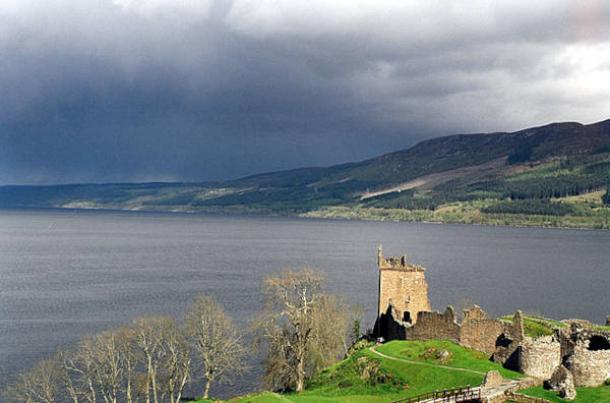
Large Freshwater Loch Ness with Urquhart Castle in the foreground in Inverness Scotland. (Sam Fentress/CC BY-SA 2.0)
In a new article he wrote for The European (a publication he’s a science correspondent for), Coulson lays out his argument for the non-existence of Nessie, while also taking aim at Bigfoot and the Yeti, two other well-known cryptids (seemingly impossible creatures that are still said to exist).
“I would dearly love for Bigfoot, Yeti, the Loch Ness Monster and other cryptids to exist, but the scientific evidence says otherwise,” he wrote. “The likelihood of such beasts living undetected in forests, mountains and lakes, in great numbers, for thousands of years without leaving a single skeleton, fossil, bone fragment or skin sample is hard enough to swallow.”
He also asserts that from an evolutionary standpoint, there is no realistic scenario that would explain how such creatures could exist, if their home areas were so restricted and their population numbers so low that they could have somehow escaped verifiable detection for centuries.
“When we also consider the biological and evolutionary factors that determine these species’ purported existence and long-term survival, the likelihood reduces to the point where it becomes so tiny as to be confidently discounted as pure fantasy and fun figments of our imagination,” he concludes, shutting the door completely (in his mind) on the possibility that a cryptid like Nessie actually exists in the 21st century.
Did the Beast Summon the Beast?
The problem with Professor Coulson’s thesis is that it limits the range of possibilities that could explain purported sightings of an interactions with strange creatures If one were to Google the topic ‘paranormal Bigfoot,’ they would discover that many investigators think Bigfoot and other cyptids aren’t undiscovered animals at all, but beings from alternate dimensions or other levels of reality that can manifest as flesh-in-blood creatures at times but are actually something more. This is how creatures like Nessie can seem so real at times, but completely not real at others.
And along these lines, there is a fascinating fact about Loch Ness that may be relevant, and that is its association with not one but two extremely notorious beasts: the Loch Ness monster, and the Great Beast himself, the legendary Aleister Crowley, a monster of an altogether different nature. This self-styled anti-Christ who declared himself ‘the wickedest man in the world’ lived at a manor known as Boleskine House on near the shore of Loch Ness from 1899 to 1913, and while there he performed endless numbers of rituals and ceremonies designed to summon demons, aliens, and other denizens of parallel dimensions to manifest in his presence.
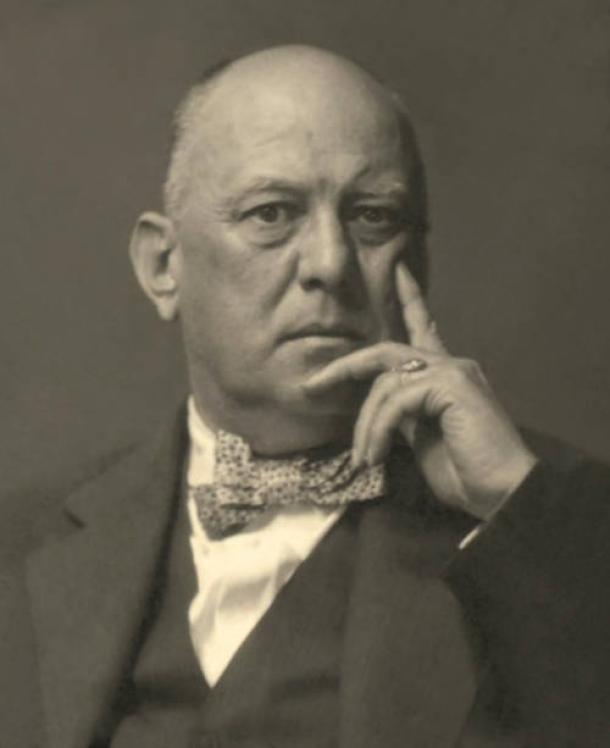
Portrait of Aleister Crowley. (Public Domain)
While most would scoff at such notions, there were many people who visited Boleskine House who reported weird experiences and shocking encounters with mysterious beings or evil forces. Some with knowledge of what Crowley was up to have raised the possibility that the Loch Ness monster was one result of Crowley’s demented deeds, claiming that through his occult dabbling he may have brought an ancient legend to life.
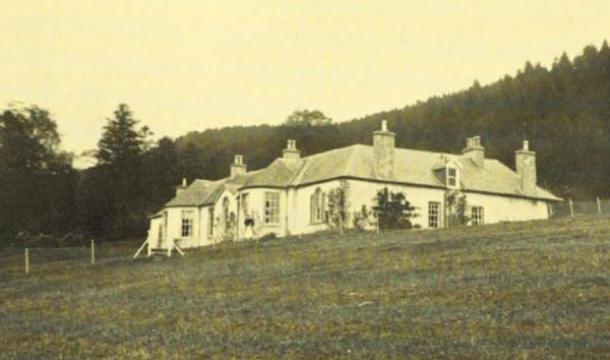
Boleskine House. (Public Domain)
Needless to say, a scientist like Coulson is likely to dismiss the possibility of a paranormal or exotic explanation for the existence of the Loch Ness monster as nonsensical (and he might be right to do so). But dismissing the possibility entirely because it doesn’t fit with the current scientific paradigm or with consensus ideas about reality, places limits on the imagination that may be artificial.
As long as people continue to report sightings of the Loch Ness monster, or of Bigfoot and Yeti, there will be reason to leave the door open at least a crack to the possibility that they may be real, in a way that would bend our concepts of what the word ‘real’ actually means.
Mouthing the words of his creator Sir Arthur Conan Dole, the great detective Sherlock Holmes was quoted as saying that “once you eliminate the impossible, whatever remains, no matter how improbable, must be the truth.” Applying this principle in his own life, Doyle eventually concluded that fairies were real (based on eyewitness sightings and experiences), and he spent decades searching for proof of their existence. So it is perhaps not so irrational to continue to search for evidence of the reality of the Loch Ness monster as well, even if its existence seems highly improbable, or even bordering on the impossible, from a purely scientific standpoint.
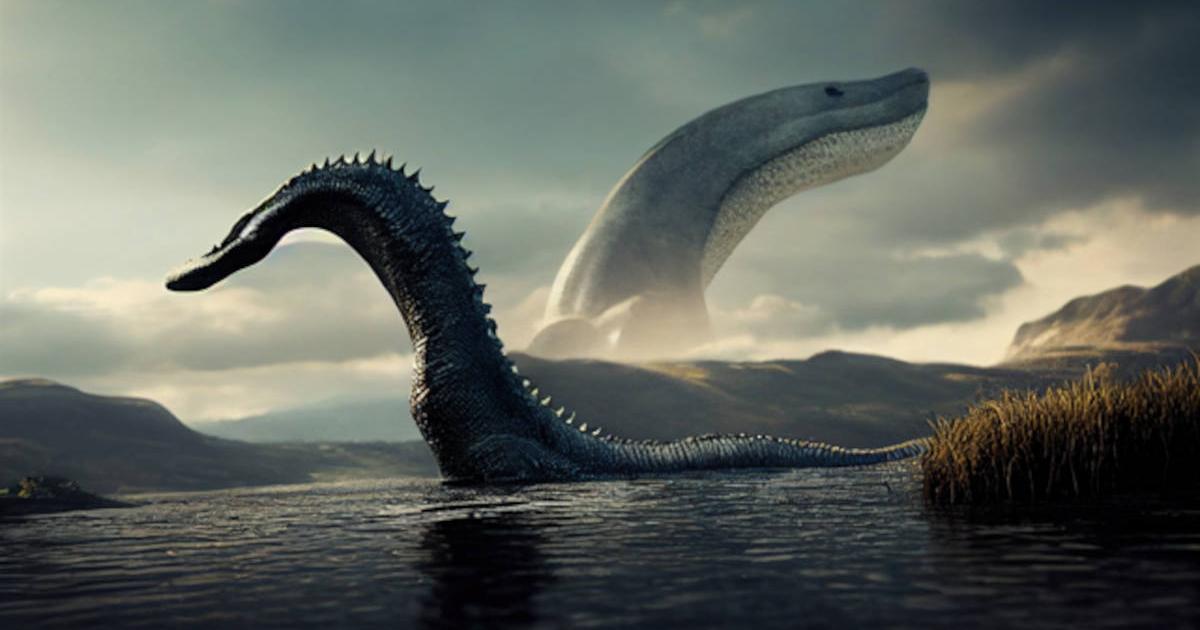
Top image: AI image representing Nessie, the Loch Ness Monster. Source: Declan Hillman/Adobe Stock
By Nathan Falde