
A new study of ancient and modern societies shows that human populations need at least 2.7 children per woman – a much higher fertility rate than previously believed – to reliably avoid long-term extinction. While a fertility rate of 2.1 children per woman is often considered the replacement level needed to sustain a population, this figure doesn’t account for random differences in how many children people have – as well as mortality rates, sex ratios, and the probability that some adults never have children. In small populations, these chance variations can wipe out entire family lineages.
Why Declining Fertility Rates are a Ticking Time Bomb
In the new study, published April 30, 2025 in the open-access journal PLOS One, Takuya Okabe of Shizuoka University, Japan, and his colleagues introduce the mathematical models they used to examine how demographic variability affects the survival of populations over many generations. Their study found that, due to random fluctuations in birth numbers, a fertility rate of at least 2.7 children per woman is needed to reliably avoid eventual extinction – especially in small populations.
- New Study Reveals Native American Population Crash Before European Contact
- Ice Ages Caused Decline and Even Extinction in Europe’s Hunter-Gatherer Populations
However, a female-biased birth ratio, with more females than males being born, can reduce the extinction risk, helping more lineages survive over time. This insight may help explain a long-observed evolutionary phenomenon: under severe conditions – such as war, famine, or environmental disruption – more females tend to be born than males. It also suggests that, while extinction isn’t imminent in large developed populations, most family lineages will eventually fade out, replaced by those that produce more females.
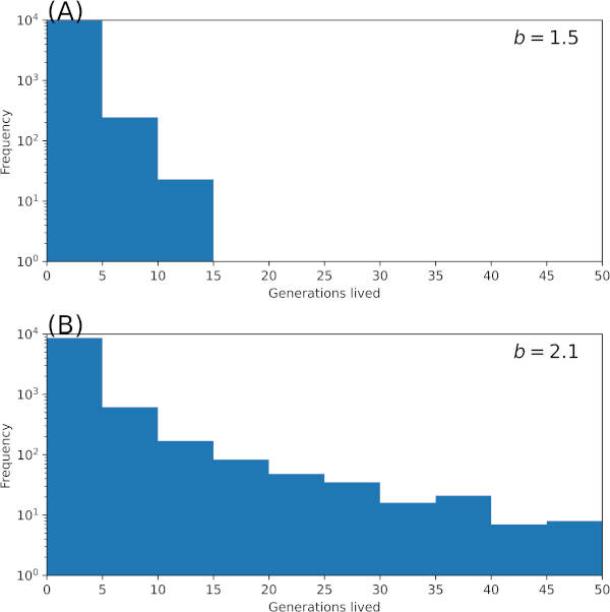
Chart showing how many generations can be expected to survive with fertility rates of 2.1 and 1.5 children per woman. (PLOS One).
The authors conclude that true population sustainability – as well as the sustainability of languages, cultural traditions, and diverse family lineages – requires rethinking conventional fertility targets. The findings also have implications for conservation efforts of endangered species in which target fertility rates are set, they point out.
"Considering stochasticity in fertility and mortality rates, and sex ratios, a fertility rate higher than the standard replacement level is necessary to ensure sustainability of our population," stated researcher Diane Carmeliza N. Cuaresma in a Public Library of Science (PLOS) press release.
Has the Population Crash Already Begun? The Numbers Suggest It Has
In recent years much alarm has been raised about crashing birth rates in developed countries, which can lead to significant long-term population decline and possibly the complete depopulation of certain nations at some point in the future. Even in the short-term this development is problematic, as it causes an aging of the population that makes it more and more difficult for younger generations to provide the resources necessary to take proper care of the elderly.
- Rising to the Challenge: Innovative Civilizations Advanced Through Climate Change
- Geneticists Show How Neanderthals Never Really Went Extinct
While immigration is a controversial subject in the modern age, there is little doubt that developed nations will have to be more welcoming to immigrants in the coming decades, if they want to prevent their population numbers from collapsing. But if the researchers responsible for this new study are correct, embracing immigration won’t solve the problem in the long run. The current fertility rate for the world as a whole is 2.3 children per woman, which is above the old 2.1 extinction level estimate but significantly below the new estimate. This implies a global population crash at some point, one that won’t be limited to developing countries alone (assuming the 2.7 estimate is correct).

One of China's deserted ghost cities, the Dayawan complex in Huizhou, Guangdong province. (Pekingi Kacsa).
Social, cultural and economic changes are all implicated in the drop in birth rates, and those factors can’t just be wished away. People’s needs, preferences, and expectations with respect to having children may change again, of course, and this combined with decisions by policymakers that might encourage higher birth rates could reverse the current trend. But this is far from guaranteed.
In the last 50 years the world’s population has doubled, rising from four billion to more than eight billion. Up to now, dealing with the consequences of this population explosion has been more urgent that worrying about future depopulation trends. But with fertility rates having now dropped below the 2.0 mark in 125 out of the 237 officially recognized nations, what was once a concern for the future may transform into a crisis in the present more swiftly than anyone could have imagined.
If the seriousness of the problem has actually been underestimated, as the new study published in PLOS One suggets, underpopulation may be shockingly close to replacing overpopulation as the world’s scariest demographic monster—in places like China, Japan, South Korea, Australia, western Europe and North America first, and almost everywhere else later on.
Top image: AI image of a future world city, abandoned and destitute and empty of people.
Source: Freepik.
This is an edited and expanded version of a press release from the Public Library of Science, entitled ‘2.1 Kids Per Woman Might Not Be Enough for Population Survival.’