
The research, published in the journal Medieval Archaeology, represents the first large-scale analysis combining isotopic data from tooth enamel with ancient DNA from more than 700 individuals buried across England between approximately AD 400 and 1100. The findings challenge traditional narratives drawn from texts like Bede's Ecclesiastical History and the Anglo-Saxon Chronicle, which portrayed migration as consisting of isolated events—most notably the 5th-century "Adventus Saxonum" (coming of the Saxons) and the 9th-century Scandinavian settlements.
- Anglo-Saxon Migration Created a 'European' Medieval England
- Ancient DNA Reveals West African Ancestry in Medieval England
Chemical Signatures Reveal Continuous Movement
Researchers employed sophisticated bioarchaeological techniques to study chemical signatures preserved in the teeth of ancient skeletons. Tooth enamel acts as a permanent record of childhood diet and environment, capturing the chemical composition of food and water consumed during tooth formation. By analyzing oxygen and strontium isotopes, scientists can determine whether an individual grew up in the region where they were buried, or migrated from elsewhere.
According to the University of Edinburgh announcement, the team compared isotopic data from 700 individuals with ancient DNA from 316 people to distinguish movement from ancestry. The results painted a picture dramatically different from the invasion narratives that have dominated historical interpretation since the 19th century.
Rather than discrete migratory events, the evidence shows consistent population movement throughout the early medieval period, with a particularly significant spike during the 7th and 8th centuries—well after the traditional date assigned to the Anglo-Saxon migration. This discovery suggests that historians may have been looking at the wrong centuries when trying to understand the formation of medieval England.
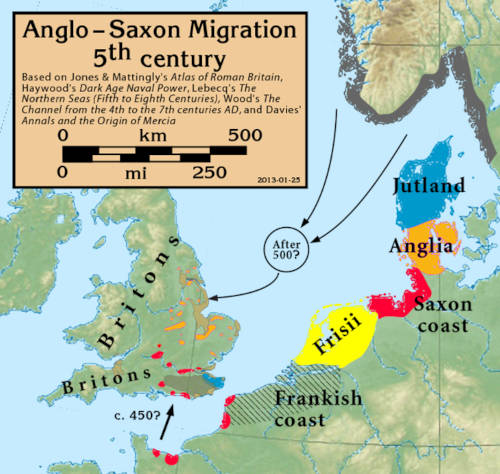
Map showing Anglo-Saxon migration routes into Britain during the 5th century, based on Jones & Mattingly's Atlas of Roman Britain. (My Work/CC BY-SA 3.0)
Gendered Patterns and Regional Variations
One of the study's most intriguing findings concerns gendered migration patterns. Male migration appeared more prominent overall, though researchers identified notable female mobility, particularly into the North East, Kent, and Wessex. This challenges simplistic models that portrayed early medieval migrations as exclusively military ventures dominated by male warriors.
The isotopic evidence revealed migration from Wales and Ireland, as well as from northwest Europe and possibly the Mediterranean. The data even captured evidence of major climate events, such as the Late Antique Little Ice Age—a period of rapid cooling in the 6th and 7th centuries—reflected in the chemical composition of tooth enamel from individuals who had consumed food and water from colder regions.
Regional variations proved significant. Some areas of England, particularly around Norfolk and the Wash, showed rapid and extensive adoption of new burial practices and material culture styles in the 5th century, suggesting a substantial migrant population. Other regions displayed more gradual cultural changes, potentially reflecting lower levels of incoming people and longer processes of acculturation and integration.
- The Anglo-Saxon Conquerors: Creators of Medieval England
- Post-Roman Britain Saw Economic Boom, Contradicting "Dark Ages" Theory
Rethinking Migration and Identity
The research team looked at how major documented sources of mobility aligned with their bioarchaeological findings. Interestingly, the traditional narratives found in texts like Bede's Ecclesiastical History and the Anglo-Saxon Chronicle don't fully match the physical evidence. These medieval texts, written centuries after the events they describe, portrayed migrations in eschatological terms—as divinely inspired journeys similar to the Biblical exodus.
Lead researcher Sam Leggett emphasized that the study "presents the results of a large-scale isotopic meta-analysis of early medieval England which reveals migration patterns from c. AD 400-1100. These patterns are gendered, regionally distinctive and fluctuate chronologically." The findings underscore the need to move away from simplistic ethnic classifications and toward a more nuanced understanding of identity and migration during this transformative period.
The biomolecular evidence provides crucial new data to answer long-standing questions about the nature and scale of early medieval migration. By demonstrating that migration was continuous rather than episodic, the study challenges both "mass migration" theories popular in the early 20th century and "elite replacement" models that suggested only small numbers of continental migrants arrived in Britain.
A Complex Picture of Medieval England
The implications of this research extend beyond academic debates about migration. The findings reveal medieval England as a far more cosmopolitan and interconnected place than previously imagined—a society continually refreshed by arrivals from across Europe and beyond, rather than one shaped by a handful of dramatic invasion events.
The researchers note that many migrants from regions with similar isotopic baselines to southern Britain—such as the Low Countries, much of Francia, and southern Scandinavia—would be "isotopically invisible" in the dataset. This means the true extent of migration into early medieval England was likely even greater than the study could directly measure.
By integrating isotopic analysis with ancient DNA data, the study lays groundwork for future high-resolution investigations that can better integrate ancestry and mobility data. This multidisciplinary approach offers a more constructive understanding of how people moved, adapted, and formed new identities during the centuries between the withdrawal of Rome and the Norman Conquest.
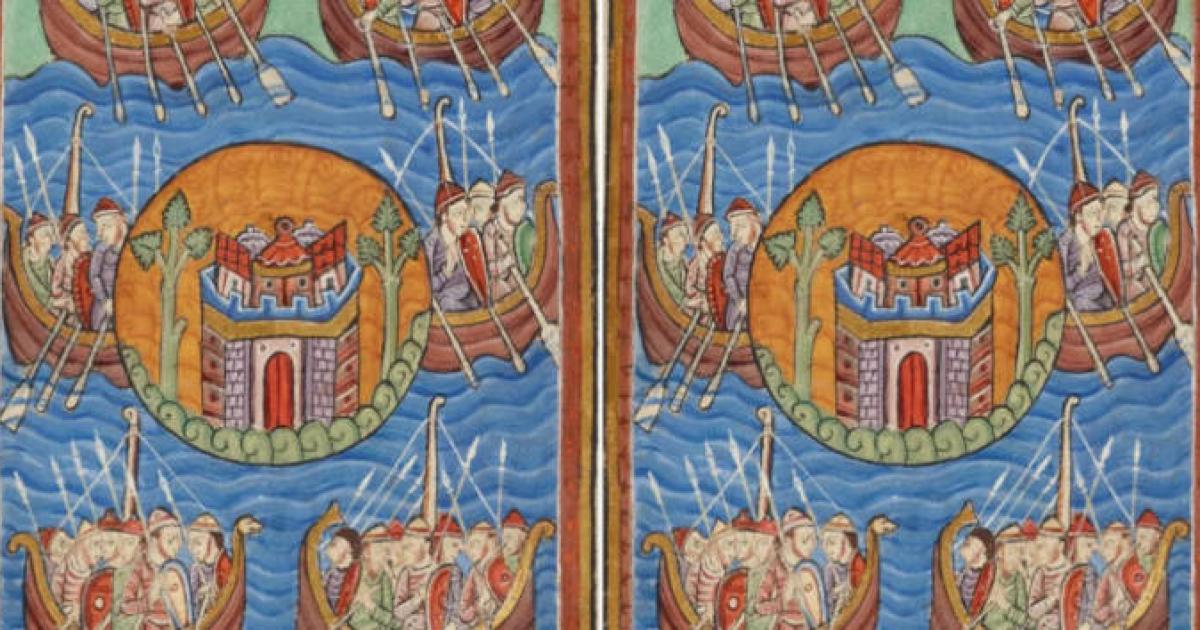
Top image: Depiction of Saxons, Jutes, and Angles crossing the sea to Britain. Source: Tgec17/CC BY-SA 4.0
By Gary Manners
References
Leggett, S., Hakenbeck, S. and O'Connell, T.C. 2025. Large-Scale Isotopic Data Reveal Gendered Migration into Early Medieval England c. AD 400-1100. Available at: https://www.tandfonline.com/doi/full/10.1080/00766097.2025.2583016
University of Edinburgh. 2026. Roots of medieval migration into England uncovered. Available at: https://www.ed.ac.uk/news/roots-of-medieval-migration-into-england-uncovered