
In a rare and chilling discovery, archaeologists have uncovered powerful new evidence of execution and public punishment from early medieval England. The remains of a woman, designated UPT90 sk 1278, reveal a harrowing story of violence, death, and social messaging-played out along the banks of the River Thames over 1,200 years ago.
Originally excavated in 1991 from the River Thames foreshore near London, the woman's skeletal remains were carefully preserved by the Museum of London Archaeology (MOLA). Now, over three decades later, a full bioarchaeological analysis has been published by Dr. Madeline Mant and her team in the journal World Archaeology (2025), casting light on a unique and troubling early medieval death ritual.
"The burial treatment of UPT90 sk 1278 lets us know that her body was meant to be visible on the landscape, which could be interpreted as a warning to witnesses," said Dr. Mant. "We can tell from the osteobiography that she was executed, but the specific offense is impossible to know for certain" (Mant et al., 2025).
- The True Origins of the Legend of Brutus of Troy and the London Stone
- Medieval Sex and Scandal: Consistory Courts and Morality in Medieval England
A Body Meant to Be Seen
Unlike typical Christian burials of the time, this woman had not been interred in the earth. Instead, her remains were carefully arranged above ground, between two sheets of bark and laid on a mat of reeds, with moss pads placed on her face, pelvis, and knees-symbolic or practical gestures lost to time.
She was laid directly on the foreshore, a liminal zone between land and river, where her body would be periodically revealed and concealed by the tides. Such locations were often reserved for those deemed socially deviant, and their placement carried both symbolic and societal weight.
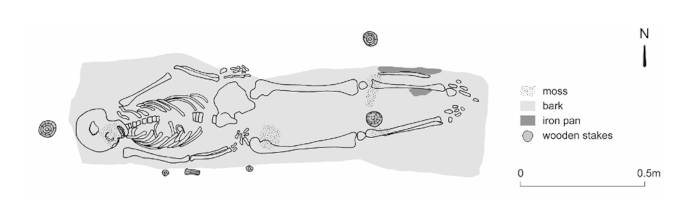
Sketch of the woman’s remains found by the River Thames, London. (Mant et al 2025.)
Signs of Terrible Suffering
Radiocarbon dating of the bark layers places her death between 680 and 810 AD, in the midst of a transformative period in Anglo-Saxon England, when law codes were beginning to codify corporal and capital punishments. Stable isotope analysis suggests she was a local woman, between 28 and 40 years old, who suffered dietary stress in childhood-perhaps from starvation or a sudden dietary shift (Mant et al., 2025).
What followed in adulthood was even more grim. The woman bore signs of over 50 traumatic injuries, likely inflicted during two separate violent episodes shortly before her death.
The first left her with bilateral scapular fractures-today often seen in victims of high-impact trauma, such as car accidents. For a woman in the 9th century, this almost certainly points to deliberate physical abuse, such as flogging. A second wave of trauma followed, with blunt-force injuries to the torso and skull. Finally, a precise blow to the left side of her head ended her life.
- Archaeologists Discover 20,000 ‘Lost Souls of Bedlam’ Under London Streets
- Cheerio and Gardi Loo! Words of Warning Prompted By Medieval Human Waste Disposal
Executed and Exposed
Why was she executed-and why so brutally? According to early medieval law codes, punishments evolved significantly during this period. While Æthelberht of Kent (c. 589-616) imposed monetary fines, later codes, such as that of Wihtred (690-725), introduced beatings and executions. Under King Alfred (871-899), crimes like theft, treason, witchcraft, and sorcery could carry the death penalty, sometimes by stoning or drowning.
"As time passed, more crimes were associated with the death penalty... This was a time of legal evolution," Dr. Mant notes.
However, executions were relatively rare. In known execution cemeteries, male skeletons vastly outnumber females-by a ratio of 4.5:1. This makes UPT90 sk 1278's case especially significant: a woman executed and publicly displayed to communicate a message of deterrence, perhaps linked to crime, religion, or social deviation.
A Medieval Warning on the Water's Edge
The Thames, often treated as a spiritual and symbolic threshold in ancient and medieval lore, formed the backdrop to this woman's final, haunting role. Her placement in such a "liminal space" suggests not only an act of justice but also a ritualized warning, a body laid bare at the edge of the known world.
This new study not only highlights a rare instance of female execution but also deepens our understanding of justice, punishment, and gender in early medieval Britain-where brutality, law, and landscape met on the watery banks of the Thames.
Top image: The remains of female UPT90 sk 1278. (0.10 m scale). Source: Museum of London Archaeology in Mant et al. 2025.
By Gary Manners
References
Mant, M. et al. (2025). Evidence for punishment and execution on the foreshore: a unique early medieval burial (680–810 AD) from London. World Archaeology. DOI: 10.1080/00438243.2025.2488739
Museum of London Archaeology (MOLA)
Phys.org. Sandee Oster (2025). New study uncovers brutal punishment and public display of medieval woman on Thames foreshore.. Available at: https://phys.org/news/2025-06-uncovers-brutal-display-medieval-woman.html