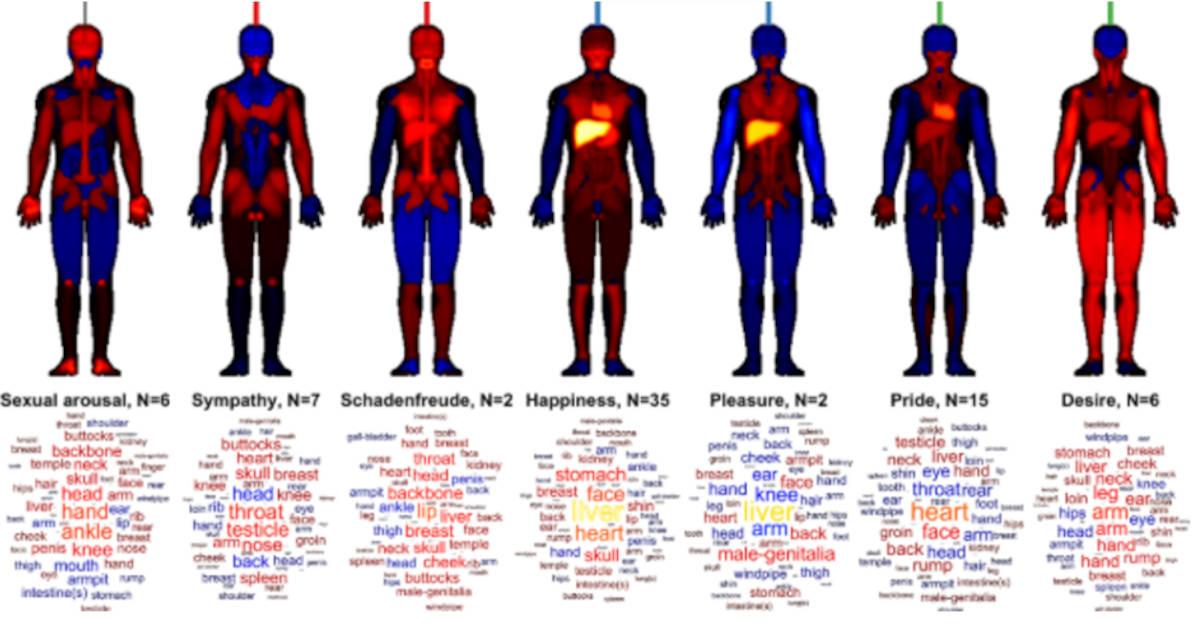

When people experience emotions of any type, it creates physiological reactions in predictable parts of their bodies. This pattern of embodiment is a normal part of the emotional experience, but new research suggests that the parts of the body associated with specific emotions may actually change over time.
Such an assertion seems incredible. Yet it appears to be true, based on the discoveries of a team of German and Finnish researchers with expertise in neuroscience and physiology. In an article that has just been published in the journal iScience, these researchers reveal the surprising results of their study of the emotional states and experiences of the ancient Assyrians, who lived in the lands of Mesopotamia more than 2,500 years ago.
While these people reported experiencing the same emotions as we do today, how they felt them in their bodies was not identical, which would seem to contradict our ideas about how the mind-body connection functions.
The Surprising Emotional Experiences of the Neo-Assyrian Empire
To discover how the Assyrian culture both described and experienced emotions, the research team, led by cognitive neuroscientist Juha Lahnakoski from the Jülich Research Center in Germany, carried out a thorough examination of Mesopotamian literature dating back to the days of the Neo-Assyrian Empire. This expansive state ruled a huge swath of territory ranging from Turkey through Iraq and into Egypt in the first millennium BC, and among their other accomplishments they achieved a high rate of literacy.
The Neo-Assyrian literature that was studied came from the years 934 through 612 BC. It has all been translated and preserved in a huge depository of ancient writings known as the Open Richly Annotated Cuneiform Corpus (ORACC), an online-accessible collection maintained by the University of Pennsylvania. The Neo-Assyrian writings, which were originally recorded on clay tablets, included cuneiform texts that in total contained about one million words, or the equivalent of a modern library with between 3,000 and 4,000 books.
What they were looking for inside these texts was any discussion or mention of emotional reactions, along with descriptions of any physiological responses they might have produced. The purpose of this initiative was “to discern consistent relationships between linguistic expressions related to both emotions and bodily sensations.”
This approach to the topic was quite innovative, and also quite productive.
“We found consistent embodied patterns for 18 distinct emotions,” the researchers wrote in their journal article. “Hierarchical clustering revealed four main clusters of bodily emotion categories, two clusters of mainly positive emotions, one large cluster of mainly negative emotions, and one of empathy and schadenfreude [taking joy at the suffering of an enemy].”
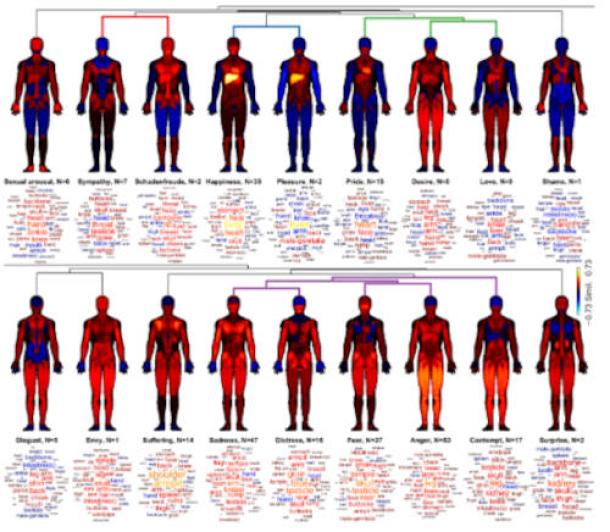
Mean co-occurrence patterns of emotions included in the 18 principal emotional categories across the body. (Juha M. Lahnakoski et al./ iScience)
With this information in hand, the researchers created a series of body maps. This allowed them to plot the various emotions onto the parts of the body where responses of one type or another had been experienced. This maps were then prepared to similar representations taken from the study of modern populations, to identify the commonalities and the differences. This approach allowed the researchers to track the impact of factors like time, geography, and customs on embodied emotional experiences.
Differences were in fact found, and some were highly intriguing.
Based on the literature, it seems the Assyrians experienced anger in their thighs, while love and happiness was felt in the area of the liver. Meanwhile emotional suffering caused a sensation in the armpits, and sexual arousal somehow created a tingling feeling in the ankles. There were many other examples like this, enough to result in the creation of emotional-response body maps that showed clear variations between then and now.
Which is not to suggest there were no commonalities between Neo-Assyrian times and modern peoples (there were in fact many). The Assyrians reported feeling a swelling in their hearts when experiencing pride, and a debilitating tightness in their chests when feeling sad. Love could be felt in the heart to some degree and not just in the liver, and other emotions also produced at least some sensations in parts of the body that would be expected based on modern ideas about how this all works.
“Even in ancient Mesopotamia, there was a rough understanding of anatomy, for example the importance of the heart, liver, and lungs,” study senior author Saana Svärd, an Assyriologist from the University of Helsinki, told Science Alert. Certainly, this understanding was based in part on how emotions seemed to impact the performance of the various organs and bodily systems, in ways that would be recognizable and identifiable both then and now.
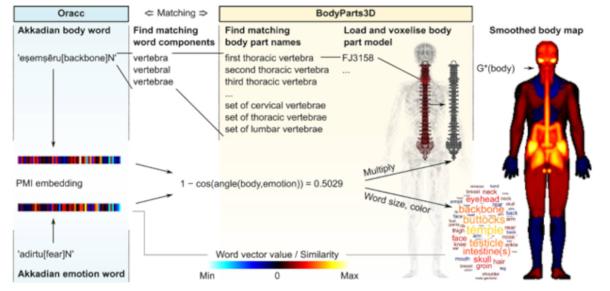
Creating emotion maps involved matching body words from the Oracc corpus to anatomical models, then combining them using a vowelised model. The final body maps were generated by calculating the similarity between emotions and body parts, resulting in visual representations of emotional responses across the body. (Juha M. Lahnakoski et al./ iScience)
Charting the Evolution of Feelings and Emotions in Time and Space
The German and Finnish researchers admit there are limitations to what can be understood about emotional experience through the study of ancient literature.
It is possible, for example, that some of the phrases they encountered supposedly describing bodily responses to emotions were meant to be metaphorical rather than literal. In some cases, the modern translations might have been only partially accurate, meaning the Assyrian authors weren’t saying precisely what it seemed. Another significant problem is that the Neo-Assyrian texts were all written by men and about men, leaving the researchers uncertain of how bodily emotions might have been experienced by the culture’s women.
“We have to keep in mind that texts are texts and emotions are lived and experienced,” Svärd said, highlighting the limitations inherent in trying to translate the subjective into the objective.
Nevertheless, many of the more unusual references were clear and unambiguous, the researchers have affirmed. As a result, their study leaves little doubt that the people of ancient Assyria experienced body sensations connected to emotions that were unique to their place and time, which is a fascinating discovery that sheds new light on the complex dynamics that shape the mind-body connection.
Top image: Some Patterns of emotions included in the 18 principal emotional categories across the body. Source: Juha M. Lahnakoski et al./ iScience
By Nathan Falde