
A new study reveals that Neanderthals in Crimea deliberately shaped ochre into crayon-like tools and used them to create marks and drawings as early as 70,000 years ago. The discovery, published in the journal Science Advances, provides compelling evidence that these ancient humans engaged in symbolic behaviors once thought to be uniquely modern human traits. Sixteen pieces of ochre from Middle Paleolithic sites in Crimea and Ukraine were analyzed using advanced techniques, revealing traces of scraping, grinding, and deliberate resharpening that suggest far more than practical applications.
The research focused on artifacts recovered from three rock shelters in Crimea's Belogorsk region: Zaskalnaya V, Zaskalnaya VI, and Prolom II, along with two pieces from Mukhovets in northern Ukraine. Lead researcher Francesco d'Errico from the University of Bordeaux and his international team employed scanning electron microscopy and portable X-ray fluorescence to examine the ochre fragments in unprecedented detail.
- Study Confirms Cave Painting Was Made By Neanderthals
- Engraved Crimean Stone Artifact May Demonstrate Neanderthal Symbolism
Deliberate Crayon-Like Tools Show Advanced Cognition
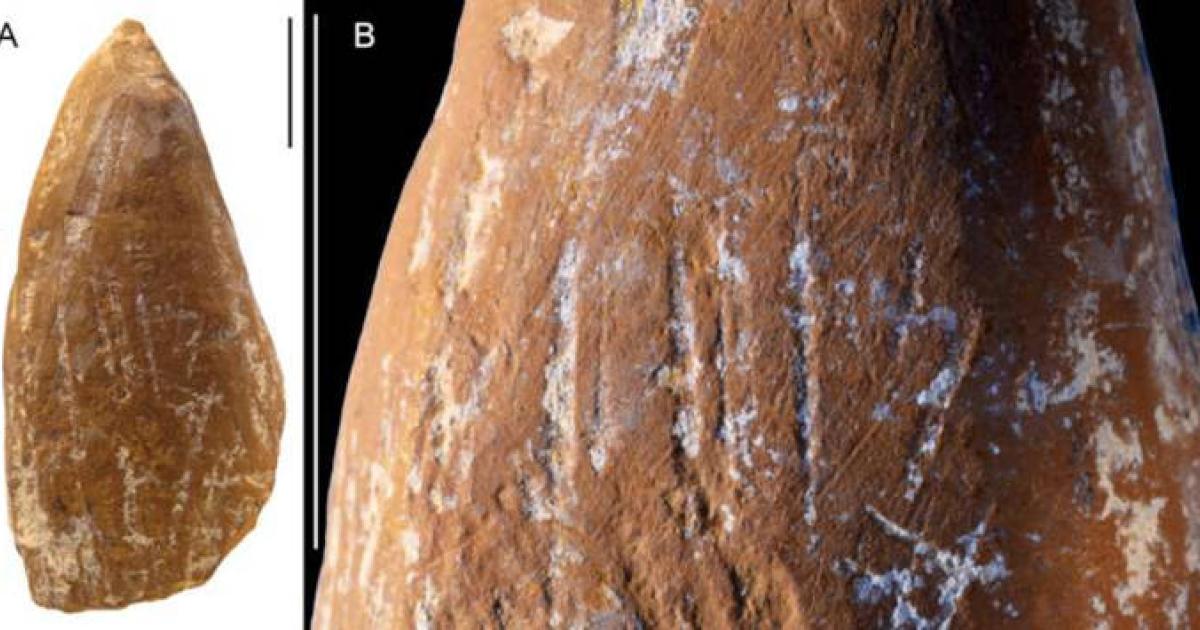
Among the most significant discoveries was a yellow ochre fragment from Zaskalnaya V, deliberately shaped into a pointed, crayon-like implement. The artifact shows evidence of a sophisticated production sequence that began with rough scraping, followed by fine grinding to refine the shape. Most remarkably, the tool displays signs of periodic maintenance through careful resharpening, indicating it was a valued implement used repeatedly over time.
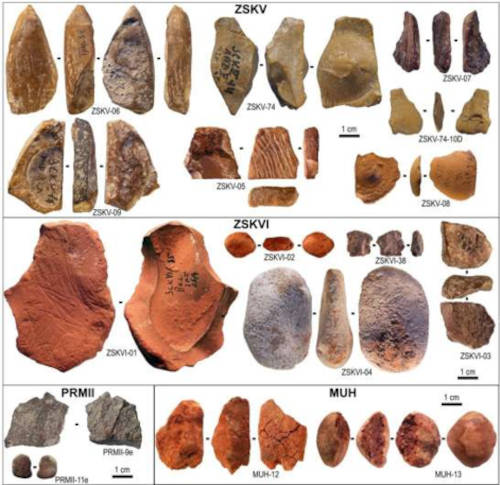
Archaeological ochre pieces recovered from Crimean Neanderthal sites showing various modifications. (d'Errico et al., Science Advances)
Another fragment appears to be the basal portion of a similar crayon whose pointed tip has broken off. After this breakage, the Neanderthals modified the fracture surface by incising a deep groove, likely to extract additional coloring powder. This adaptive reuse demonstrates resourcefulness and understanding of the material's properties.
A third extraordinary piece features a flat surface covered with deep, deliberately incised parallel lines. Microscopic analysis revealed that all the lines were created by moving the same tool consistently in one direction. The pattern suggests an organized design, with the maker taking care to avoid overlapping lines and maintain their parallel arrangement.
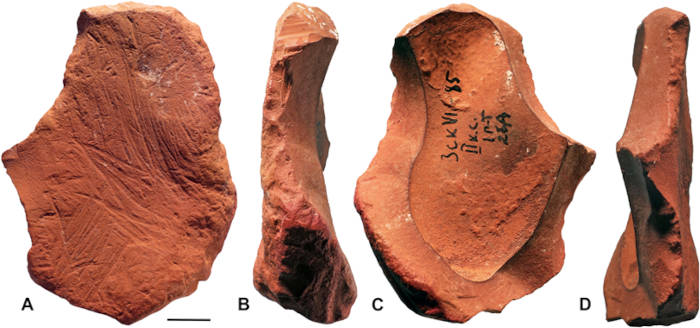
Four views of ochre fragment ZSKVI-01 displaying multiple modifications. (A) Outer friable surface exhibiting extensive scoring, pitting, and short randomly oriented striations on smoothed areas. (B) Right margin showing heavily worn microchipping. (C) Concave, harder, inner surface displaying on its right margin. (D) Fresh invasive flake scars. Scale bar, 1 cm. (d'Errico et al., Science Advances)
Symbolic Expression Challenges Neanderthal Stereotypes
The research team's findings demonstrate more than technical skill with pigments. As the researchers wrote:
"The deliberate shaping and reuse of crayons, the engraved motifs, and the evidence for curated tools collectively support the conclusion that at least some ochre materials were involved in symbolic activities."
Neanderthals selectively collected ochre from sources up to a mile (1.5 km) away, showing intentional procurement rather than opportunistic gathering.
The multiproxy analysis included examining the chemical composition and comparing pieces to natural geological sources. Researchers sampled an Oligocene clay formation approximately a mile (1.5 km) from the Zaskalnaya sites, confirming it as one source. Different ochre pieces received different treatments based on their physical properties - softer ochres were scraped and ground, while harder materials were flaked to create chips for pounding. This adaptive approach demonstrates cognitive capacity to assess materials and select appropriate processing techniques.
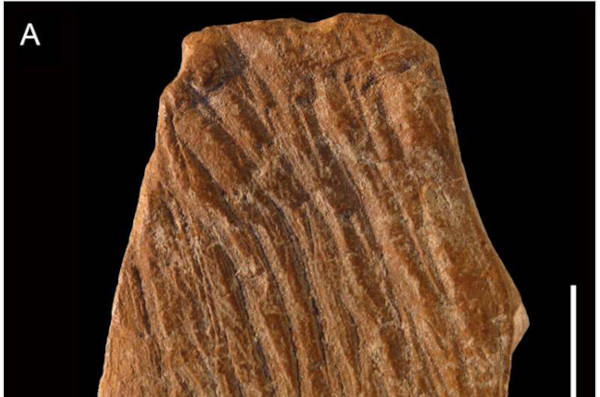
Ochre fragment ZSKV-05 showing deliberate parallel incisions created with a single tool.
(d'Errico et al., Science Advances)
Cultural Sophistication Spans Millennia
The temporal depth revealed by stratigraphic evidence is striking. The ochre-bearing layers span from approximately 100,000 to 33,000 years ago. While the archaeological record doesn't demonstrate continuous use throughout this span, the recurrence of modified ochre in multiple layers indicates that working with colored pigments held enduring cultural significance within the Micoquian Neanderthal tradition of Crimea.
This evidence adds to a growing body of research demonstrating that Neanderthals were far more cognitively sophisticated than long-believed stereotypes suggested. Previous discoveries include engraved bones and carefully crafted stone tools in the region, while finds elsewhere in Europe have revealed Neanderthal cave paintings, decorated shells, and possible burial practices. The Crimean ochre crayons provide another crucial data point in understanding when and how symbolic thought emerged in human evolution.
For much of the 20th century, symbolic behavior was considered a defining characteristic separating modern humans from other hominins. The accumulating evidence increasingly challenges this view, suggesting that symbolic cognition evolved in multiple hominin lineages. The Crimean crayons, with their deliberate shaping, repeated resharpening, and engraved surfaces, provide some of the clearest evidence yet for non-utilitarian, symbolic intentions among Neanderthals who lived tens of thousands of years ago.
Top image: Scraped and ground ochre crayon (ZSKV-06) showing deliberate modifications aligned with the object's main axis, partially obscured by oblique striations from grinding.
Source: d'Errico et al., Science Advances
By Gary Manners
References
d'Errico, F. et al. 2025. Evidence for symbolic use of ochre by Micoquian Neanderthals in Crimea. Science Advances. Available at: https://www.science.org/doi/10.1126/sciadv.adx4722
Phys.org. 2025. Ancient ochre crayons from Crimea reveal Neanderthals engaged in symbolic behaviors. Available at: https://phys.org/news/2025-10-ancient-ochre-crayons-crimea-reveal.html

![The Great Pyramid Of Giza Top image: The Great Pyramid of Giza under a starlit sky, highlighting the North Face. Source: [Pixabay/Creative Commons] Image](https://www.ancient-origins.net/sites/default/files/styles/article_featured_big/public/field/image/Great Pyramid Of Giza_0.jpg?itok=yavsyDqT)