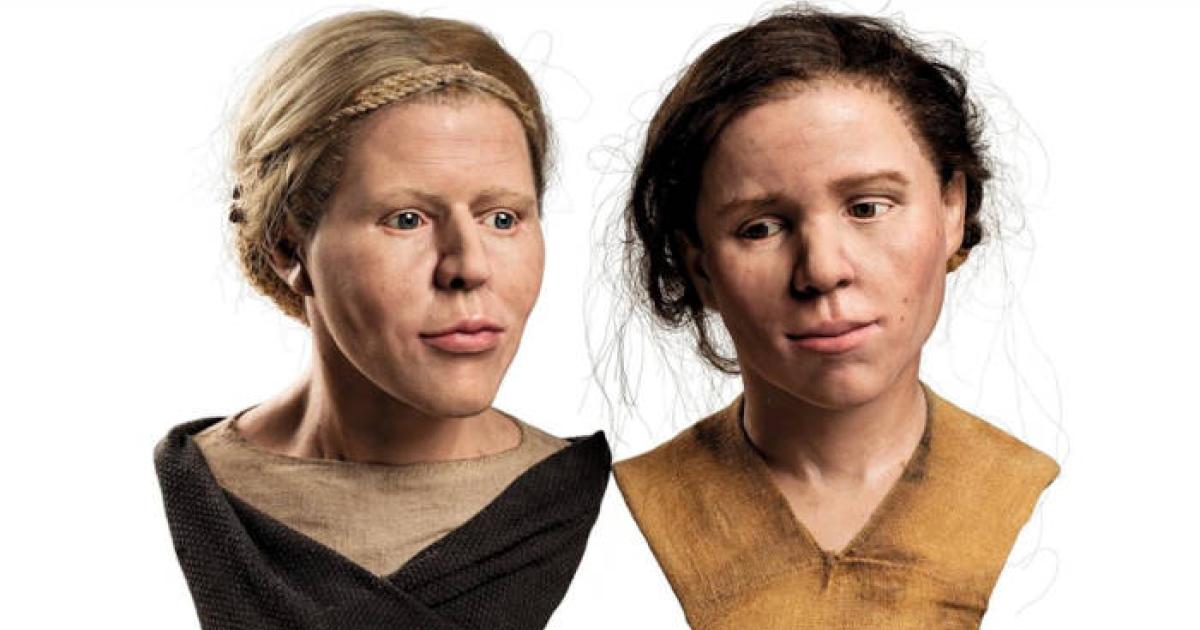

Revolutionary 3D facial reconstructions have brought to life two Neolithic sisters who endured brutal lives in a 6,000-year-old mining settlement in the Czech Republic. The hyper realistic recreations reveal not only their striking physical features but also provide compelling evidence of ancient social inequality and labor exploitation that may have targeted society's most vulnerable members.
The sisters were discovered over 15 years ago in the Krumlov Forest of South Moravia, buried within the very mining shaft where they likely spent their final days extracting chert (flint). Their remains tell a harrowing story of physical hardship, malnourishment, and possible ritual sacrifice that challenges our understanding of Neolithic society, finds the report published in Archaeological and Anthropological Sciences.
- Recreating the Face of a 4000-Year-Old Stone Age Woman
- Researchers Recreate Face of 5000-Year-Old Man from Chinese Neolithic Culture
Evidence of Brutal Lives and Social Exploitation
The forensic analysis reveals shocking details about the sisters' harsh existence, reports Archaeology Magazine. Both women, aged between 30-40 years and standing approximately 4 feet 9-10 inches (1.48 and 1.46 meters) tall, bore extensive evidence of heavy manual labor. Their bones showed worn vertebrae, early arthritis, herniated discs, and partially healed fractures - including a forearm break on the older sister that had mended while she continued working.
"The hardest labor may no longer have been done by the strongest, but by those who could most easily be forced to do it," the researchers concluded, suggesting that even in early agricultural societies, labor exploitation was distributed based on gender, age, or social status rather than physical capability. The sisters' burial within their workplace - an unprecedented discovery - indicates they may have been considered expendable members of society.
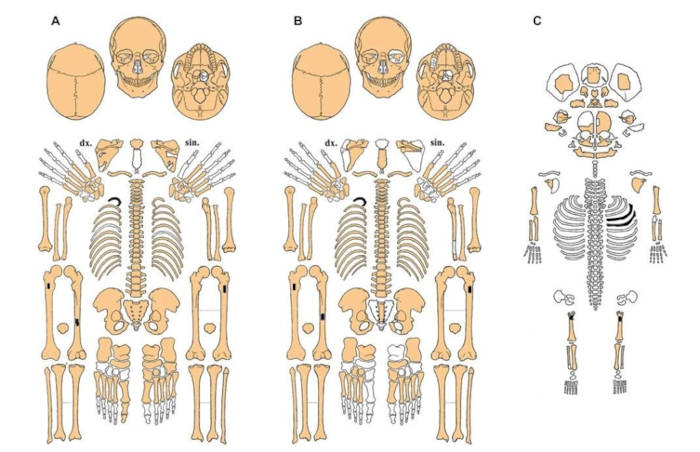
Skeletal preservation scheme showing the positions of the buried sisters (H1 and H2a) and infant (H2b) (E. Vaníčková, et al.)
Remarkable Preservation and Scientific Analysis
The exceptional preservation of the sisters' remains enabled researchers to conduct comprehensive DNA analysis, revealing fascinating details about their appearance and relationship. The younger sister likely had dark hair and green or hazel eyes, while her older sibling possessed blue eyes and blonde hair. Genetic testing confirmed their familial relationship and provided crucial data for the lifelike facial reconstructions now displayed at the Moravian Museum in Brno.
Despite their harsh living conditions during childhood - evidenced by signs of malnutrition and illness - isotopic analysis revealed that both women consumed a high-meat diet in adulthood. This unusual finding for European Neolithic populations may reflect better access to wild game in the densely forested region or represent a nutritional strategy to sustain their physically demanding labor.
- Neolithic Romeo and Juliet? The Star-Crossed Lovers of Valdaro
- Mistaken for Lovers, Roman-Era Grave Holds Mother and Daughter
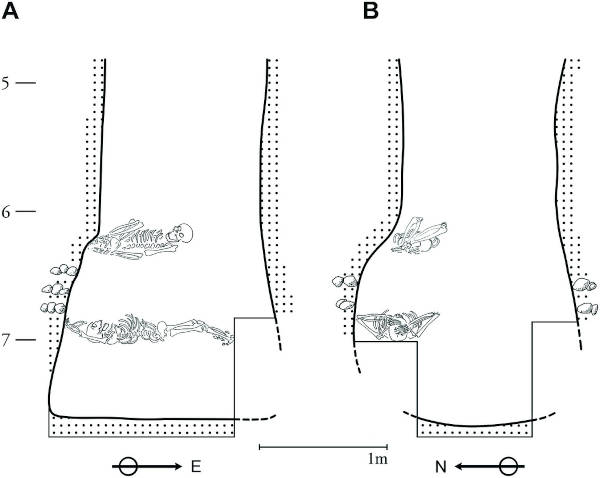
Test pit VI-9-1, shaft No. 4 with skeletons (H1 is the upper one and H2a and H2b are the lower ones), view East-West (A) and North-South (B); depth in meters on the left side. Drawing by L. Píchová according to the documentation of P. Kostrhun (Oliva/2010)
Mysterious Burial Circumstances
The burial circumstances raise intriguing questions about the sisters' final moments. The older woman was found embracing an unrelated newborn infant, while a partially complete dog skeleton lay nearby. The positioning suggests this may not have been a natural death but rather a ritual sacrifice or symbolic offering to appease earth spirits - a practice that would align with the spiritual significance mining shafts held for Neolithic peoples.
The absence of tooth staining, typically associated with the harsh conditions of ancient mining work, combined with the unrelated infant and ceremonial positioning, has led researchers to consider whether these women were victims of ritual practices rather than simple work-related deaths. The Krumlov Forest site, known as one of Europe's largest chert mining fields dating from the Mesolithic to the Iron Age, may have held deep spiritual significance requiring human offerings.
Revolutionary Reconstruction Techniques
The lifelike reconstructions utilize plaster, silicone, prosthetic eyes, and implanted hair to recreate the sisters' appearances. Incredibly, for 6,000 years ago, the clothing depicted in the reconstructions derives from authentic Neolithic textile finds, featuring plant fibers like flax and nettles. The older sister wears a simple blouse and plant-fiber wrap with a hairnet, while her younger sibling sports a linen blouse with braided fabric strips woven through her hair.
These reconstructions provide an unprecedented glimpse into the faces of Neolithic society's forgotten victims, transforming anonymous skeletal remains into compelling human stories. The project demonstrates how advanced scientific techniques can illuminate the harsh realities of ancient life, revealing social inequalities that echo through millennia of human civilization.
Top image: Anthropological reconstruction of the two Neolithic sisters discovered in a mining shaft in the Czech Republic's Krumlov Forest, showing their lifelike faces brought back through advanced forensic techniques. Source: E. Vaníčková, et al., Archaeological and Anthropological Sciences
References
Vaníčková, E., Vymazalová, K., Vargová, L. et al. 2025. Ritual Burials in a Prehistoric Mining Shaft in the Krumlov Forest (Czechia). Available at: https://link.springer.com/article/10.1007/s12520-025-02251-1
By Gary Manners