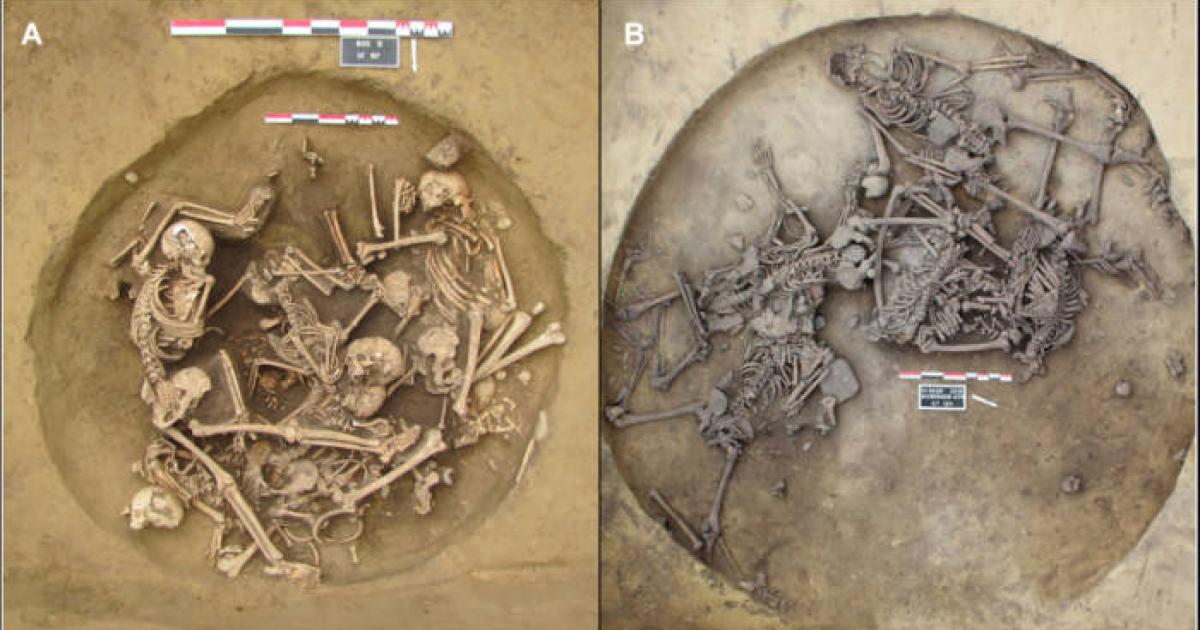

French archaeologists have uncovered horrifying evidence of Stone Age brutality in northeastern France, where 82 tortured and mutilated skeletons reveal one of the earliest documented examples of victory celebrations following prehistoric warfare. The gruesome discovery, dating between 4300 and 4150 BC, shows that captured enemies were systematically tortured, their left arms severed as trophies, and their bodies displayed as warnings before being buried in mass pits.
The chilling findings, published in Science Advances, provide unprecedented insight into the violent nature of Neolithic warfare and the ritualized brutality that followed military victories. Researchers believe the victims were invaders from the Paris region who were captured during raids into northeastern France, then subjected to prolonged torture as part of community-wide celebrations of triumph.
"We believe they were brutalized in the context of rituals of triumph or celebrations of victory that followed one or several battles," explained Dr. Teresa Fernández-Crespo, an osteoarchaeologist at Valladolid University in Spain who led the analysis. The evidence suggests these were not quick battlefield deaths, but deliberate acts of prolonged violence designed to dehumanize captives before the entire community.
- Debate continues over whether Stone Age people were peaceful or warlike
- Scant Evidence that Early Prehistoric People were Warlike
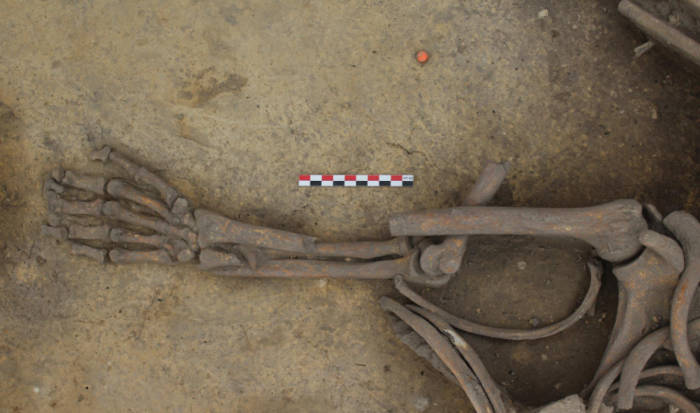
An upper limb shows multiple fractures in the arm and forearm at the Achenheim site. (© Philippe Lefranc/Inrap)
Systematic Torture and Mutilation
The skeletal remains, discovered at two sites in Achenheim and Bergheim in northeastern France, reveal a horrifying pattern of systematic violence. Victims had their lower limbs deliberately fractured to prevent escape, while their bodies showed extensive blunt force trauma consistent with prolonged beatings. Most shocking were the numerous severed left arms and hands, which researchers believe were removed as war trophies.
"The severed upper limbs would represent war trophies removed at the battle site following the violent encounter and then taken back to the settlement for perhaps further transformation and display," the research team wrote in their study.
Piercing holes found in some bones suggest that bodies were mounted on structures for public exhibition, serving as gruesome warnings to other potential enemies.
Chemical analysis of teeth and bones revealed that the mutilated victims came from outside the local area, with dietary signatures suggesting they originated from around Paris. This supports archaeological evidence showing increased pottery from the Paris region appearing in northeastern France during this period, indicating ongoing territorial conflicts between expanding populations.
- Shocking Cycle of Violence and Cannibalism Revealed in Bronze Age Site
- Was Humanity More Advanced in Prehistoric Times Than We Think?
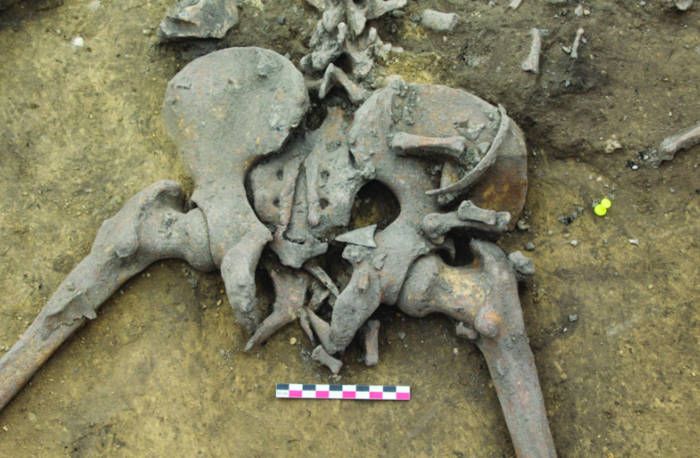
Arrowhead found in the pelvic region of an adult male present in the grave. (© Philippe Lefranc/Inrap)
Europe's Age of Violence
The discovery occurs within a broader context of widespread prehistoric violence across Europe between 4500 and 4000 BC. Professor Detlef Gronenborn from Germany's Leibniz Center for Archaeology, who was not involved in the research, explained that this period represented "a time of considerable unrest Europe-wide and is linked to a period of high climate volatility, a continent-wide crisis period."
This climatic instability triggered massive population movements, with groups from southern France pushing northward and bringing warfare in their wake. Archaeological evidence shows breaks in site occupation patterns, suggesting "sudden high mobility due to a general increase in warfare" throughout the region.
The French sites reveal an unprecedented level of violence that goes far beyond typical Neolithic conflicts. "Injuries provoked in Neolithic battles usually targeted the head and very less often other body parts," noted Dr. Fernández-Crespo. However, these discoveries show "an unprecedented intensity of violence to the body that can only be understood in a context of torture, mutilation and dehumanization of the victim."
Public Theater of Violence
What makes these findings particularly disturbing is their public nature. The burial pits were located in the middle of settlements, suggesting that the torture and mutilation were performed as community spectacles. "This firmly suggests that the act would have been a public theater of violence intended to dehumanize the captive enemies in front of the entire community," researchers concluded.
The systematic nature of the violence suggests these were not random acts of rage but carefully orchestrated rituals designed to demonstrate power and intimidate future enemies. The removal of left arms as specific trophies indicates established protocols for processing captives, while the public display of tortured bodies served both as celebration and deterrent.
Interestingly, not all skeletons in the pits showed signs of mutilation. These unmutilated remains had different chemical signatures indicating local origin, suggesting they may have been defenders who died protecting their territory during the initial conflicts. The distinction between mutilated foreigners and unmutilated locals provides clear evidence of how victors and victims were treated differently in these ancient conflicts.
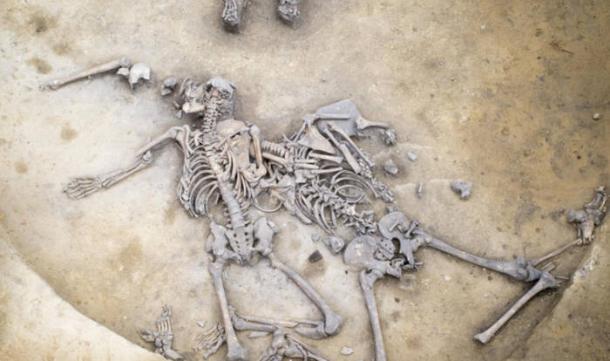
The men discovered in the grave had numerous fractures (limbs, skulls, pelvises, etc.) and were lying on their backs or stomachs. (© Michel Christen/Inrap)
Rewriting Neolithic History
This discovery fundamentally challenges romanticized views of peaceful Stone Age societies. Dr. Linda Fibiger from the University of Edinburgh, who was not involved in the research, called it "an exciting, well executed and carefully interpreted find that gives important insights into the varied practice of violence in the Neolithic."
The chemical analysis techniques used in the study represent a breakthrough in prehistoric archaeology. As Dr. Miguel Ángel Moreno-Ibáñez from Edinburgh University noted, the research has "made it possible to achieve something as important as distinguishing between captives and attackers in prehistoric contexts of interpersonal violence as far back as the Neolithic."
These gruesome victory celebrations may have served as acts of revenge, the researchers suggested, representing an escalation in the cycle of violence that characterized this turbulent period. The findings demonstrate that organized warfare, systematic torture, and ritualized violence were already established practices over 6,000 years ago, revealing darker aspects of human nature that have persisted throughout history.
Top image: Overhead views of Stone Age pits filled with human skeletons excavated in France, showing evidence of systematic violence and trophy-taking 6,300 years ago. Source: left; Fanny Chenal and Right; Philippe Lefranc/INRAP/Science Advances
By Gary Manners
References
Fernández-Crespo, T. et al. 2025. Multi-isotope biographies and identities of victims of martial victory celebrations in Neolithic Europe. Available at: https://www.science.org/doi/10.1126/sciadv.adv3162
Jarus, O. 2025. 6,300 years ago, dozens of people were murdered in grisly victory celebrations in France. Available at: https://www.livescience.com/archaeology/6-300-years-ago-dozens-of-people-were-murdered-in-grisly-victory-celebrations-in-france
Various Authors. 2025. Gruesome pit of tortured warriors is uncovered in France after being laid undiscovered for 6,000 years. Available at: https://www.dailymail.co.uk/sciencetech/article-15022269/pit-warriors-uncovered-France-6-000-years.html