
An archaeological discovery in war-torn Ukraine is making history—literally. It is pushing back the date when humans first started using a highly valued material by nearly 300,000 years, once again showing that human ingenuity is not bounded by time.
For millions of years, early humans shaped and carved bones into tools. When it comes to ivory, the material has long been associated with symbolic artifacts and tools in the archaeological record as well. Until recently, however, the oldest known ivory modification was thought to date back approximately 120,000 years. However, a groundbreaking study by Dr. Vadim Stepanchuk and Dr. Oleksandr O. Naumenko, published in the International Journal of Osteoarchaeology, has significantly extended that timeline. Their analysis of artifacts from the Lower Paleolithic site of Medzhibozh A in Ukraine reveals the first use of ivory as early as 400,000 years ago, radically overturning previous ideas.
- Hunters Melted and Sculpted Ivory 12,000 Years Ago
- Archaeologists unearth 6,000-Year-Old Temple in Ukraine
Into the Deepest History of European Ivory Use
Medzhibozh A, one of several Paleolithic sites found along the Southern Bug River near Medzhybizh, Ukraine, was first uncovered in 2011. The location was studied intermittently up through 2018 and offers a window into hominin occupation spanning many thousands of years.
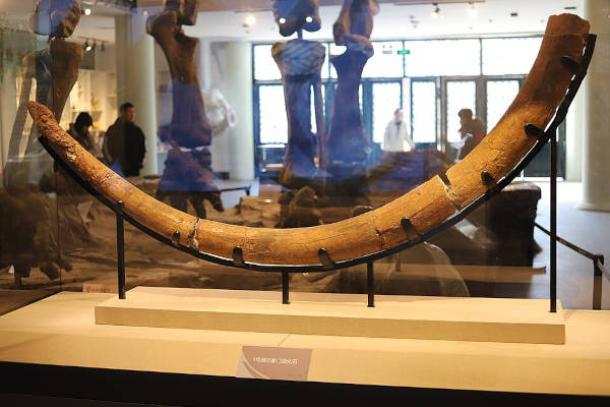
Weifang ivory mammoth tusk, kept in museum in China. (Baomi/CC BY-SA 4.0).
Archaeologists recovered 24 fragments of ivory from several stratigraphic layers. These fragments were found in upper layers and were dated to around 400,000 years ago, using electron spin resonance (ESR), as well as geological and faunal analyses. Initially, these pieces were cataloged among general faunal remains. But during laboratory analysis, their unusual features caught researchers’ attention.
"The ivory fragments were identified during laboratory analysis of ordinary faunal remains recovered from the upper layers of the Medzhibozh A site,” Dr. Stepanchuk said in an interview published by Phys.org. “This is a Lower Paleolithic site that yielded relatively modest faunal remains and a number of lithic artifacts. Some bones show cutmarks. The study of the ivory began without a specific hypothesis, but their unusual characteristics, indicative of intentional modification, prompted closer examination."
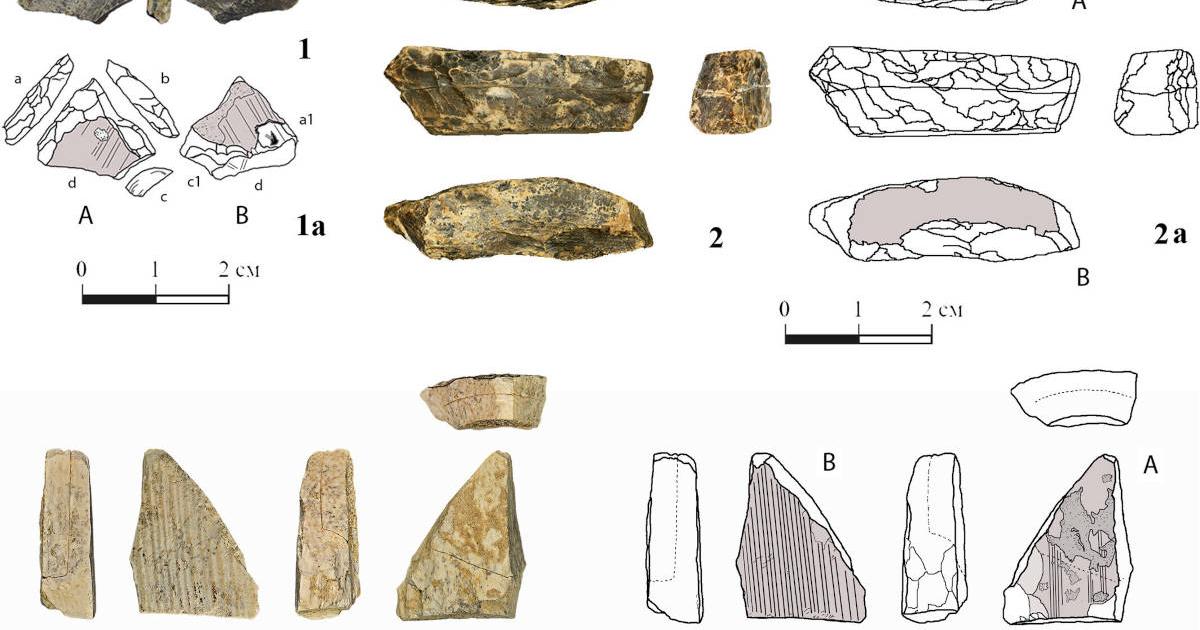
The detailed study revealed that 11 of the ivory pieces bore evidence of deliberate shaping. Six fragments had been knapped, three were altered using a bipolar-on-anvil technique, two were identified as flakes, one was shaped into a point, and another functioned as a core. The point and core were especially significant as they showed unmistakable signs of human modification.
These findings are remarkable not only for their age but for the use of ivory itself—an unusual and relatively fragile material for tool production.
- 40,000-BC Ivory Pendant is the Oldest Eurasian Jewelry, Says Study
- Triumph, Rebellion And The Ancient History Of Ukraine
"The miniature ivory pieces from Medzhibozh A are rare even in Upper Paleolithic contexts and perform poorly compared to stone tools of similar size due to their low hardness and fragility,” Dr Stepanchuk noted. “Small ivory tools are far less efficient than stone tools of similar size. The Mohs hardness of dentin and cement layers is only 2 and 3–4, respectively, compared to 4–5 for siliceous limestone and 7–8 for flint and quartz. This raises doubts about their practical purpose."
More Than Function: Experimental Tools or Childhood Playthings?
While ivory from mammoths may not have been the most effective raw material for functional tools, the evidence indicates that it was intentionally shaped. The Medzhibozh A artifacts now represent the earliest clear use of ivory in toolmaking, predating previous finds by approxiately 280,000 years.
Before this discovery, the earliest widespread ivory use had been linked to the Upper Paleolithic, when ivory was fashioned into tools, figurines, and ornaments. Yet Stepanchuk and Naumenko highlight that occasional uses of ivory appeared even earlier.
"Ivory begins to be widely and diversely used starting in the Upper Paleolithic—primarily for tools and ornaments—from around 40,000 years ago onward. However, there are scattered indications that ivory may have attracted human attention much earlier," Dr. Stepanchuk explained. "In some Neanderthal contexts dated to around 120,000 years ago, there are occasional finds suggesting use or modification. For example, at the Neanderthal site of Zaskalnaya V (Crimea), we documented a pointed fragment made from mammoth ivory."

Woolly mammoth specimens trodding across an ancient European landscape. (Mauricio Anton/CC BY-SA 2.5).
The Ukrainian research team theorizes that the ivory tools may have been created because of a lack of quality stone material in the area, prompting experimentation with alternative resources. This idea is supported by the fact that the ivory pieces were processed with techniques similar to those used on local stone tools, including edge trimming, flake removal, rotation, and bipolar-on-anvil knapping.
An alternative hypothesis delves into the social dimension of these tools. Stepanchuk and Naumenko propose that some of the ivory artifacts might not have been intended for practical uses, but could reflect aspects of early social learning.
"We suggest they may represent imitative behavior, possibly by children, mimicking adult knapping as part of early social learning. The goal, in this case, was not a functional tool, but rather a 'pretend' tool—possibly a play object or training piece," Dr. Stepanchuk stated.
Although the authors acknowledge the possibility that the artifact-bearing layer might have been misdated or that the features seen on the ivory fragments could be natural in origin, they consider these scenarios unlikely. The technological complexity and clear signs of modification make it difficult to attribute the artifacts to natural processes, and the dating procedures used to evaluate their age were sound.
If confirmed, these discoveries challenge long-standing assumptions about the cognitive and cultural capabilities of early hominins. The ivory tools of Medzhibozh A not only extend the timeline of ivory use but also suggest a previously unrecognized level of innovation and social behavior occurring nearly half a million years ago, before modern humans (Homo sapiens) had even evolved.
Top image: Photographs and drawings of ivory mammoth pieces shaped to a point.
Source: Stepanchuk, et.al/International Journal of Osteoarchaeology.
By Nathan Falde