
Why Did This Type of Stone Tool Endure for 300,000 Years in Kenya?
Archaeological research from Kenya's Turkana Basin has uncovered evidence that early humans maintained a sophisticated stone toolmaking tradition for nearly 300,000 years while navigating one of Earth's most unstable environmental periods. The discovery reveals artifacts spanning from 2.75 to 2.44 million years ago at the Namorotukunan site, offering unprecedented insights into humanity's earliest technological innovation.
The findings challenge previous assumptions about early human capabilities. Rather than abandoning their craft during severe droughts, wildfires, and dramatic vegetation shifts, these ancient toolmakers refined and transmitted their knowledge across countless generations, creating what researchers describe as the first multi-purpose "Swiss Army knives" of the prehistoric world.
- Tools Found in Algeria Provide Evidence Human Origins Were Spread Throughout Africa
- Results of Kenyan Dig Suggest Africa's First Toolmakers Were Not Humans
Mastering Technology Across Millennia
The international research team, led by Professor David R. Braun from George Washington University and the Max Planck Institute, excavated three distinct archaeological horizons yielding 1,290 stone artifacts. These tools belong to the Oldowan tradition, the earliest known systematic production of sharp-edged implements in the hominin behavioral record.
"This site reveals an extraordinary story of cultural continuity," Braun explained in a George Washington University release.
"What we're seeing isn't a one-off innovation - it's a long-standing technological tradition."
The artifacts show that early hominins had developed an acute understanding of rock mechanics, preferentially selecting fine-grained materials like chalcedony and jasper that produce predictable fracture patterns and sharp cutting edges.
Analysis of flaking angles and striking platforms reveals that toolmakers understood fundamental principles of fracture mechanics. Sharp-edged flakes and fragments comprised between 79.4 and 94.2 percent of the assemblages, indicating that producing cutting edges was the primary technological focus.
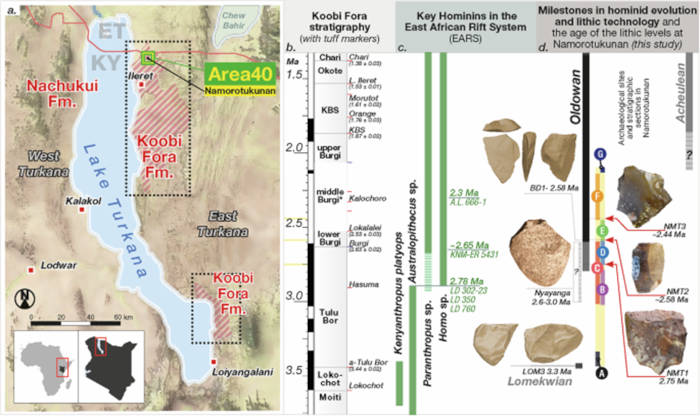
Infographic of the study, showing map of the Lake Turkana and where the tools were found, hominins in the area and development of stone tools over time. (Braun et al. 2025/Nature)
Thriving Through Environmental Upheaval
The discoveries are particularly remarkable because they coincide with extreme climate instability. Using volcanic ash dating, paleomagnetic analysis, and microscopic plant fossil identification, researchers reconstructed an environmental timeline connecting early toolmaking to major climatic transformations between 2.75 and 2.2 million years ago.
Before 2.75 million years ago, the Namorotukunan area featured lush wetlands with abundant palms and sedges, with mean annual precipitation reaching approximately 855 millimeters per year. However, around 2.8 to 2.7 million years ago, the environment shifted dramatically as the paleo-lake shoreline retreated due to increasing aridity.
"The plant fossil record tells an incredible story: The landscape shifted from lush wetlands to dry, fire-swept grasslands and semideserts," said Rahab N. Kinyanjui at the National Museums of Kenya and Max Planck Institute, according to Phys.org. "As vegetation shifted, the toolmaking remained steady. This is resilience." Mean annual precipitation plummeted to under 300 millimeters per year, while evidence of landscape-scale wildfires increased significantly.
- Climate Changes Linked to Ancient Human Innovations
- Early Humans Evolved in Ecosystems Unlike Any Found Today
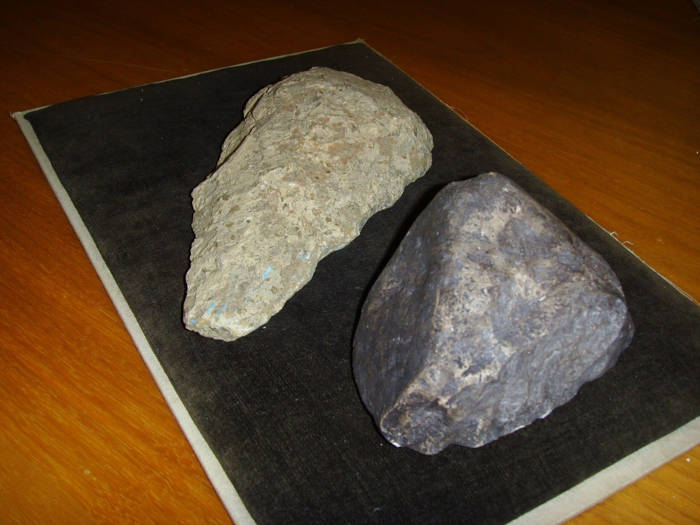
Oldowan-style stone tool replica from Dmanisi, Georgia. (Gerbil/CC BY-SA 3.0)
Dietary Innovation and Survival
The enduring nature of stone tool technology suggests these implements provided critical survival advantages during environmental stress. Butchery marks identified on bone specimens within the 2.58 million-year-old assemblage demonstrate that hominins used sharp-edged tools to extract meat from large mammalian carcasses, significantly broadening their dietary options.
"At Namorotukunan, cutmarks link stone tools to meat eating, revealing a broadened diet that endured across changing landscapes," noted Frances Forrest at Fairfield University. This dietary flexibility likely transformed environmental challenges into evolutionary opportunities, allowing toolmaking populations to access high-quality protein sources.
According to Susana Carvalho, director of science at Gorongosa National Park and senior author of the study published in Nature Communications, "Our findings suggest that tool use may have been a more generalized adaptation among our primate ancestors."
Dan V. Palcu, corresponding author and senior scientist at GeoEcoMar and Utrecht University, reflected: "Namorotukunan offers a rare lens on a changing world long gone—rivers on the move, fires tearing through, aridity closing in - and the tools, unwavering. For approximately 300,000 years, the same craft endures - perhaps revealing the roots of one of our oldest habits: using technology to steady ourselves against change."
The research demonstrates that by 2.75 million years ago, hominins had already mastered sharp stone tool production, suggesting Oldowan technology origins may be even older. The consistent technological approaches across hundreds of thousands of years indicate that knowledge was successfully transmitted across countless generations, forming an enduring legacy that laid the foundation for all subsequent human technological development.
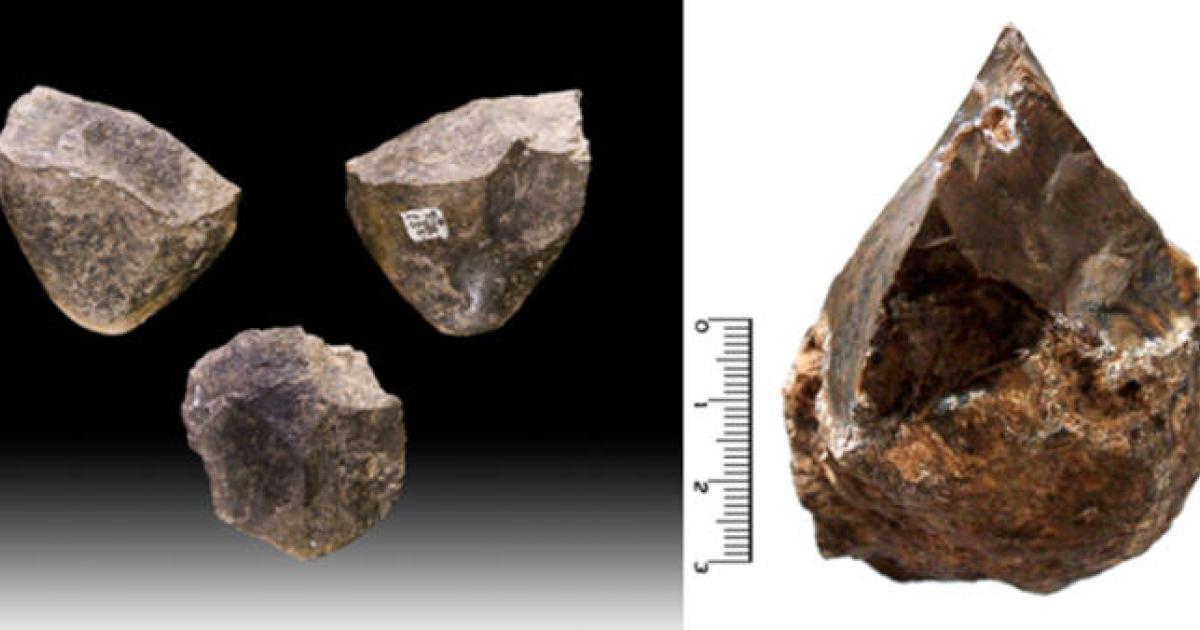
Top image: Oldowan tradition stone tool choppers showing the characteristic sharp flaked edge. Source: Left; Didier Descouens/CC BY-SA 4.0, Right; Jos-Manuel Benito Álvarez/CC BY-SA 3.0
By Gary Manners
References
Braun, D.R., et al. 2025. Early Oldowan technology thrived during Pliocene environmental change in the Turkana Basin, Kenya. Available at: https://www.nature.com/articles/s41467-025-64244-x
George Washington University. 2025. 2.7-million-year-old tools reveal humanity's first great innovation. Available at: https://www.sciencedaily.com/releases/2025/11/251104094133.htm
Phys.org. 2025. 2.75-million-year-old stone tools may mark a turning point in human evolution. Available at: https://phys.org/news/2025-11-million-year-stone-tools-human.html

![The Great Pyramid Of Giza Top image: The Great Pyramid of Giza under a starlit sky, highlighting the North Face. Source: [Pixabay/Creative Commons] Image](https://www.ancient-origins.net/sites/default/files/styles/article_featured_big/public/field/image/Great Pyramid Of Giza_0.jpg?itok=yavsyDqT)