

Halloween, or the ancient Samhain, is considered the time of year when the veil between our world and the spirit world is at its thinnest. As darkness falls and families light their pumpkin Jack-o'-lanterns, they are, perhaps unknowingly, repeating the ancient traditions of honoring the dead and marking the beginning of the ‘dark half’ of the year.
Halloween Origins: Celtic Harvest Festivals
Halloween is an annual celebration held largely in the western world on October 31st. Starting in the evening, children, and sometimes adults, dress in masks and costumes, traditionally as ghostly figures, witches, or the undead – vampires, zombies, skeletons. They go knocking door-to-door, requesting treats, or else threatening a mischievous trick upon the household. Typical activities of the modern observance can include costume parties, pumpkin carving, trick-or-treating, lighting bonfires, playing pranks, and more.
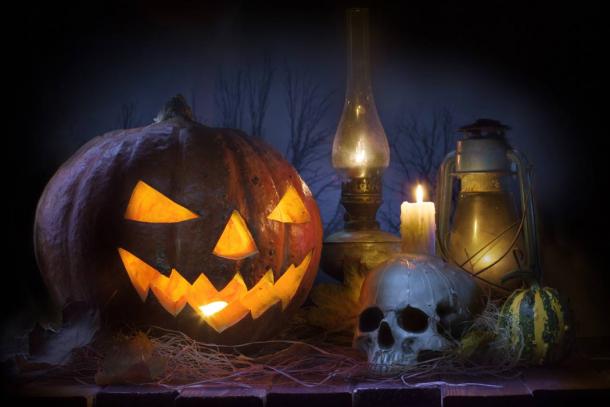
Popular Halloween symbols have pre-Christian origins. (bioraven /Adobe Stock)
Hallowe’en, a shortened form of "All Hallows' Evening" is an echo of Celtic harvest festivals of pre-Christian Europe. Observed now in several countries around the world, it is the evening before ‘All Hallows Day’, when saints (hallows) and martyrs are remembered by people of many Christian denominations. This ritual, however, coincides with (and some scholars suggest co-opted) the ancient observance of Samhain.
What were Pagan Rituals on Samhain?
Samhain (pronounced sah-van or sow-in) is the traditional Gaelic festival marking the change of seasons and the approach of winter. There are many important events that begin or happen around the time of Samhain in Irish myth. For example, people would bring their cattle back from the summer pastures and slaughter livestock in preparation for the upcoming winter. They would also light ritual bonfires for protection and cleansing as they wished to mimic the sun and hold back the darkness. It was also a time when people believed that spirits or fairies (the Aos Sí ) were more likely to pass into our world.
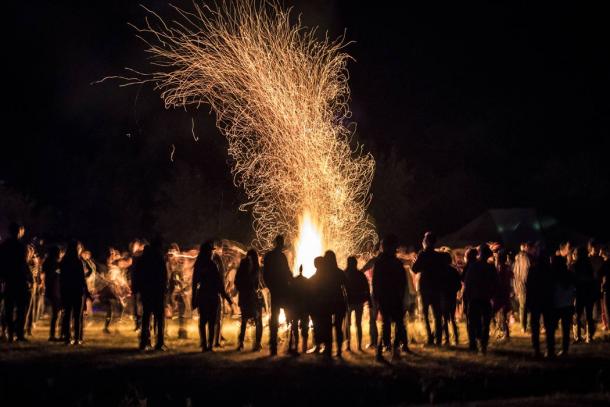
A bonfire is an ancient tradition at Samhain. (Cheryl /Adobe Stock)
Dead and departed relatives played a central role in the tradition, as the connection between the living and dead was believed to be stronger at Samhain, and there was a chance to communicate. Souls of the deceased were thought to return to their homes. Feasts were held and places were set at tables as a way to welcome them home. Food and drink was offered to the unpredictable spirits and fairies to ensure continued health and good fortune.
- Halloween CAN Go on With These Fun Ancient Traditions
- Tricking and Treating Has a Long History
- Ex-Devil Worshipper Says: I'm Shocked Christians Celebrate Halloween
Transforming Samhain
The idea that souls return home on a certain day of the year is repeated across many cultures around the world. Día de Muertos, or the Day of the Dead, is a similar holiday held around the same time of year in Mexico celebrating and honoring family members who have died.
Samhain saw a metamorphosis due to the early Church. In The History of Halloween or Samhain, Jack Santino writes:
“As a result of their efforts to wipe out ‘pagan’ holidays, such as Samhain, the Christians succeeded in effecting major transformations in it. In 601 A.D. Pope Gregory the First issued a now famous edict to his missionaries concerning the native beliefs and customs of the peoples he hoped to convert. Rather than try to obliterate native peoples' customs and beliefs, the pope instructed his missionaries to use them: if a group of people worshipped a tree, rather than cut it down, he advised them to consecrate it to Christ and allow its continued worship.”
In the 12th century, obligatory holy days across Europe involved town criers dressed all in black, ringing mournful bells and calling on Christians to remember the poor souls of the dead. Special ‘soul cakes’ would be baked and shared. This custom of “souling” was present in England, Germany, Belgium, Austria, and Italy, and this is thought to be the precursor of trick-or-treating.
Eventually, mumming and guising (going door-to-door in disguise and performing in exchange for food) was taken up as another variation on these ancient customs. Pranks were thought to be a way of confounding evil spirits. Pranks at Samhain date as far back as 1736 in Scotland and Ireland, and this led to Samhain being dubbed “Mischief Night”.

Painting of a Halloween party in Ireland, 1832. By Daniel Maclise. (Public Domain)
Controversy Surrounding Modern Halloween Practices
Many of the modern practices for Halloween date to 19th century England and North America. Fortune telling and divination have traditionally played a part in celebrations. Games were played with the intention to divine one’s future. Nuts and fruit featured in eating and drinking games, and soul cakes were prepared.
Around Halloween, pumpkins are hollowed out, and spooky faces are carved into them, creating Jack-o'-lanterns. Candles are then lit inside the pumpkins, creating eerie lanterns, and serving as signals that a household observes Halloween. Pumpkins are frequently used today as they’re easier to carve and a symbol of harvest, but the original lanterns in Ireland and Scotland were carved from turnips. These turnip lanterns were used to frighten off evil spirits by guisers, and were a motif of the Irish Christian folk tale of Jack, a wandering soul who was denied entry into both heaven and hell.

A traditional Irish turnip Jack-o'-lantern from the early 20th century. (Rannṗáirtí anaiṫni/CC BY SA 3.0)
Observing Halloween is not without controversy. Some religions discourage participation, suggesting that it trivializes Samhain, it has satanic associations, or it is an inappropriate tribute to paganism or the occult. However, the modern practices heavily influenced by commercialization and popular culture differ appreciably from the ancient traditions of Samhain and All Hallows’ Eve.
Still, the connection exists and the history is clear - when you light a Jack-o'-lantern and brighten the darkening season, you’re carrying on an age-old tradition that bridges cultures around the world and reaffirms our connection to our departed loved ones.
Top Image: Halloween has origins in Samhain, a time when the veil between the living and dead is thinnest. Source: fergregory /Adobe Stock
By Liz Leafloor
Updated on October 28, 2020.
References
Halloween Express (2015) ‘The History of Halloween.’ Halloween Express. Available at: https://www.halloweenexpress.com/blog/the-history-of-halloween/
Hansen, R. (2017) ‘Tricking and treating has a history.’ The Conversation. Available at: https://theconversation.com/tricking-and-treating-has-a-history-85720
Newgrange.com (n.d.) ‘Samhain (Samain) - The Celtic roots of Halloween.’ Newgrange.com. Available at: https://www.newgrange.com/samhain.htm
Ramirez, J. (2018) ‘Ex-Devil Worshipper Says: I'm Shocked Christians Celebrate Halloween.’ Ancient Origins. Available at: /history-ancient-traditions/halloween-0010877
Santino, J. (1982) ‘Halloween: The Fantasy and Folklore of All Hallows.’ The American Folklife Center. Available at: https://www.loc.gov/folklife/halloween-santino.html







If you REALLY want to get
Permalink
If you REALLY want to get deep on this information:
"The Babylonian Connection to Halloween"
http://mystery-babylon.org/halloween.html
and
ALL of the occult holidays and sabbats- many we know by other names (like Valentine's Day, Independence Day, Christmas, etc..)
http://www.bibliotecapleyades.net/cienciareal/cienciareal20.htm
Cheers,
Shell
More nonsense
Permalink
In reply to If you REALLY want to get by Shell (not verified)
What is it with the people posting nonsense in response to this article? That page you linked to has "insights" such as: "Deception is the stock and trade of Satan and his demonic forces. They have, over a period of time, lulled this world to sleep, thus setting it up for the ultimate deception – the Antichrist."
If it is 'nonsense' to you,
Permalink
In reply to More nonsense by Sako (not verified)
If it is 'nonsense' to you, that says more about you, friend than the material. Beware of illusions and deceptions.
Halloween
Permalink
In reply to If you REALLY want to get by Shell (not verified)
I'm not sure why you are suggesting middle Eastern or Satanic links - Samhain had/nothing to do with either. It was a time of linkage to the dead. Funeral rites were often delayed until Samhain so the dead could properly be sent on their way. vistations by the dead were seen as warnings like those of na bhean sidhe. The nasty evil scary image of today is a modern twisting of an ancient festival seen as a most important timeof the year, signalling the start of winter - the first Official fire of the winter was lit and spread to the country form Teamhair na Rí, SO please don't mock people's customs by claiming they are associated with something they are not.
Halloween controversy
Permalink
Another, more recent controversy regarding the celebration of Halloween comes from the political Left in the U.S., which views Halloween, erroneously, as a Christian celebration, and therefore it must be purged from public life in the name of "diversity"