
May 24, 1218, saw from the battered yet still crusader-held port of Acre a group of European knights, clergy, and soldiers set out on a daring and untried mission—not to Jerusalem, but to Egypt. It was the start of the Fifth Crusade's most reckless phase: the siege of Damietta.
They followed an extreme strategy: in contrast to the previous crusades that made a direct attack on the Holy City, the crusaders of the Fifth Crusade, with papal backing, thought that the capture of Egypt would weaken Muslim power and prompt the fall of Jerusalem without actually attacking it, explains Jonathan Riley Smith in his seminal work, The Crusades: A History.
All Eyes on Damietta: The Initial Exchanges
Egypt was the pulsating center of the Ayyubid Sultanate. It was now the hub of Muslim power within the lands following the passing of the great Saladin, and its dominance of the Levant was the backbone of Muslim resistance. To move south, rather than east, was geopolitical sense.
The Crusaders assumed that if they could cut off this artery, the limbs of Islamic domination of Palestine and Syria would be weakened. In addition, Damietta, situated on the Nile Delta, was not only a strategic port but also a prosperous trade center. Its loss would not only be a military defeat but an economic one as well.
- Understanding the Crusades from an Islamic Perspective
- Crusaders Grave Shows Many Were Killed From Behind
The army which sailed from Acre was a potpourri of European contingents: Germans, Italians, Franks, and a significant number of Dutch and Frisian volunteers. The campaign was blessed by Pope Innocent III and, after his death in 1216, was taken up by Pope Honorius III. At its head were leaders like King John of Brienne (titular King of Jerusalem), and the papal legate Cardinal Pelagius, who soon emerged as a powerful—and contentious—force in the crusading establishment.
Their destination was Damietta, a city well-defended by river chains, towers, and the Nile's natural moat.
The Siege of Damietta: Triumph, Arrogance, and the Fall of a Dream

Map in Arabic depicting the attempted siege of Damietta by the European forces. (محک/ CC BY-SA 4.0)
The Crusaders came before Damietta in early summer 1218 and were presented with strong defenses at once. The Nile's mouth was defended by a giant tower constructed on a small island within the river, linked to the city by a great chain that prevented ships from moving upriver. The fortress, or Tower of the Chain, was all but impregnable to traditional attack.
To overcome it, the Crusaders used extraordinary resourcefulness: under the German cleric Oliver of Paderborn's supervision, they constructed a gigantic two-story siege tower atop two tied-together ships that enabled them to break into the island fortress from the river itself. It was finally captured in August 1218, after months of unsuccessful attempts.
Damietta Fights Back: Nature and Other Elements
But progress was bogged down after the initial success. The city of Damietta itself resisted for over a year. In the course of the long siege, the Crusader camp experienced heavy rains, flooding, and disease. Thousands succumbed to dysentery and fever.
Sanitation in the camp declined quickly, morale fell, and internal conflicts among secular and ecclesiastical leaders increased. Cardinal Pelagius, while revered as a religious leader, had little insight into military logistics. His adamant refusal to take counsel from experienced commanders such as John of Brienne caused expensive delays and lost chances.

Illustration: a Christian and Muslim soldier fight one another. (Getty/CC BY-SA 4.0)
In spite of all these mishaps, Damietta fell on November 5, 1219. The defenders, who were starving and plagued, were no longer able to keep the city. The Crusaders marched in triumph, discovering it mostly deserted. For a fleeting instant, victory seemed within reach. The Sultan al-Kamil, Saladin's nephew, even made the Crusaders a proposal: he would restore Jerusalem and considerable tracts of the Kingdom of Jerusalem if they left Egypt, reports World History Encyclopaedia.
The proposal would have returned the holy city to Christians—something the Third and Fourth Crusades had not managed. But Pelagius, obstinately convinced that there was more to be gained, spurned it.
This disastrous choice had calamitous consequences. Encouraged by their victory, the Crusaders tried pushing south towards Cairo in July 1221. But they were not aware of the Nile's seasonal flooding. When the waters rose, the Crusader army was stranded on wet, impassable ground. Al-Kamil took advantage of the situation and counterattacked near Mansoura. The Crusader army, disorganized and hungry, was encircled and compelled to surrender. A humiliating treaty was signed: they would withdraw from Damietta and leave Egypt altogether. The great campaign was a complete failure.
- Principality of Antioch, the Pillar of the Crusader States
- Why the Crusades Were Not a ‘Clash of Civilizations’
The Egyptian campaign of the Fifth Crusade is an example of the dangers of religious fervor untempered by strategic sense. While militarily creative and tactically aggressive, the crusade was undermined by arrogance, bad coordination, and the refusal of the Crusaders to settle for a negotiated triumph. If only the terms al-Kamil offered had been accepted, Jerusalem could have reverted peacefully to Christian control—something history has seldom witnessed.
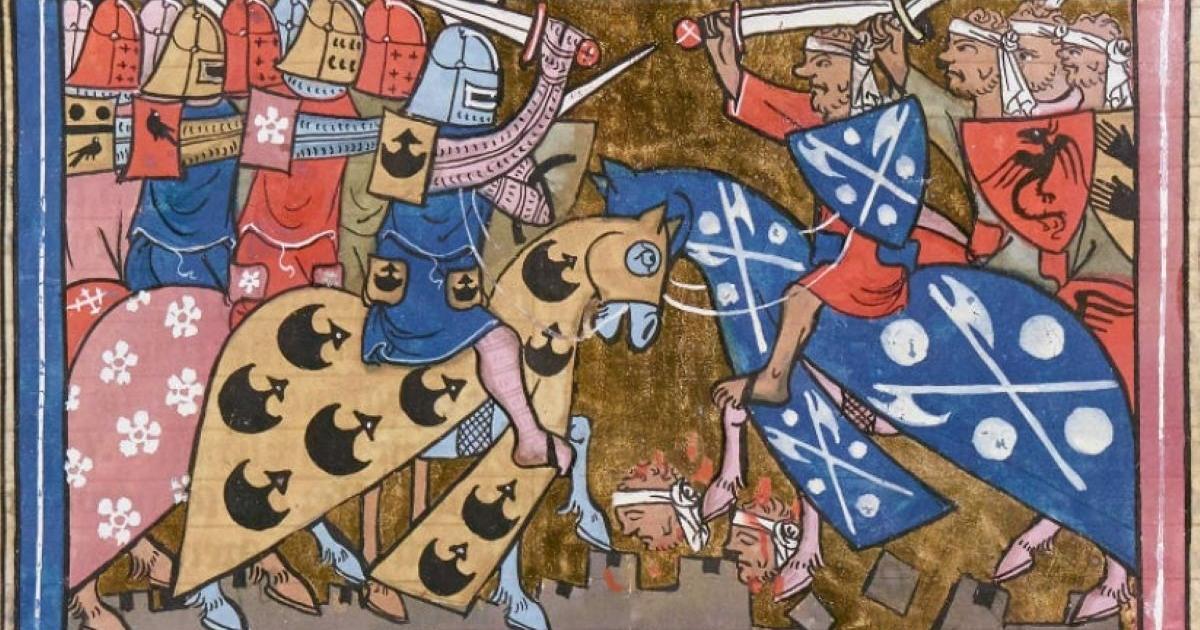
Top image: This miniature illustrates one of the battles of the second crusade of Louis VII, who came to the aid of the king of Jerusalem, Baldwin III, against the Saracens, in the middle of the 12th century. Source: anonymous, Public domain
By Sahir
References
Cartwright, M. 2018. Fifth Crusade. Available at: https://www.worldhistory.org/Fifth_Crusade/.
Riley-Smith, J. The Crusades: A History. Bloomsbury, 2005.
Tyerman, C. God’s War: A New History of the Crusades. Harvard University Press, 2006.