
Researchers have uncovered a 35,000-year-old ritual complex deep within Manot Cave, located in the Western Galilee, Israel. This finding represents one of the earliest known examples of communal ritual behavior in the Levant — and possibly the world.
The discovery, detailed in a study published in the Proceedings of the National Academy of Sciences (PNAS), challenges long-held notions about the development of organized worship and suggests that ritual practices were a significant part of human social evolution during this era. Manot Cave, already known for its archaeological significance, has now provided rare insight into the early stages of collective ritualism.
Led by Dr. Omry Barzilai of the Israel Antiquities Authority and the University of Haifa, alongside Prof. Ofer Marder of Ben-Gurion University and Prof. Israel Hershkovitz of Tel Aviv University, the research sheds new light on the spiritual lives of early Upper Paleolithic hunter-gatherers.
- Excavators Find Christian Town in Galilee’s ‘Forbidden Territories’
- Discoveries Show that Galilee and Jerusalem are Far Older than Once Believed
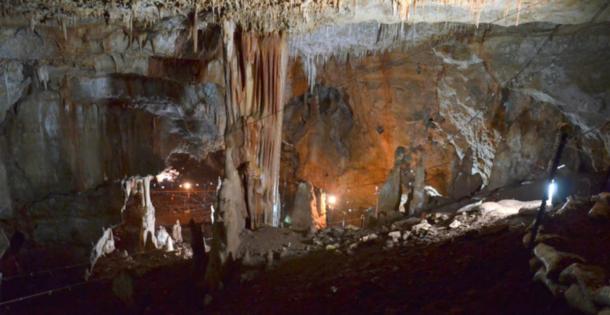
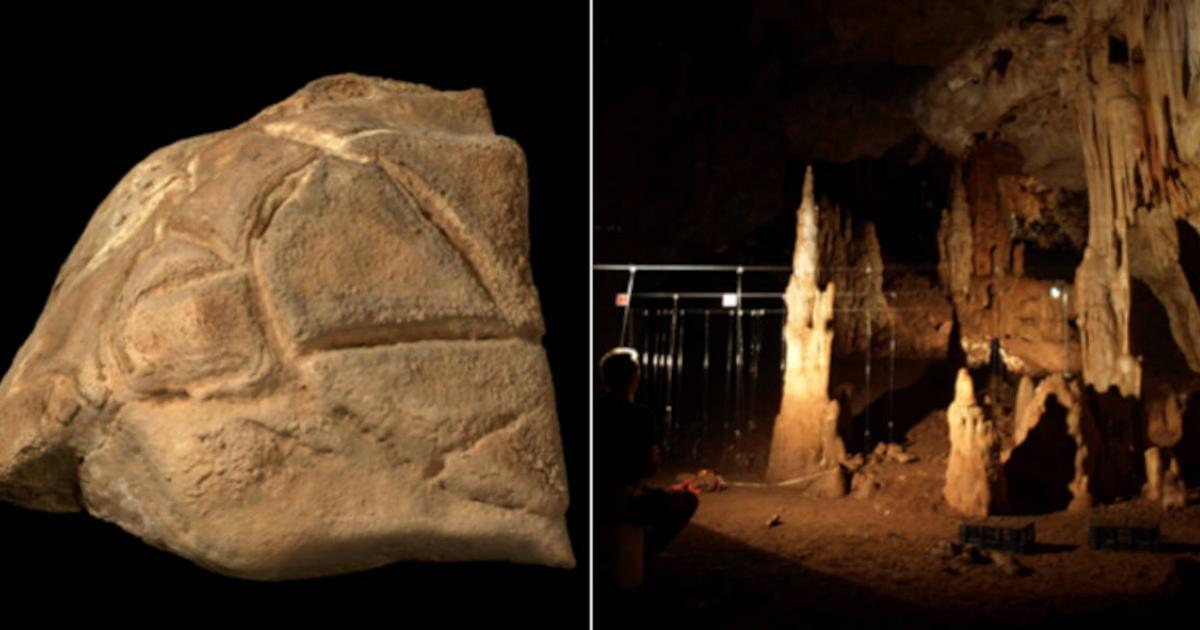
The carved boulder was found in a secluded part of the Manot cave network. (IAA)
A Hidden Chamber for Sacred Rituals
The ritual complex was found in the cave’s deepest and darkest sections, far from the living areas near the entrance where flint knapping, butchering, and cooking activities took place. The secluded space is naturally enclosed by stalagmites, creating a distinctive threshold that may have symbolized entry into a sacred realm. One of the most striking elements of the discovery is a large dolomite boulder, prominently positioned at the back of the gallery, which features intricate geometric engravings resembling a tortoise shell.
Dr. Barzilai explained the significance of the engraved rock:
“The turtle-shell design, carved on a three-dimensional object, indicates that it may have represented a totem or a mythological or spiritual figure.”
The careful placement of the boulder in the deepest part of the cave, away from daily activities, supports the hypothesis that it was used in ceremonial or symbolic rituals.
- Why Rituals Have Been Crucial for Humans Throughout History
- A Unique Mixture of Afro-Cuban Religious Rituals or Witchcraft? The True Story Behind Santeria
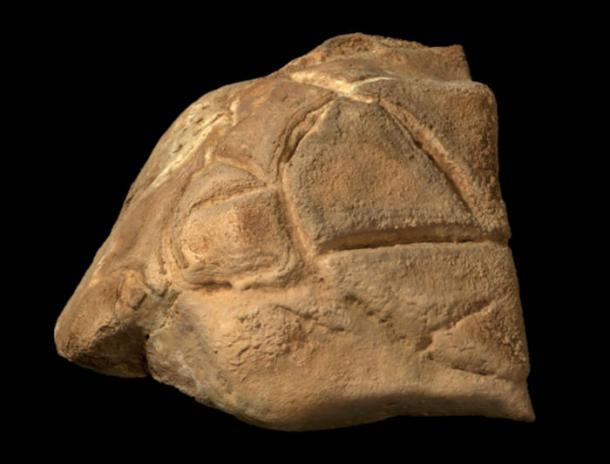
The carved boulder resembling a tortoise shell that is thought to have been used in ritual practices. (Clara Amit/Israel Antiquities Authority)
The engravings were analyzed using a specialized confocal microscope by Prof. Rachel Sarig from Tel Aviv University’s Dental Medicine Laboratory. This analysis revealed linear micro-scratches within the grooves, confirming they were created by sharp flint tools wielded by human hands. These carvings are a testament to the artistic skill and ritual significance embedded in the cultural practices of early humans.
Illuminated by Fire and Enhanced by Sound
Evidence of fire use was found in the form of wood ash particles embedded in the stalagmite layers near the engraved rock. The researchers suggest that torches were used to illuminate the chamber during rituals. Acoustic analysis further revealed that the space had unique sound properties, making it ideal for communal activities involving chanting, singing, or other auditory elements. Prof. Hershkovitz remarked, “This is an unprecedented discovery of a space with ‘audio-visual equipment,’ centered around a ritual object (the turtle). Darkness embodies sacred and hidden qualities, symbolizing rebirth and renewal.”
The enhanced acoustics may have amplified the experience, providing a setting conducive to fostering communal identity and spiritual connection. The combination of visual, auditory, and spatial elements points to a highly organized and intentional form of ritual practice.
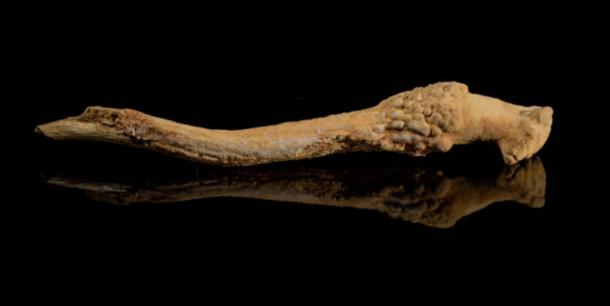
A complete deer antler was discovered near the ritual complex cavern. (Dafna Gazit/Israel Antiquities Authority)
Ritual Objects and Symbolic Meaning
In addition to the engraved boulder, the researchers found a complete deer antler in a small chamber adjacent to the ritual complex. This antler, which showed signs of use, may have held symbolic or functional importance in the ceremonies conducted within the cave. Prof. Marder noted that deer antlers were commonly used as raw materials for tools in Upper Paleolithic cultures, both in Europe and the Levant.
The clear spatial separation between the ritual complex and the habitation areas at the cave’s entrance underscores the significance of this discovery. Alexander Wigman from the Israel Antiquities Authority highlighted the importance of this delineation, stating, “This observation strengthens the hypothesis about the significance of the complex and the need to differentiate it from the areas where daily activity took place.”
Shedding Light on Early Human Society
This discovery at Manot Cave offers a rare glimpse into the communal and symbolic world of early humans during the Upper Paleolithic period. The site’s chronological age of 35,000–37,000 years places it within the era of the Aurignacian culture, known in Europe for its symbolic objects and cave art. The findings suggest that similar cultural developments were occurring in the Levant, pointing to the parallel evolution of ritual behavior in different regions.
Dr. Barzilai and his colleagues concluded that this discovery represents a significant milestone in understanding human social evolution. “Identifying communal rituals in the Paleolithic era marks a breakthrough in our understanding of human society and offers more than just a glimpse into ancient ritual practices. It reveals the central role of rituals and symbols in shaping collective identity and strengthening social bonds.”
The ongoing excavations at Manot Cave, supported by multiple institutions and foundations, continue to reveal the complexities of early human life and the origins of organized spiritual practices. This ritual complex stands as a testament to the cognitive and cultural sophistication of our ancient ancestors.
Top image: Left; the boulder with tortoise marking engraved. Right; Manot Cave, Galilee, Israel. Source: Asaf Peretz/Israel Antiquities Authority
By Gary Manners
References
O. Barzilai et al. 2024. Early human collective practices and symbolism in the Early Upper Paleolithic of Southwest Asia, Proc. Natl. Acad. Sci. U.S.A.121 (51) e2404632121. Available at: https://doi.org/10.1073/pnas.2404632121