A Conversation with Prof. Paul Cartledge, Cambridge University
In this interview, author and scholar Richard Marranca, Ph.D spoke with Dr. Paul Cartledge, A.G. Leventis Senior Research Fellow, Clare College, Emeritus A.G. Leventis Professor of Greek Culture, about one of his favorite subjects: the Parthenon, the greatest architectural prize of ancient Greece to survive into modern times. Professor Cartledge expounds on the Parthenon’s incredible history, its aesthetics, and its meaning to both the ancient and modern worlds.
RM: One of our recent pleasures in Athens was having breakfast on the rooftop garden (Hotel Byron), staring at the Parthenon! You walk down the street and there’s the remnants of the monastery where he stayed…
PC: Excellent choice of hotel – name: Lord Byron died exactly two centuries ago, at Missolonghi, in the earlier stages of the Greek War of Independence from the occupying (since 1453) Ottoman Turks…
RM: Your book (Ancient Greece: A History in Eleven Cities) has a terrific chapter on Athens and other cities. Can you mention a few things the traveler should see in Athens?
PC: Selection of “to-be-visiteds” is invidious, but I’d say there are four main areas or sites that one should make absolutely sure to visit in Athens, three both archaeological and topographical, one only topographical: the Acropolis (and its associated Museum), the Greek (distinct from Roman) Agora and Museum, the Kerameikos/Cerameicus cemetery and Museum, and Lykavittos/Lycabettus hill.
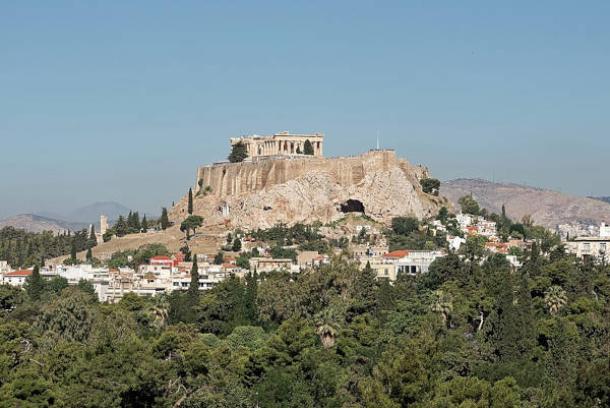
View of the acropolis in Athens from a distance. (Jakub Halun/CC BY-SA 4.0).
Lykavittos is a 277m ‘hill’ (or mountain). Ascend by funicular, descend by winding footpath. When up top you’ll have spectacular 360 degree views: the best is due south via the Acropolis and on down to Piraeus, Athens’s port now as in antiquity.
- Homer’s Odyssey Meets Cinema Magic: Ralph Fiennes & Juliet Binoche in The Return!
- High-Tech Tools: Exploring Egypt with Dr. Hawass
RM: My wife Renah, who studied politics in college, was thrilled with the Parthenon tour. The guide had a solid background in archaeology and pointed out some of the major projects. Can you shine a candle to one or more ongoing projects?
PC: Ever since the 1970s the Parthenon and Acropolis have been a World Heritage site. The temple was built between 447 and 432 BC in honour of Athena the Virgin (she never married, never was dominated by a male). It became over the succeeding 2,500 years a Christian (Roman Catholic) church, an Islamic mosque, and finally, after 1832, a historic monument.
Over those years it was subjected to multiple depredations, both natural (climate) and man-made. Two of the man-made are the most responsible for the ruins looking the way they do: a 1687 cannonade by Venetians attacking Ottoman Athens, and between 1801 and 1804 the removal of many sculptures – pedimental, metopal and figured frieze slabs – by the agents of the Seventh Lord Elgin, British (Scottish) ambassador to the Sublime Porte.
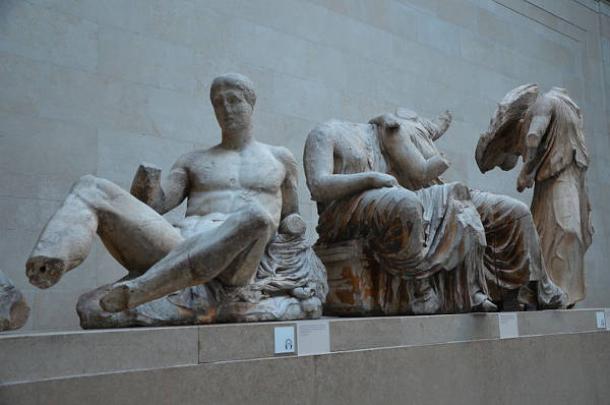
Some of the Parthenon Marbles (statues) that remain in the possession of the British Museum, despite ongoing efforts to have them returned to Greece. (Carole Raddato/CC BY-SA 2.0).
The new, post-Ottoman Greek state began the process of repair, reconstruction and renewal, which took a leap forward first in the 1970s (undoing some of the earlier, misguided Greek attempts) and then again in 2009 (the founding of a dedicated new Acropolis Museum equipped with the latest scientific techniques and tools).
- The Parthenon: An Epic Monument Or a Mystery in Measurements?
- Are the Controversial Elgin Marbles Finally Destined for Athens?
RM: This whole place is a sacred site, is it not - and there are many important features and structures?
PC: It's absolutely key to understand that the Parthenon is not self-standing but an integral part of an entire ancient building complex located on top of the sacred rock known as the ‘High City’, Acropolis. Hence the new Acropolis Museum takes visitors first through the entire history of human activity on the rock before leaving them at the summit, in the dedicated Parthenon Gallery in sight of the ruins of the original and built to the same dimensions so as to house, curate and properly display the Parthenon’s sculptural remains.
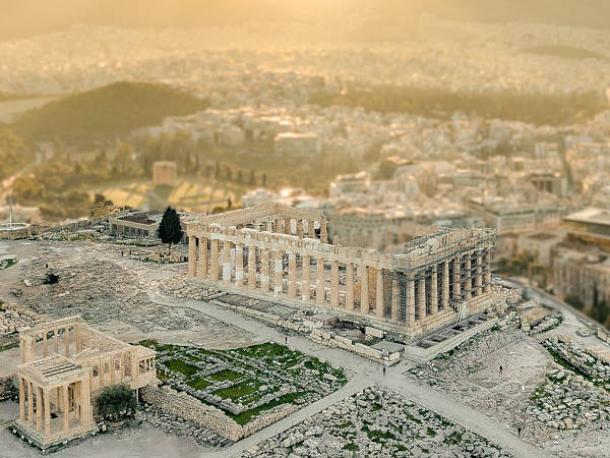
Aerial view of the Parthenon and acropolis in Athens. (Sfetkos/CC BY-SA 4.0)
RM: Can you mention some of the aesthetics and mathematics of the Parthenon?
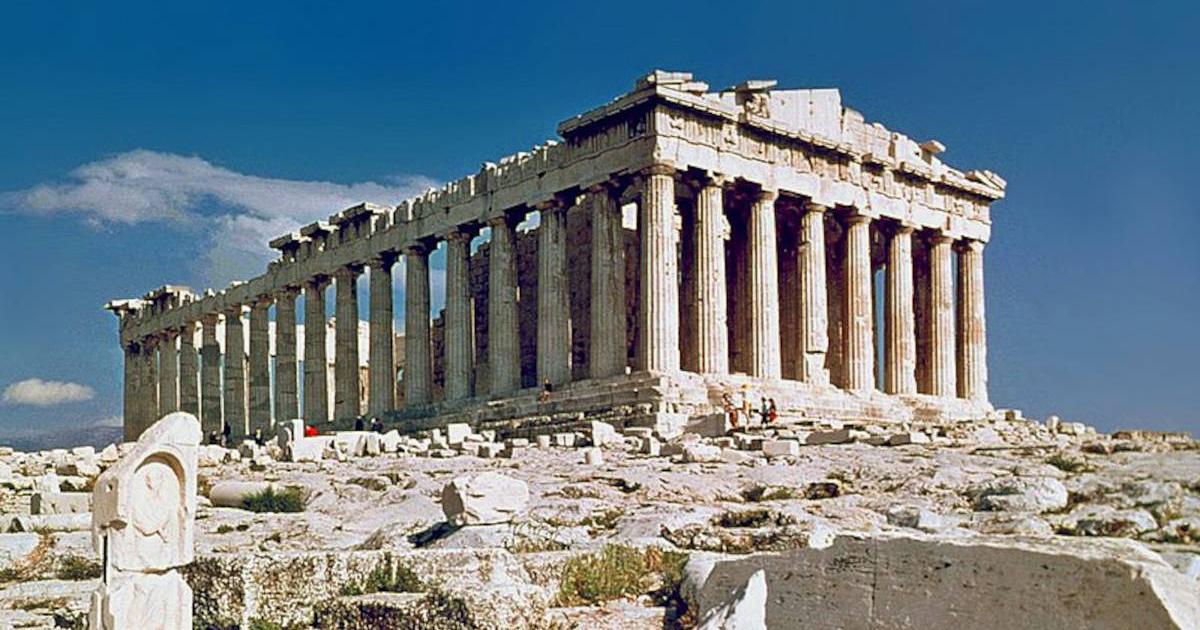
PC: The aesthetic refinements of the Parthenon are quite staggeringly impressive – despite appearances, there’s not a single straight line, and a ratio of 4:9 throughout displays in hard stone the ancient Greeks’ mathematical genius. The sculptural programme, in which Pheidias probably had a crucial hand, as he certainly did in fashioning the gold-and-ivory cult-statue of Athena, is quite exceptionally rich. (The originals were of course lavishly painted too.) There’s nothing to compare to it anywhere else in the entire ancient Greek world of Hellas.
RM: Can you delve further into the reasons for its importance?
PC: Mainly due to piety – the Parthenon, like many of the other greatest buildings on the Acropolis (and elsewhere), was an offering of thanks to the gods for their aid in defeating the Persian invasions of 490 BC and 480-479 BC and in keeping Athens and other Greeks free from alien, foreign control.
It was also a democratic monument: voted for and managed by the Athenian demos (People) under the guidance above all of Pericles. The themes chosen for representation besides the purely Athenian were pan-Hellenic, all-Greek, tales of civilization triumphing over barbarism and anarchy. No wonder the original programme was controversial, mainly because of its expense!
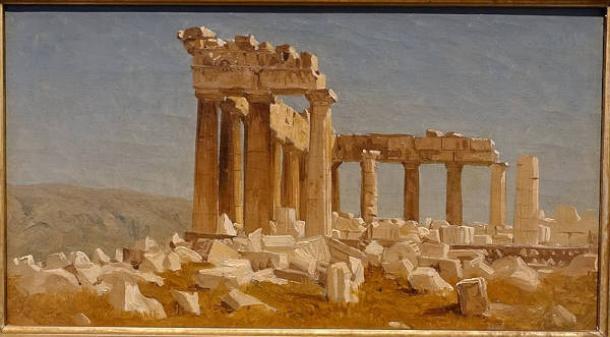
Painting by Sanford Robinson Gifford, 1869, entitled ‘The Parthenon.’ (Daderot/Public Domain).
Professor Paul Cartledge is a distinguished scholar of ancient Greek history, best known for his research on the culture, politics, and history of ancient Greece, particularly during the Classical and Hellenistic periods. He is the author or editor of more than 20 books and is the Vice-Chair of the British Committee for the Reunification of the Parthenon Marbles, an organization leading the campaign to convince the British Museum to return sculptures removed from the Parthenon in the 19th century to their rightful home, in Athens.
Top image: The Parthenon, Athens’ sparkling jewel from ancient Greece.
Source: Steve Swayne/CC BY-SA 2.0.
Dr Richard Marranca is an author, teacher and filmmaker. He has a strong interest in history and religion in the ancient world and publishes in these areas. His Egyptian manuscript Speaking of the Dead: Mummies & Mysteries of Egypt , will be published by Blydyn Square Books in New Jersey. Richard has a doctorate and MA that included a semester in Athens. He has had a Fulbright to teach at the University of Munich, as well as seven National Endowments for the Humanities summer grants -- the most recent was at College of the Holy Cross in Massachusetts in June 2022. His books are available online. See more at https://www.richardmarranca.com/