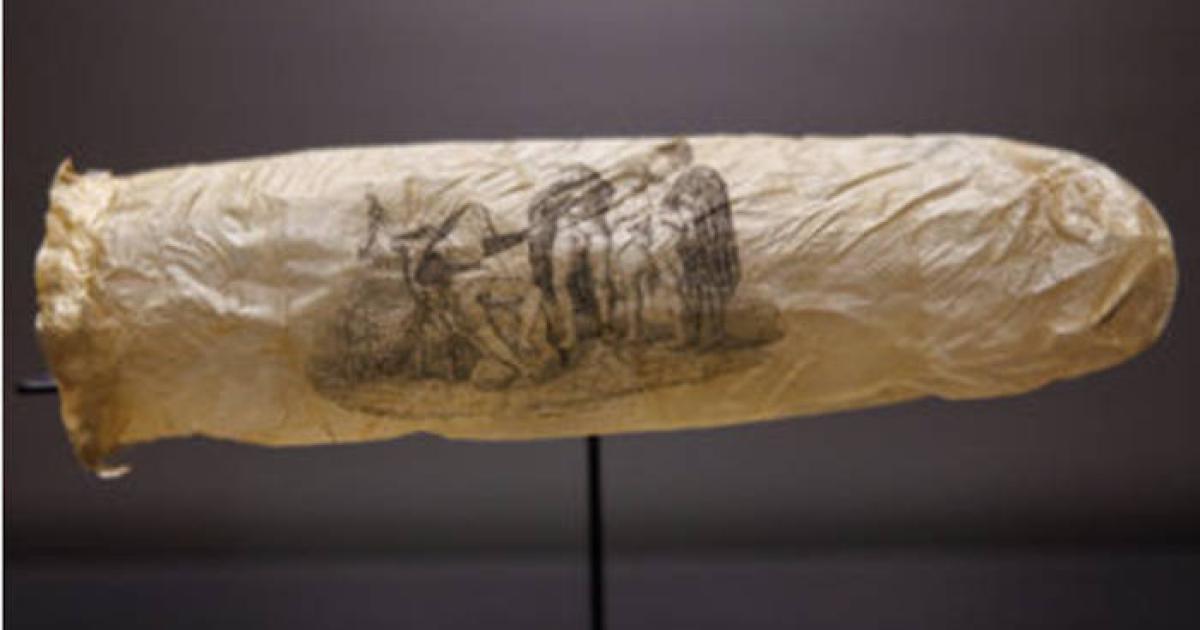

In a bold exploration of historical sexuality and satire, the Rijksmuseum has unveiled a rare and provocative artifact: a nearly 200-year-old condom from 1830, likely crafted from a sheep's appendix, and featuring an erotic print of a nun and three clergymen.
A Rijksmuseum press release describes the rare item, believed to be a souvenir from a French brothel, as inscribed with the French phrase "Voilà mon choix" ("This is my choice"), a satirical reference to the Judgement of Paris from Greek mythology. The nun, seated with her legs apart, gestures toward the three aroused clergymen, lampooning celibacy and the moral hypocrisy of religious institutions in 19th-century Europe.
Only two such erotic condoms are known to have survived, making this object exceptionally rare and culturally significant. Measuring 20 centimeters, the condom was not intended for use but instead functioned as a novelty or collector's item-likely commissioned by an elite clientele with both means and a taste for the risqué.
- Ancient Methods of Contraception – Even Tutankhamun Wore Protection
- What is this Mysterious Ancient Structure Found in Downtown Miami?

Anonymous, Condom with print, c. 1830. Acquired through the F.G. Waller Fonds. (Kelly Schenk /Rijksmuseum)
A Unique Artifact of Sexual History
The artifact appears on show from 3 June 2025 in the Rijksmuseum Print Room as part of a new show, "Safe Sex?", until the end of November. The show explores 19th-century sexuality, prostitution and sexual health, through prints, drawings, photographs, and now this single condom.
"This object provides a unique glimpse into the private lives of historical times that tend to be forgotten in traditional collections to museums," the museum explained in the press release.
"It demonstrates how print was utilized in domestic and playful manners, and indicates how 19th-century society struggled with desire, disease, and morality."
The condom was bought at auction six months previously in Haarlem for €1,000 from funds provided by the F.G. Waller Fund. It now forms part of an overall collection of more than 750,000 works on paper owned by the Rijksmuseum.
- Syphilis Originated in Americas, but Was Spread Around World by Europeans
- In a world with no antibiotics, how did doctors treat infections?
Context and Historical Significance
Condoms in the early 19th century were commonly made from linen or animal membranes. While rudimentary by modern standards, they were used to prevent both unwanted pregnancy and the spread of sexually transmitted infections, most notably syphilis, which was widespread and deadly at the time.
The etching on the condom adds another layer of meaning, illustrating how sexuality, humor, and political or religious commentary often intersected. Erotic prints were a popular but underground medium, offering discreet commentary on taboo subjects.
This artifact joins a small group of preserved historic contraceptives, such as those in the Wellcome Collection (London) and Musée de l'Érotisme (Paris), providing scholars and the public alike with rare evidence of early contraceptive technologies and sexual expression.
The Rijksmuseum's exhibition contributes to a growing trend in European institutions to highlight underrepresented aspects of social history, including gender, sexuality, and everyday life. It invites us to reconsider how artifacts of pleasure and parody can inform our understanding of the past.
Top image: Anonymous, Condom with print, c. 1830. Acquired through the F.G. Waller Fonds Source: F.G. Waller Fonds/Rijksmuseum
By Gary Manners