Three dozen monkey burials at the ancient Red Sea port of Berenike reveal that Roman military elite maintained exotic primates as beloved companions, complete with grave goods - and their own animal companions! This extraordinary discovery changes previous assumptions about ancient pet keeping and reveals the first archaeological evidence of live animal trade from India to the Roman Empire during the 1st and 2nd centuries AD.
Indian Monkeys Replace African Species in Roman Pet Culture
Archaeologists working at the animal cemetery at Berenike have documented remains from three dozen primates, marking a significant shift in Roman pet-keeping practices. Previously, the handful of monkey skeletons discovered at other Roman sites, including one that perished during Mount Vesuvius's eruption at Pompeii, were exclusively Barbary macaques from North Africa. These animals came from within the empire's borders, making them relatively accessible to wealthy Romans.
The Berenike monkeys represent something entirely different. Analysis published in the Journal of Roman Archaeology identified them as rhesus macaques and bonnet macaques, with one grivet specimen, all originating from either southern India or the Indus Valley region of northern India. This discovery provides the first zooarchaeological evidence that live animals were being transported from India to Roman territories, expanding our understanding of ancient Red Sea trade networks.
- Pet Monkeys Buried Like Children In Ancient Egypt
- A Roman Era Pet Cemetery: 86 Cat Burials Discovered in Egypt
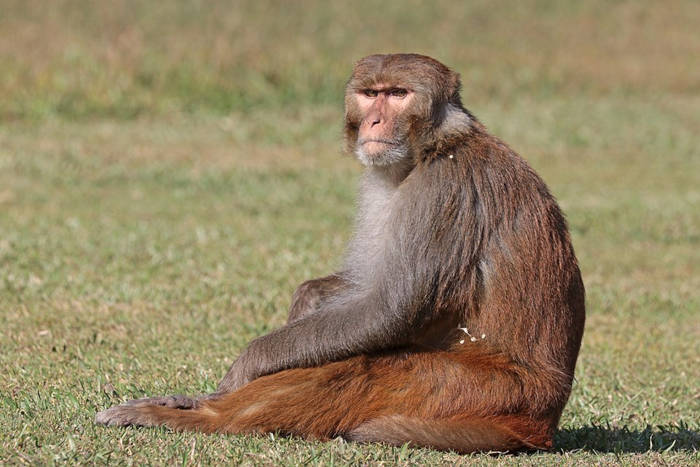
Rhesus macaque, the species kept as pets by Roman officers in Egypt. (Charles J. Sharp/CC BY-SA 4.0)
Monkeys Buried With Elaborate Grave Goods
The burial practices at Berenike demonstrate the extraordinary status these primates held among their Roman owners. Among other companion animals at the site - primarily cats and some dogs - the monkeys received notably special treatment. One skeleton dated to the early 1st century AD was discovered alongside a piglet's remains, along with a pair of large seashells, a woven basket, and a piece of cloth folded to resemble a rag doll. According to researchers, these items undoubtedly belonged to the young macaque during its lifetime.
Another monkey burial contained the remains of both a puppy and a kitten, suggesting the primate had formed bonds with other animals. Yet another burial featured a tomb marker, mirroring practices typically reserved for human graves. The research team suggests these grave goods represented the monkeys' most treasured possessions in life, perhaps included to ease their transition to the afterlife.
Such elaborate burial practices align with writings from Pliny the Elder, who documented that Romans viewed primates as possessing semi-human status, warranting special consideration and treatment within Roman society.
- Ancient Red Sea Port May Have World's Oldest Pet Cemetery
- Asian and Nubian Influences Found In Ptolemaic Era Berenike
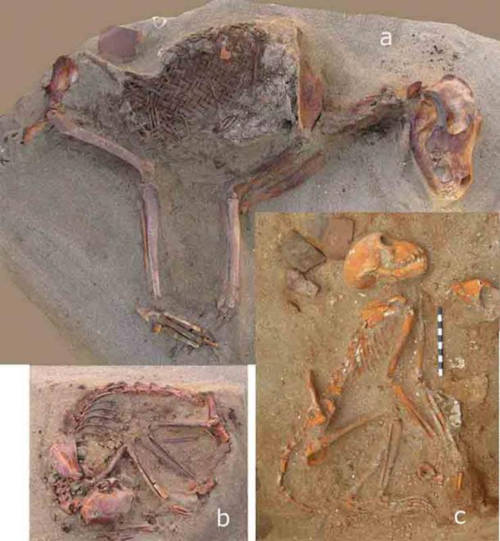
Manner of placement of the body of a dog, cat and monkey in the ‘pet cemetery’ at Berenice. (Osypinska, M., Skibniewski, M., & P. Osypinski/World Archaeology 2021)
The presence of restraining collars on several specimens indicates the monkeys were kept on leashes, while iridescent shells and food delicacies found in the graves likely served as status markers. The burial ground's proximity to a Roman military installation at Berenike suggests these exotic pets belonged to legionary officers and other members of the social elite stationed at this frontier port.
Status Symbols Despite Signs of Hardship
While Roman officers clearly treasured their monkey companions, evidence suggests they struggled to provide adequate care for these exotic animals. Many of the monkey skeletons exhibited signs of malnutrition, indicating the challenges of maintaining primates far from their native habitats. The dietary requirements and environmental needs of Indian macaques would have been difficult to meet in the harsh desert climate surrounding Berenike, even for wealthy Romans with access to imported goods.
Despite these difficulties, owning an Indian macaque provided significant social advantages in the competitive world of Roman military society. For officers stationed at a frontier port on the edge of the empire, these animals served as visible proof of their exotic connections and extraordinary experiences. The researchers note that someone walking through Berenike with an Indian macaque on a leash would have commanded immediate respect and admiration, recognized as an explorer of distant lands and a person of exceptional social standing.
Daily Life of a Roman Citizen Talk, available now from the Ancient Origins Store.
The discovery provides the most comprehensive archaeological evidence to date regarding the socio-cultural context of keeping exotic pets in the Roman world. Berenike's role as a crucial node in the maritime trade network connecting the Mediterranean world with Africa and Asia made it an ideal location for such luxury goods - including living ones - to enter the Roman Empire. The port's cosmopolitan nature, documented through finds of Indian pottery, African goods, and Mediterranean artifacts, created an environment where exotic pets could symbolize participation in this vast trading system.
Top image: AI generated monkey in Roman armor at an amphitheater. Source: bajita111122/Adobe Stock
By Gary Manners
References
Osypińska, M., Skibniewski, M., and Osypiński, P. 2025. A centurion's monkey? Companion animals for the social elite in an Egyptian port on the fringes of the Roman Empire in the 1st and 2nd c. CE. Available at: https://www.cambridge.org/core/journals/journal-of-roman-archaeology/article/abs/centurions-monkey-companion-animals-for-the-social-elite-in-an-egyptian-port-on-the-fringes-of-the-roman-empire-in-the-1st-and-2nd-c-ce/BC4AE30501792AF350762ADD326AE5B6
Taub, B., 2025. Roman military officers had pet monkeys, and the pet monkeys had pet piglets. Available at: https://www.iflscience.com/roman-military-officers-had-pet-monkeys-and-the-pet-monkeys-had-pet-piglets-81764