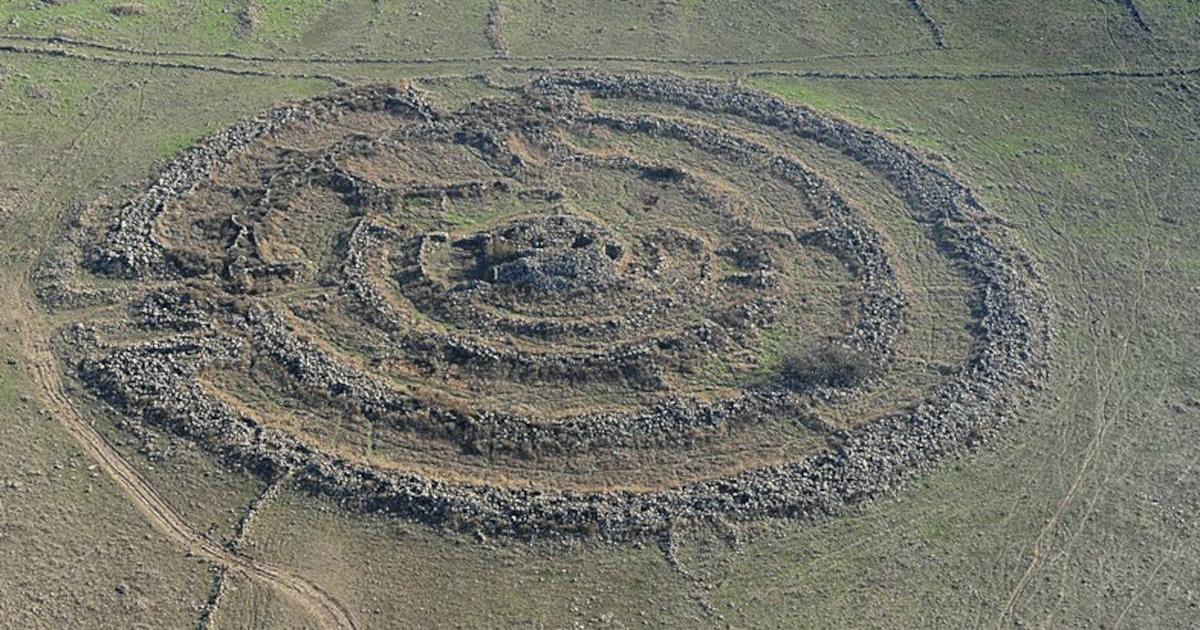

Archaeologists and historians have long pondered the true meaning and purpose of the ancient megalithic stone circles built in the Early Bronze Age (3,000 to 2,700 BC) at the Rujm el-Hiri site in the Golan Heights of Israel. Given their uncanny resemblance to other megalithic stone circles found around the world, including Stonehenge, it was natural to conclude (as many experts have) that the concentric circles constructed at Rujm el-Hiri reflected an interest in sacred astronomy, as such building projects did elsewhere.
But according to new research, this assumption is in error. While other stone monuments do have a connection to the structure and movements of the night sky, it seems that Rujm el-Hiri doesn’t match that familiar pattern.
Remote Sensing Debunks the Observatory Theory
In a new article appearing in the journal Remote Sensing, a team of experts from Tel Aviv University and Ben-Gurion University make their case that Rujm el-Hiri, the so-called Stonehenge of Israel, has been misidentified as an ancient observatory.
- Evidence of Ancient Megalithic Culture in Massachusetts Revealed For the First Time
- The Legend of Atlantis: Between Ancient Ruins and a Philosopher’s Tale
The previous belief was that the walls and entrances to the set of concentric stone circles installed in the Golan Heights 5,000 years ago were specifically aligned to match the positions and/or movements of certain objects in the night sky (the Sun, the Moon, the stars, the planets, etc).
However, the researchers involved in this new remote sensing study are convinced that their work has disproved this theory.
"The study was based on calculations of the sky map and aligning the directions of the solstices, equinoxes, and other celestial bodies as they appeared between 2500–3500 BCE, coordinated with the symmetry and entrances of Rujm el-Hiri in its current position,” the research team wrote in their Remote Sensing article, before dropping their bombshell. “The findings show that the entrances and radial walls during that historical period were entirely different, reopening the question of the site's purpose.”
Remote sensing techniques allow researchers to obtain detailed information about the positioning and contours of objects located at ground level. Remote sensing studies harvest data from satellite images, aerial photographs, and the ground-penetrating scanning system known as LIDAR to make more accurate and precise measurements than would be possible studying these objects directly.
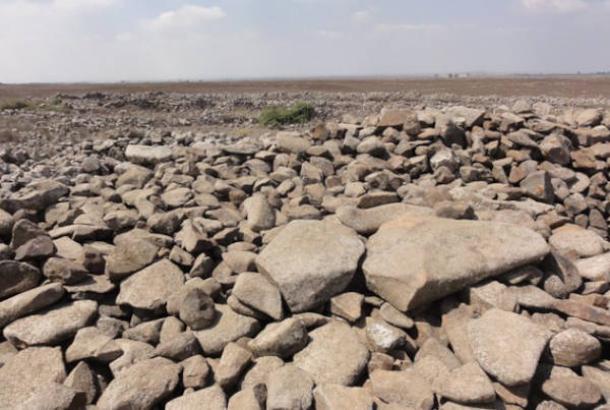
View from the center of the Rujm el-Hiri stone circle installation looking outward. (Michael Homan/Flickr).
In this case, what they discovered is that the stones of the Rujm el-Hiri circles have rotated counterclockwise in the 5,000 years since they were first constructed, meaning they were in a different position at the time they were built than they are now. So any correlations between the stone circles and ancient astronomical developments are simply coincidence and not proof of anything.
- Resurrecting the Ancient Israelites From the Valley of Dry Bones
- Junapani Stone Circles: India’s Astronomical Megalithic Tombs
The research team, which was led by Dr. Olga Khabarova and Prof. Lev Eppelbaum of the Department of Geophysics at Tel Aviv University and Dr. Michal Birkenfeld of the Department of Archaeology at Ben-Gurion University, analyzed satellite data collected over multiple years to track the miniscule movements of the ground in the Golan Heights region, which remains an ongoing process. Correlating this information with data obtained from geomagnetic analysis and the reconstruction of past tectonic movements, they were able to calculate that the ground in the Rujm el-Hiri area of the Golan Heights has been moving at an average rate of 8-15 millimeters per year for a long time, carrying the stones on top of it along for the ride.
This may not sound like much. But if this calculation is accurate, it means the gigantic stones of Rujm el-Hiri have all likely moved at least several meters off their original positions, which obviously represents a significant deviation.
“The findings show that the entrances and radial walls during that historical period were entirely different, reopening the question of the site’s purpose,” the researchers wrote, shutting the door on the astronomical observatory hypothesis.
Finally Solving the Mystery of Rujm el-Hiri
The Arabic name Rujm el-Hiri means “stone heap of the wild cat,” while its Hebrew name, Gilgal Refaim, means “wheel of giants.”
The four concentric circles and the central rock mound burial chamber (tumulus) that comprise the monument were constructed from more than 42,000 basalt rocks. At its widest point the entire structure is 520 feet (160 meters) in diameter. The highest wall reaches a height of eight feet (2.4 meters), while the tumulus in the middle is 15 feet (4.6 meters) tall.
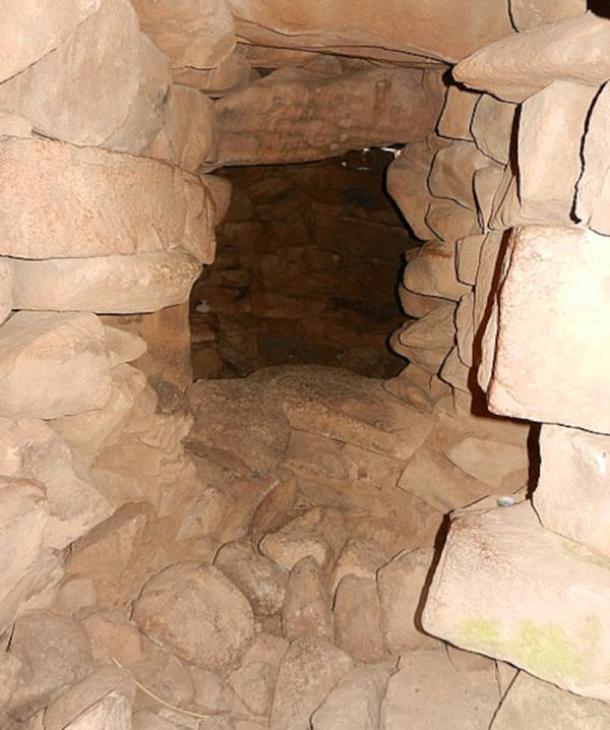
View of the burial chamber found inside the central Rujm el-Hiri structure. (Ani Nimi/CC BY-SA 3.0).
It is known that several Early Bronze Age settlements were built within walking distance of the megalithic structure. Using remote sensing technology, the researchers were able to survey a broad area around Rujm el-Hiri, and they discovered the ruins of ancient buildings, walls and burial mounds within an 18-mile (30-kilometer) radius of the site.
While rejecting the idea that Rujm el-Hiri was an astronomical observatory or solar calendar, the researchers do note similarities between this monument and similar structures in the Mediterranean area that were also built during the Early Bronze Age.
“The similarities in structure, such as concentric circles and radial walls, highlight the need for further interdisciplinary research that combines archaeological, geophysical, and paleoenvironmental data to understand these monuments’ origins and purposes better,” the researchers concluded in their Remote Sensing article, suggesting that the answer to the riddle of Rujm el-Hiri won’t be found by studying this single monument alone, but by looking more closely at the regional culture at the time it was created.
Top image: Megalithic stone circles of Rujm el-Hiri in the Golan Heights of Israel, constructed during the Early Bronze Age.
Source: Abraham Graicer/CC BY-SA 4.0.
By Nathan Falde