A massive, 205-foot (62.5-meter) scorpion-shaped mound discovered in Mexico's Tehuacán Valley may have served as an astronomical observatory for ancient farmers, challenging long-held beliefs about who controlled celestial knowledge in pre-Hispanic Mesoamerica. The rare effigy mound, built between AD 600 and 1100, appears to align precisely with both the summer and winter solstices, suggesting that ordinary countryside farmers possessed sophisticated astronomical understanding independent of elite priestly classes.
Ancient Observatory in the Valley
The scorpion effigy is one of twelve mounds forming a civic and ceremonial complex spanning approximately 22 acres in the Tehuacán Valley, located about 160 miles (258 km) southeast of Mexico City. Archaeologists from the University of Texas at Austin first documented the site in 2014 while surveying prehistoric irrigation systems in the region. The surviving structure, composed of mixed dirt and rocks, stands about 30 inches (76cm) tall with clearly defined features including a head, body, pincers, and tail.
- Teotihuacan's Pyramid of the Moon is Actually Aligned with the Solstice Sun
- The Planet Venus as a Symbol of Death and Resurrection in Ancient Mesoamerica
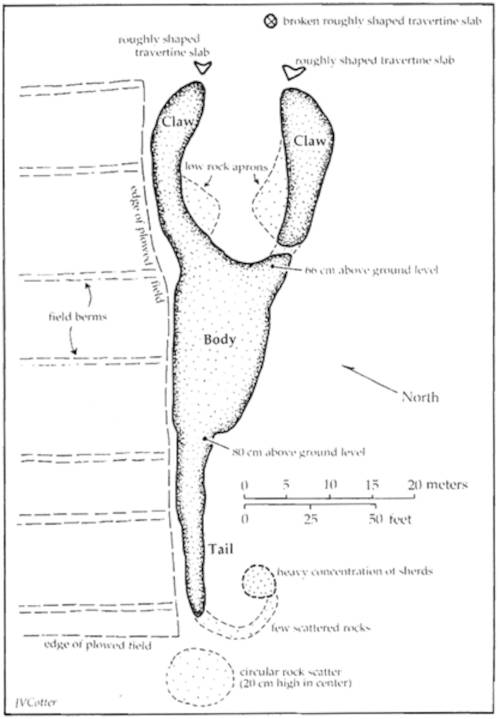
A detailed scale drawing of the scorpion mound showing its distinctive features. (Neely et al/Ancient Mesoamerica Journal)
According to research published in the journal Ancient Mesoamerica, lead author James Neely of the University of Texas at Austin and his colleagues discovered that the mound's orientation reveals a deliberate astronomical design. The scorpion faces east-northeast, and careful calculations showed that on the morning of the summer solstice, a person standing at the "stinger" - marked by a cluster of ceramic fragments at the tail's tip - would witness the sun rising between the scorpion's claws. By the actual solstice, the sun would reach the tip of the northern claw, signaling the crucial beginning of the rainy and planting season.
Celestial Scorpion and the Morning Star
The choice of a scorpion shape carries profound symbolic meaning. In pre-Hispanic Mesoamerica, the scorpion known as Tlāhuizcalpantēcuhtli represented a powerful celestial deity closely associated with Venus, the morning star planet. Many Mesoamerican peoples viewed this creature as both a terrestrial danger and a heavenly guardian, embodying the connection between earth and sky that governed agricultural cycles.
The winter solstice alignment proved equally precise. Standing at the tip of the northern claw, observers could watch the sun set directly beyond the stinger, marking the shortest day of the year. This dual functionality transformed the mound into a year-round calendar, allowing farmers to track solar movements and plan their agricultural activities accordingly. The researchers noted that such alignments are common in Mesoamerican architecture, but their presence in a rural farming context represents something unprecedented.
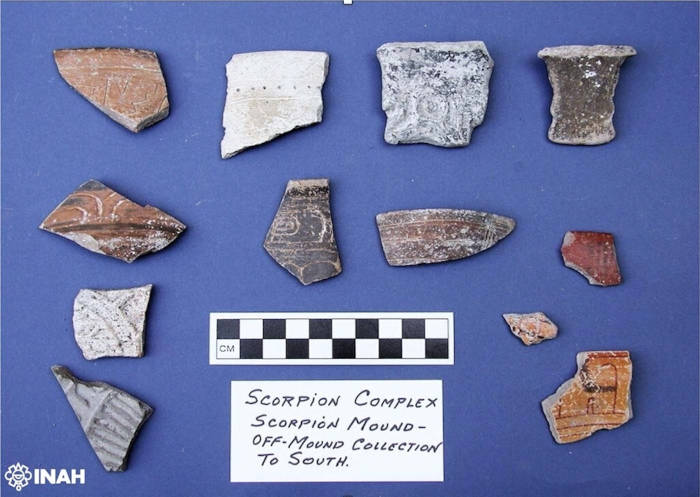
Ancient pottery fragments discovered at the scorpion mound. (Neely et al/Ancient Mesoamerica Journal)
Democratizing the Heavens
Among the artifacts recovered from the site, archaeologists found bowls, jars, plate fragments, and molcajetes - tripod bowls used for grinding food. An incense burner and the fragment of a hollow figurine suggest ritual activities took place at the mound, particularly at the stinger location where the ceramic collection was deliberately buried. These everyday objects, combined with the mound's location among irrigation canals rather than near elite centers, paint a picture of astronomical knowledge in the hands of common people.
"It is the first indication that knowledge and control of astronomical phenomena based on solar observations was not totally in control of the elite class," Neely explained to Live Science. This discovery challenges the traditional narrative that astronomical knowledge remained the exclusive domain of priests and rulers in ancient Mesoamerica.
The latest edition of Ancient Origins Magazine, Archeoastronomy, available now.
The finding reveals the sophistication of countryside farmers who built complex irrigation systems and monuments demonstrating advanced engineering and astronomical understanding. As Neely noted, this points to rural communities living "a life way of greater independence and self-determination from elite/state control," much like their modern counterparts who continue farming the same valleys today.
Effigy mounds like this scorpion are remarkably rare in Mesoamerica, making this discovery particularly significant for understanding how different levels of ancient society interacted with celestial phenomena. While thousands of effigy mounds exist in North America, including the famous Great Serpent Mound in Ohio, Mesoamerican examples remain notably scarce, elevating the importance of the Tehuacán Valley scorpion in archaeological research.
Top image: A map showing the scorpion effigy mound and the paths the sun likely took on the summer and winter solstices. Source: Neely et al/Ancient Mesoamerica Journal
By Gary Manners
References
Neely, J. et al. 2025. Did Ancient Mesoamerican Farmers Use Scorpion Mound to Track the Sun? Ancient Mesoamerica. Available at: https://doi.org/10.1017/S0956536125000070
Archaeology Magazine. 2025. Scorpion-Shaped Mound in Mexico May Have Been Used to Track the Sun. Available at: https://archaeology.org/news/2025/10/13/did-ancient-mesoamerican-farmers-use-scorpion-mound-to-track-the-sun/
Geggel, L., 2025. 200-foot scorpion effigy mound in Mexico may align with the solstices. Available at: https://www.livescience.com/archaeology/200-foot-scorpion-effigy-mound-in-mexico-may-align-with-the-solstices