
Archaeologists have uncovered compelling evidence of an ancient ritual burial beneath a Silla Dynasty tomb in Gyeongju, South Korea, revealing what appears to be the remains of a man buried alive alongside his master approximately 1,600 years ago. The discovery provides the first complete skeletal evidence of sunjang, a practice of human sacrifice that was eventually banned in 502 AD during the reign of King Jijeung, according to the Korea JoongAng Daily.
The newly discovered Hwangnam-dong Wooden Chamber Tomb No. 1 was found beneath the previously excavated Tomb No. 120 in Gyeongju's Daereungwon tomb complex. Announced by the Korea Heritage Service and Gyeongju city officials, the tomb dates to the late 4th to early 5th century and contains the remains of a high-ranking Silla general and what researchers believe was his sacrificed subordinate.
- Discovery of Ancient Tomb Suggests Man was Sacrificed to Serve a Korean Noblewoman
- The Ancient Korean Kingdoms: Silla, Goguryeo, and Baekje
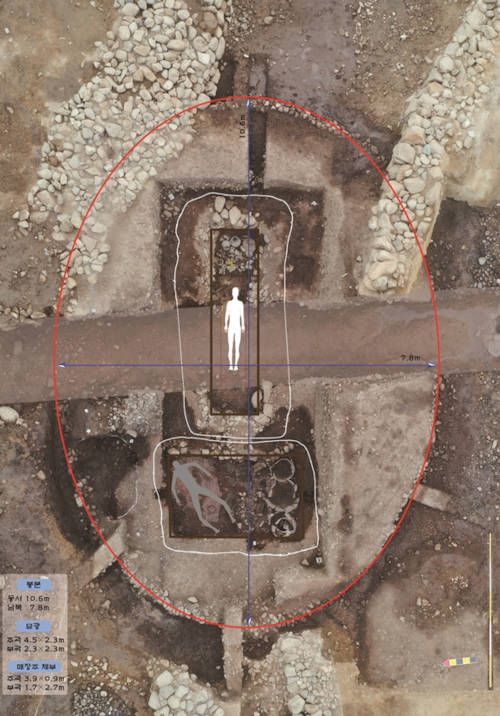
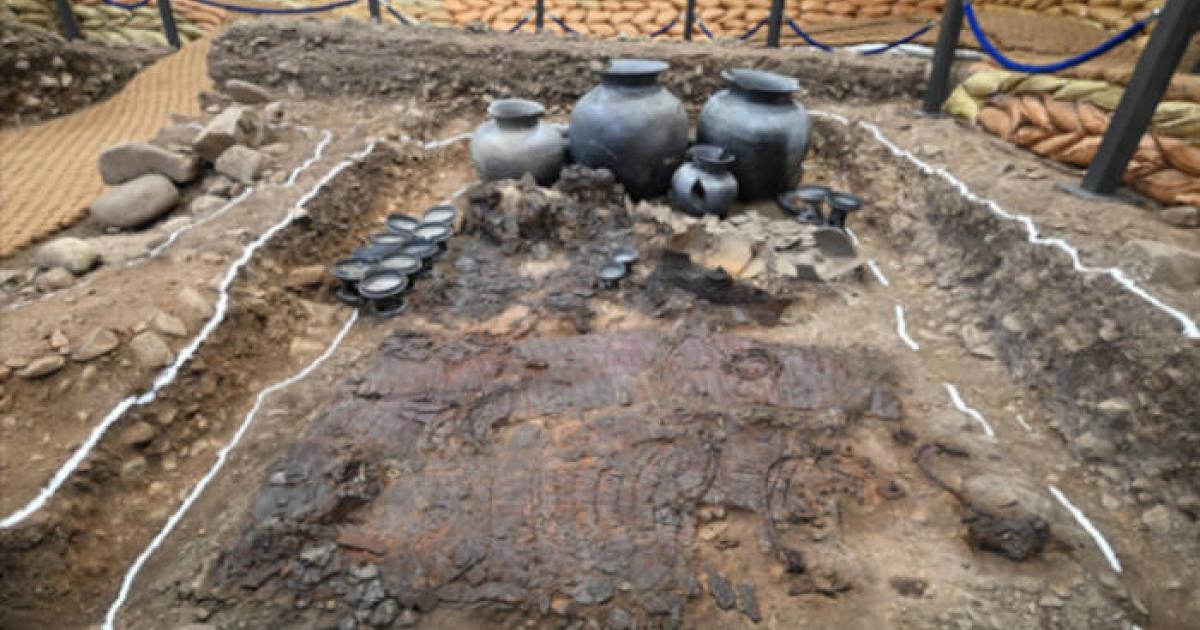
The Silla general’s tomb containing fragments of a gilt-bronze crown and armor. In a separate chamber is a man, believed to have been sacrificed to accompany the general to the afterlife. (Korea Heritage Service)
A General's Final Journey
The main burial chamber held the remains of a man in his early 30s, adorned with fragments of a gold-bronze crown featuring intricate openwork patterns. According to Archaeology Magazine, the crown pieces bear striking similarities to cap-style crowns found at other Silla sites, particularly the famous Geumgwanchong tomb in Gyeongju. The design also shares characteristics with gold-bronze ornaments attributed to the Goguryeo Kingdom found in Ji'an, China, suggesting cultural exchanges between the ancient Korean kingdoms during this period.
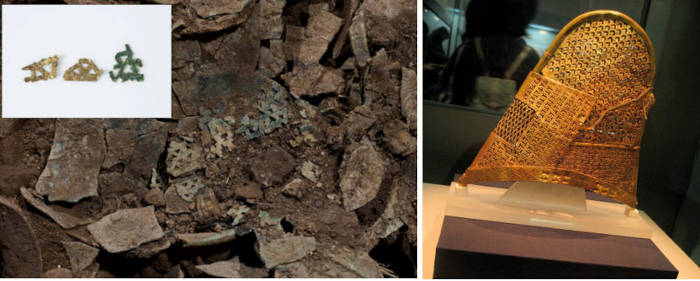
Left; Crown pieces found in the main chamber of the tomb. Right; A golden inner cap of a Silla crown from the sixth century. (Left; Korea Heritage Service, Right; Matt and Nayoung Wilsobn/ CC BY 2.0)
The tomb structure itself represents a transitional phase in Silla burial practices. Unlike the massive stone mound style typical of later tombs, this burial features a low, oval-shaped mound measuring 10.6 meters by 7.6 meters with a partial stone border, marking an evolutionary step in burial architecture.
Evidence of Live Burial
The side chamber revealed the most disturbing aspects of the discovery. The skeleton, presumed male and standing between 160 and 165 centimeters tall, was found with legs splayed outward in an O-shape. Kim Heon-seok, a researcher at Gyeongju National Research Institute of Cultural Heritage, explained that grave goods including pottery, armor, and helmets were placed in the chamber first, with the body then forced into the remaining space.
"The Samguk Sagi (The Chronicles of the Three States) records that Silla banned the practice of sunjang in the year 502 during the reign of King Jijeung, but this is the first time we have clearly identified a case of such burial with a complete skeleton," Kim stated.
- Shocking Discovery Shows Ancient Koreans were Sacrificed for Building Project
- Major Kingdom Finds Provide New Insights Into Korean History
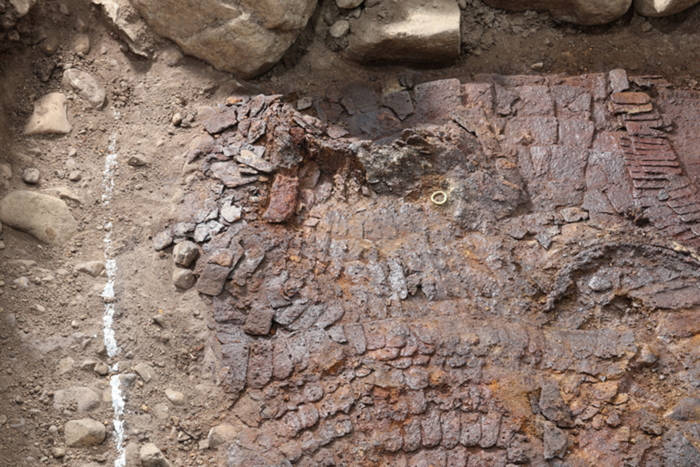
Lower Part of Armor excavated from the auxiliary chamber of Hwangnam-dong No. 1, Gyeongju. (Korea Heritage Service)
A gold earring discovered near the skull suggests the individual held considerable rank, indicating that even subordinates of status could be selected for the ritual sacrifice. The skeletal remains were badly corroded and entangled with soil and iron relics, but the complete skeleton allowed researchers to make definitive conclusions about this ancient practice.
Rare Military Equipment
Among the most significant finds were complete sets of armor and helmets designed for both humans and horses. This marks only the second time horse armor has been discovered in a Silla tomb, following the earlier find in Tomb C10 in Gyeongju's Jjoksaem District. Park Jun-hyeon, a researcher at Pukyong National University Museum, noted that unlike iron armor found in other tombs, this armor was constructed from organic materials such as leather, making it lightweight and suitable for heavily armed cavalry operations.
The discovery of such sophisticated military equipment provides valuable insights into Silla's expanding military power during the late 4th and early 5th centuries when the kingdom was engaged in territorial conflicts with neighboring Goguryeo and Baekje kingdoms.
Archaeological Significance
Since 2018, the restoration team has been surveying the Daereungwon tomb complex, discovering six wooden chamber tombs beneath Tomb No. 120. The positioning of Wooden Chamber Tomb No. 1 partially beneath the northern border stones suggests it predates the larger mound by 50 to 100 years, offering crucial information about the developmental stages of Silla tomb architecture.
Sim Hyeon-cheol, a history professor at Keimyung University, speculated that building a tomb directly over an earlier one might indicate shifts in ruling elites or changes in burial practices. A total of 165 artifacts were recovered, with the tomb site and artifacts displayed at the Silla Wolseong Research Center. The discovery reinforces Gyeongju's historical importance as the capital of the Silla Kingdom for nearly a millennium and demonstrates the ongoing archaeological potential of the region.
Top image: Armor and burial goods discovered a ritual burial beneath a Silla Dynasty tomb in Gyeongju, South Korea. Source: Korea Heritage Service
By Gary Manners
References
Kim, H.S. et al. 2025. Ancient tomb discovered beneath another, with man possibly buried alive 1,600 years ago. Available at: https://koreajoongangdaily.joins.com/news/2025-10-20/culture/koreanHeritage/Ancient-tomb-discovered-beneath-another-with-man-possibly-buried-alive-1600-years-ago/2424452
Silla Kingdom Tomb Excavated in South Korea. 2025. Archaeology Magazine. Available at: https://archaeology.org/news/2025/10/23/silla-kingdom-tomb-excavated-in-south-korea/

![The Great Pyramid Of Giza Top image: The Great Pyramid of Giza under a starlit sky, highlighting the North Face. Source: [Pixabay/Creative Commons] Image](https://www.ancient-origins.net/sites/default/files/styles/article_featured_big/public/field/image/Great Pyramid Of Giza_0.jpg?itok=yavsyDqT)