
Europeans did not always look the same as they do today. Among the things that have changed are skin tone, which has gotten lighter over time. In fact, according to new research, the pale complexions associated with European ancestry today only appeared in the region within the range of historical time.
In a new study published in the journal bioRxiv, researchers from the University of Ferrara in Italy introduce the fascinating results of their genetic study of ancient Eurasian populations, which show that light skin only became common in Europe in the first millennium AD. For 96% of the history of European people, dark skin was the norm, and it was only in the fourth of fifth century that more than half displayed the light skin tones recognized as “European” today. This means that even during the days of the Roman Empire, darker skin predominated on the continent.
In their enlightening survey, the researchers began by analyzing genetic materials taken from two populations, those of a Paleolithic people from Russia and a Mesolithic population from Sweden. They then compared the data with information taken from 348 ancient Eurasian genomes from other places, specifically to track changes in eye, skin and hair color over time—and what they discovered upended some previous assumptions.
“The shift towards lighter pigmentations turned out to be all but linear in time and place, and slower than expected, with half of the individuals showing dark or intermediate skin colors well into the Copper and Iron ages,” they wrote in thei bioRxiv article.
Converted into a number-based timeline, the results tracked the evolution of European skin color over the course of nearly 50,000 years, from about 45,000 years ago to 1,700 years ago.
Secret History of Skin Pigmentation Revealed by DNA
Based on this groundbreaking genetic analysis, it seems that light skin tones first appeared in Europe about 14,000 years ago (during the Mesolithic period) in Scandinavia. But light skin remained rare for the next 7,000 years or so. During the Copper and Bronze Ages (5,000 to 1,000 BC), light pigmentation continued to increase, but darker skin was still more widespread. This was a surprise for the Italian research team, who had expected to discover a much faster spread of light complexions.
- Skin Color Didn’t Matter to the Ancient Greeks and Romans
- Dark Skin and Blue Eyes: European Hunter-Gatherers Did Not Fit with Common Representations
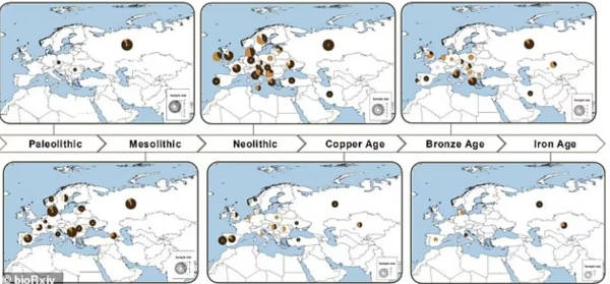
Chart of the changes in skin color that occurred over the course of tens of thousands of years in Eurasia, with pie charts to represent dark, light and intermediate skin tones. (bioRxiv).
There was some regional variation, however, as the shift took place more rapidly in northern Europe. By the Iron Age (3,000 to 1,700 years ago), light skin could be found in the majority of those who lived in this region, although darker skin was still present in the majority overall (and in a sizable minority in northern Europe). During this time dark pigmentation was still more common in southern Europe, including among the Romans who built the Republic and Empire and conquered so many peoples.
Overall, nearly all European individuals had dark pigmentation during the earliest period (Paleolithic, around 45,000 to 13,000 years ago), with only one exception showing an intermediate skin color.
In the Paleolithic (45,000 to 13,000 years ago), Europeans all had dark complexions, and this situation remained nearly the same into the Neolithic period, when the agricultural revolution began.
In Neolithic Britain in 8000 BC, 85% of the inhabitants were dark-skinned, with the biggest change coming from that point until 3,500 BC, when the ratio was about half and half. By the end of the Bronze Age in 500 BC, out of every four Brits there would have been one person with light skin (like that associated with the modern era), one with dark skin, and two with intermediate skin tones.
In France the change came more quickly. About two-thirds were dark-skinned during the Mesolithic, but by the middle of the first millennium BC the country had become virtually 100-percent light-skinned.
- 10,000-years-ago Irish Hunter-Gatherers Were Dark-Skinned
- Blue Eyed, Black Skinned British Hunter Closes Race Debate
Why Skin Color Evolved (and Will Continue to Evolve)
So why did the skin color of the ancestors of modern Europeans change at all? This as an evolutionary adaptation, rooted in a decline in hours of sunlight exposure experienced by the people who left Africa between 60,000 and 70,000 years to migrate northward, eastward and westward in large numbers, setting foot in Eurasia on a mass scale for the first time.

Map of human migration out of Africa and across the planet, which among other things led to evolutionary changes in skin color. (Ephert/CC BY-SA 3.0).
With lighter skin the body is able to absorb a higher percentage of the lower ultraviolet (UV) radiation emitted by the sun, and it is this radiation that boosts the body’s production of vitamin D, which is vital to the maintenance of strong bones and muscles. Conversely, darker skin offers more protection from UV-induced damage that can be caused by too much exposure to sunlight. So it seems that the proximity of a modern person’s ancestors to the equator (generally speaking) ultimately determined what their skin color would be today.
“When Homo spread Northwards from Africa into Eurasia, the selection regime thus changed, and lighter phenotypes emerged,” the researchers noted, using language that emphasizes the role of evolution in the changes.
Migration did play a factor in the eventual proliferation of light skin as well. During the Neolithic period farming people from the north of Europe spread out and settled in new regions, in response to the demands of population growth, carrying their rapidly developing tendency toward light skin tones with them. Overall what this intriguing research showed is the development of light skin in Europeans is a more recent phenomenon than was previously believed.
Top image: A representation of the unity of all humanity, regardless of race or ethnicity.
Source: Optimist Club.
By Nathan Falde