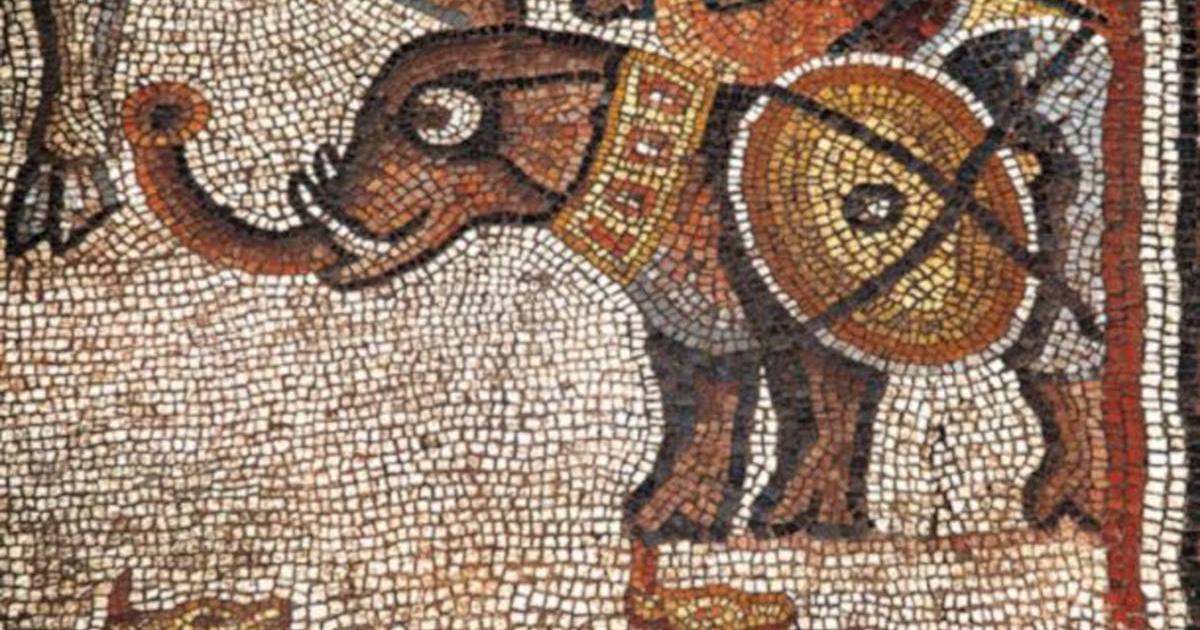
In a Galilean village just eight miles (12.5 kilometers) northwest of Tiberias, archaeologists unearthed an extraordinary mosaic floor inside a fifth-century synagogue. Among the vivid scenes depicted is an armored elephant, an unexpected image in a region where elephants never roamed.
This site, Huqoq, is now considered home to some of the most significant archaeological discoveries in Israel in recent decades, finds that have revealed fascinating truths about Jewish life during the late Roman and Byzantine periods.
Led by Professor Jodi Magness of the University of North Carolina, the excavation project (2011–2023) revealed a synagogue floor adorned with richly detailed mosaics portraying both biblical and non-biblical scenes. Some are familiar: Samson carrying the gates of Gaza, Jonah being swallowed by a series of fish, and the Israelite spies bearing a massive cluster of grapes from Canaan. Others are more surprising—like a full zodiac wheel featuring Helios, the Greco-Roman sun god, and the enigmatic elephant.
This kind of art challenges assumptions about Jewish religious expression during an era long thought to be dominated by aniconism (the opposition to using images or icons to represent deities or creatures from the natural and supernatural worlds). One interpretation offered by Magness suggests the elephant could reference a legendary meeting between Alexander the Great and a Jewish high priest, or to symbolize a military alliance involving John Hyrcanus and the Seleucid Greeks. Either way, it reflects a blending of traditions that historians are only beginning to fully acknowledge and understand.
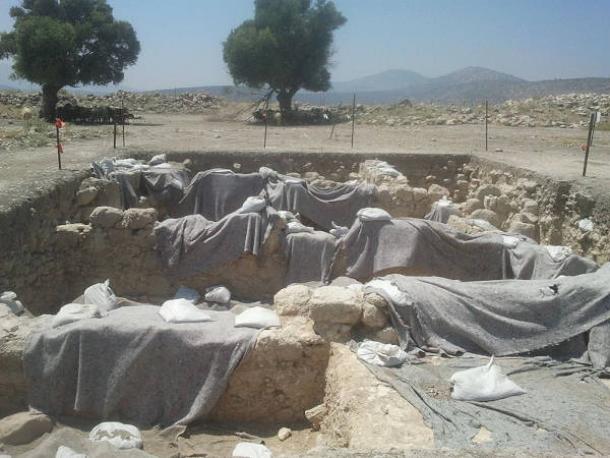
Huqoq archaeological site, near the village of Tiberias in Israel. (Hanay/CC BY-SA 3.0).
A Thriving Jewish Community Hidden in Plain Sight
The idea that Jews in post-Temple Israel lived quietly under Roman oppression has long colored historical interpretations.
- Valuable Coin Hoard and Medieval Synagogue Unearthed in Galilee, Israel
- “Rediscovered” Judean Roman Coffins Decorated For Afterlife Protection
Yet synagogue remains across the Holy Land tell a different story. Edward Robinson, a 19th-century American biblical archaeologist, was among the first to document the grandeur and abundance of ancient Galilean synagogues. Visiting the ruins of two synagogues at Bar’am in the 1800s, he marveled at their scale and craftsmanship—details that, to him, suggested prosperity and community cohesion rather than decline.
This impression has only been reinforced over the last century, with the discovery of more than 100 ancient synagogue sites in the region, many dating from the third to seventh centuries AD. Contrary to earlier assumptions, Jewish communities not only survived under Roman and later Christian rule, they often thrived, and apparently did not keep anything hidden about their beliefs or practices. Elaborate mosaic floors featuring figurative artwork of a kind not normally associated with synagogues was the rule at these places rather than the exception, indicating a level of artistic freedom and wealth that calls for a revision of the traditional narrative.
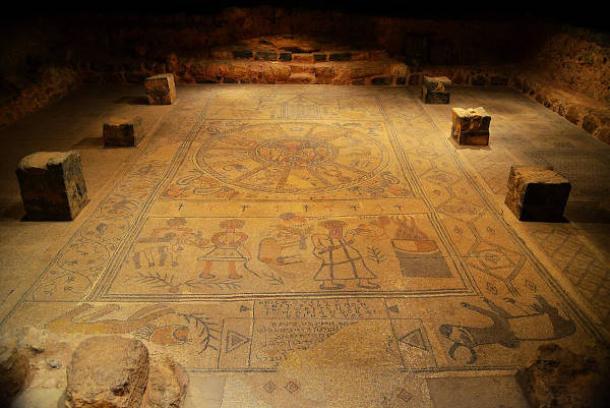
Remarkable mosaic imagery, including a central zodiac circle, on the floor at the Beit Alpha synagogue. (Zxc0505/CC BY-SA 4.0).
One example is the synagogue at Beit Alpha, unearthed in 1928 during construction work at Kibbutz Beit Alfa. Its mosaic floor features the binding of Isaac alongside a large zodiac circle with Helios at its center. Another example, the Na’aran synagogue near Jericho, also contains a wealth of amazing and evocative imagery, seen for the first time in centuries after it was accidentally exposed by a Turkish artillery shell in World War I. Both date to the sixth century and include artistic motifs that would have seemed out of place in a strictly iconoclastic religious setting at one time, although they are coming to be seen as the norm now.
Reconciling Religious Law with Figural Art
So how do we explain these figural depictions in light of the Second Commandment’s ban on graven images?
Scholars suggest that Jewish views on such art during the late Roman period were more nuanced than once thought. Archaeologist Lee Levine points out that, apart from Jerusalem, Roman cities were saturated with figurative art. Jewish communities living within this world likely adopted a more flexible approach, especially when the imagery served narrative or symbolic rather than idolatrous purposes.
- Mistaken Identity? Mosaic in Israel Purported to Show Alexander the Great, but Some Not So Sure
- Entire Prison in Israel to Be Moved to Save Third-Century Jesus Mosaic
Historical figures like Rabban Gamliel, head of the Sanhedrin after the Second Temple’s destruction, accepted figural representation if it was not used for idol worship. This perspective may have opened the door for the kinds of imagery seen in synagogue mosaics.
Still, there were complexities. Levine raises the issue of how worshippers might have conducted rituals—such as lying prostrate during fast days—on floors decorated with zodiac signs and pagan deities. The answer remains speculative, but the evidence suggests that Jewish religious practice in this era was adaptive rather than rigid.
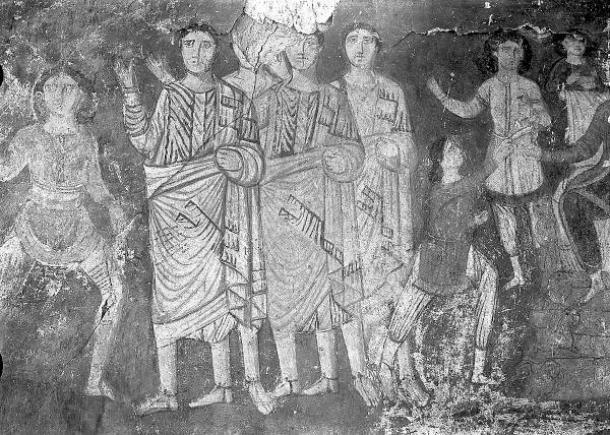
A photograph from Dura-Europos synagogue of a painting showing scene featuring Mordecai and Esther. (Anonymous/CC0).
This artistic leniency wasn’t limited to the Land of Israel. In 1932, the synagogue at Dura-Europos—a Roman frontier town in modern-day Syria—was uncovered. Dating to 244 AD, its walls were covered in vibrant murals depicting scenes like Moses parting the Red Sea and the binding of Isaac. Though these paintings lacked the zodiac and Helios motifs seen in Israeli synagogues, they still reveal a comfort with visual storytelling that belies the notion of strict religious prohibitions.
The Intriguing Legacy of Jewish Artistic Expression
This acceptance of figural art continued centuries later in a very different context: the wooden synagogues of Eastern Europe. In the 16th and 17th centuries, the Polish-Lithuanian Commonwealth saw the rise of elaborate wooden synagogues, many adorned with intricate carvings and paintings on walls and ceilings. These designs frequently featured liturgical verses, animal motifs—including elephants—and the signs of the zodiac.
One of the most impressive examples that displayed all of these was the Gwoździec Synagogue in what is today Ukraine. Although destroyed during the Nazi occupation, photographs preserved its memory. A stunning reconstruction of its ceiling now resides in the POLIN Museum of the History of Polish Jews in Warsaw, a testament to a rich artistic heritage nearly lost to history.
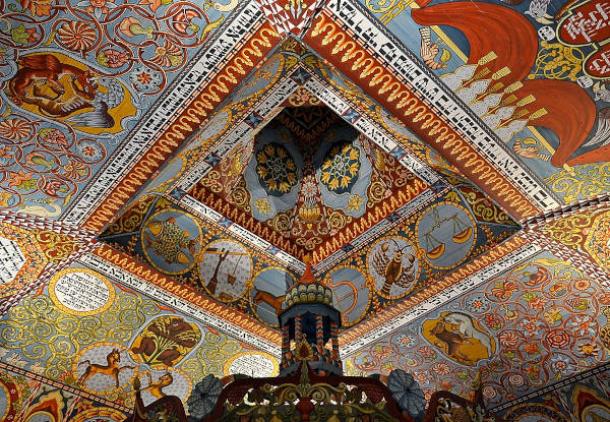
Recreation of the colorful ceiling of the Gwoździec Synagogue, displayed at the Museum of the History of Polish Jews in Warsaw. (Pudelek/CC BY-SA 4.0).
What all of this reveals is incredibly significant. First and foremost, Jewish communities were far from marginal after the Temple’s destruction. Archaeological evidence from Huqoq, Beit Alpha, Dura-Europos, and beyond demonstrates that Jews adapted to their surroundings while maintaining distinct cultural identities. The blending of sacred tradition with visual expression, even when it involved pagan symbols, speaks to a dynamic religion negotiating its place in a complex world. This was a survival strategy, but it also shows that most people’s idea about worship is flexible and adaptable, rather than being rigid and tied to fundamentalist conceptions about what religious practice is “supposed to” look like.
Top image: Elephant Mosaic, Huqoq, Galilee region, Israel, featuring an elephant alongside other soldiers and war animals, as well as an elder holding a scroll surrounded by young men with sheathed swords.
Source: Jim Haberman.