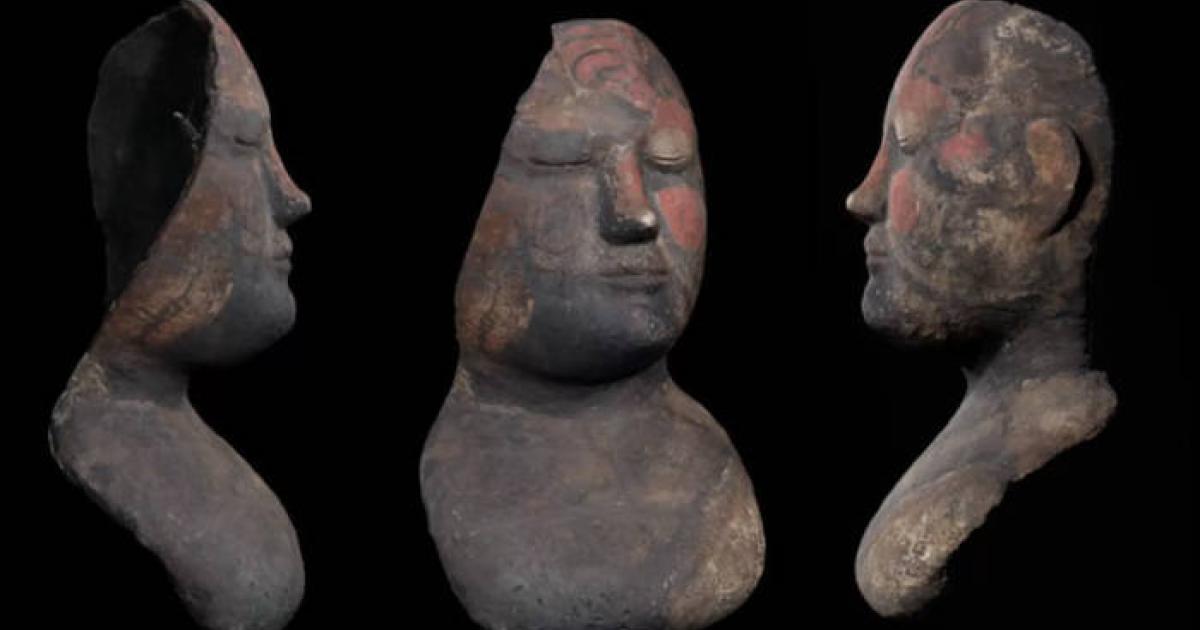

Cutting-edge artificial intelligence has brought ancient Siberian funerary masks back to life, revealing unprecedented details about the mysterious Tashtyk culture that flourished in southern Siberia between the 1st century BC and 7th century AD. Researchers at Moscow's State Historical Museum, collaborating with technology experts, have successfully reconstructed missing elements of these rare gypsum death masks using advanced 3D scanning and AI-based digital restoration techniques.
The project offers the public an unprecedented glimpse into the spiritual and artistic world of a vanished civilization whose elaborate funerary rituals included creating lifelike masks to preserve the identities of the deceased for centuries-long commemorative ceremonies.
- Tashtyk Death Mask Scan Reveals Evidence of Prehistoric Surgery
- Mystery of 2100-year-old Death Mask Found to Contain Ram's Skull
Preserving the Faces of the Dead
The digital restoration was developed based on archaeological evidence, comparisons with similar artifacts, and studies of ancient mask-making methods. The State Historical Museum currently preserves 26 fully restored Tashtyk masks, six partially preserved examples, and fragments of nearly 200 additional pieces - most discovered during excavations in modern-day Krasnoyarsk Krai between the late 19th and early 20th centuries.
"Modern technologies significantly expand the possibilities of archaeological science, allowing us to examine the structure and composition of artifacts without risking damage to priceless cultural heritage," explained Alexey Levykin, Director of the State Historical Museum, according to an Arkeonews report.
Advanced digital radiography is helping researchers uncover hidden details invisible to the naked eye, from crafting methods to structural features that reveal secrets of ancient burial practices.
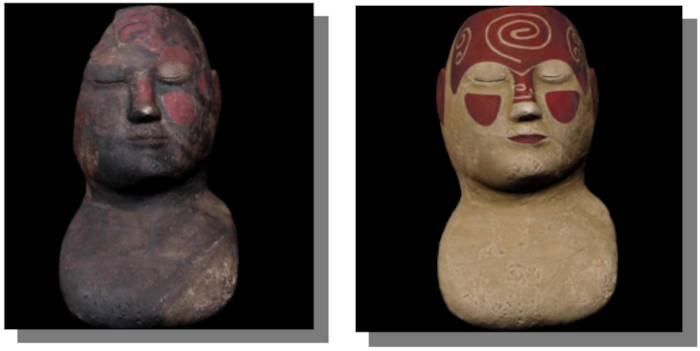
The original and then AI recreated Tashtyk funerary mask. (Russian State History Museum)
Sacred Vessels of Memory and Identity
Unlike many ancient cultures that practiced burial of intact bodies, the Tashtyk were known for elaborate cremation rituals. After cremating the deceased, families would place carefully crafted funerary masks on mannequin-like effigies of the dead person, preserving their likeness for complex commemorative ceremonies that could last months or even years.
These masks often featured finely painted facial features and were sometimes adorned with hair, jewelry, or textiles. The distinctive artistic style shows clear gender differences: women's masks were typically painted white with red spirals and scrolls, while men's were red with black stripes. Scholars believe they symbolized both ancestor veneration and the continuity of life after death, making them sacred vessels of memory rather than mere artistic objects.
- The Female Siberian Ice Maiden Whose Legend Lives On
- The Stunning Ancient Tattoos of the Pazyryk Nomads
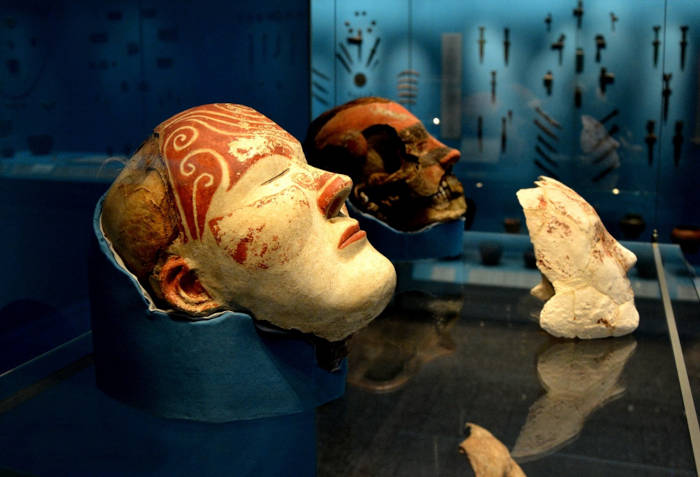
Tashtyk funerary masks displayed at the State Historical Museum, showcasing the remarkable preservation and artistic sophistication of these 2,000-year-old artifacts. (dibattista/CC BY-SA 2.0)
Enigmatic Multi-Ethnic Civilization
The Tashtyk people remain largely mysterious to archaeologists. Research suggests they were a multi-ethnic community influenced by Scythian, Sarmatian, and Central Asian nomadic groups who lived in fortified settlements and practiced both agriculture and skilled artisanship, particularly in metalwork and textile production. Their culture eventually disappeared around the 7th century AD, absorbed by waves of Turkic migrations across ancient Siberia.
The fusion of archaeology and artificial intelligence opens new possibilities for heritage preservation. Interactive 3D models can now be studied online by scholars worldwide and appreciated virtually by museum visitors, ensuring that even fragmented artifacts can be digitally reconstructed to provide fuller understanding of ancient burial traditions and spiritual worldviews.
The digital resurrection of Tashtyk funerary masks highlights both the enduring legacy of this vanished Siberian civilization and the power of modern technology to bring history back to life, transforming silent archaeological fragments into vivid stories of human creativity, ritual, and the universal desire to preserve memory beyond death.
Top image: Various aspects of the Tashtyk funerary mask without digital restoration. Source: Russian State History Museum/Yandex 360
By Gary Manners
References
Altuntaş, L. 2025. Tashtyk Mask Digital Reconstruction Project. Available at: https://arkeonews.net/2000-year-old-siberian-funerary-masks-reveal-secrets-of-the-tashtyk-people/
Russian State History Museum. 2025/ On Archaeologist's Day, the State Historical Museum and Sber's Center for Immersive Technologies presented a digital interactive copy of the Tashtyk mask. Available at: https://shm.ru/upload/iblock/b6f/31zuhvmyx0zy1chg7384ccjgpjek0x96/PR_SBER-MASKA-_1_.pdf