



Today, the word "Aryan" has become synonymous with all sorts of negative connotations, including theories of racial superiority and white supremacy. This association has led to a widespread misunderstanding of the term's origins and meaning, and resulting baseless concepts related to a supposed Aryan race have been coopted and misused by racist ideologies.
Only in the late 19th early 20th centuries did Aryan become equated with Germanic or Nordic peoples. Prior to this corruption, Aryan referred to an archaic language whose speakers are thought to have spread and influenced languages throughout the Indian subcontinent.
- Ahnenerbe: Nazi Secret Society and their Reinterpretation of History
- Unearthed Brooch Tells of the Nazis’ Abuse of Ancient Norse Runes to Spread Their Dark Ideology
Over time, and largely due to Nazi ideology, Aryans have become associated with racial hierarchies that consider white-skinned, blonde and blue-eyed peoples as superior. This served as a very useful propaganda tool for couching racist sentiments in seemingly scientific or historic, yet completely false, realities.
The Nazi regime's misappropriation of the term “Aryan” resulted in a legacy of hatred, discrimination, and persecution that continues to impact society today. To counteract the harmful misconceptions that have been propagated in the name of the "Aryan" label, it is essential to understand its true meaning and historical context. Recognizing the origins of the term and how it has been misused in the past can help us move towards a more inclusive and equitable society that respects diversity and rejects racist ideologies.
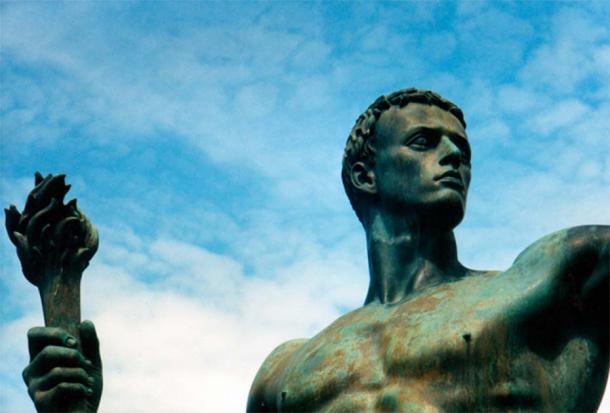
Neoclassical Nazi sculpture by Arno Breker, created in 1939, which depicted desirable characteristics supposedly representative of what the Nazi party dubbed the “Aryan race. (Arno Breker / CC BY-SA 3.0)
The Real Aryans: Putting Nazi Suppositions About Aryan Race to Rest
To quickly put any Nazi suppositions to rest, the earliest known Aryans lived in prehistoric Iran. These people migrated to northern India sometime around 1,500 BC. Previous inhabitants of the Indian subcontinent called these newcomers ārya. The English term “Aryan” comes from this Sanskrit word. Interestingly, the term has a cognate in the Persian language, ērān. This word is the source of the name of the modern-day country known as Iran.
Prior to the arrival of the Aryans, the Indus Valley Civilization had already achieved a high level of development. Research indicates that the social conditions of the Indus Valley Civilization were comparable to those of Sumeria, and in some aspects superior to the Babylonians and Egyptians of the era. By 5500 BC, the world witnessed the emergence of religions, followed by farming communities around 4000 BC, and the development of urban living around 2500 BC. The peak of this ancient civilization was reached around 2000 BC.
The Hindu Kush Mountains served as a gateway for nomadic cattle herders from Central Asia to settle in the lush Indus Valley from about 1500 BC. These nomads were, of course, the Aryans. Contrary to popular myth, the Aryans were not unstoppable invaders, but rather a group that gradually migrated to the region. There is limited evidence to support the notion that the Aryans were proto-Mongols who conquered the Indian subcontinent and caused the collapse of the Indus Valley Civilization as a result.
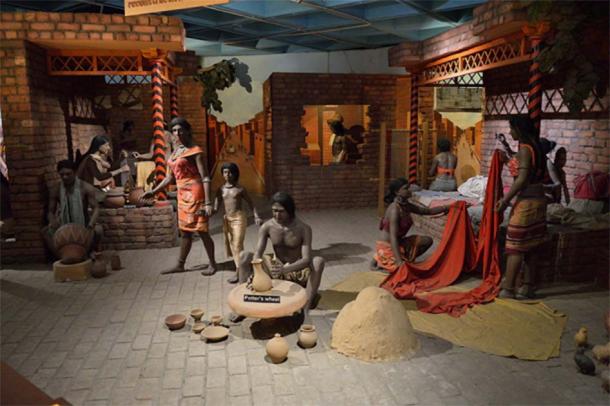
Diorama of everyday life in Indus Valley Civilization at the National Science Centre in Delhi, India. (Biswarup Ganguly / CC BY 3.0)
In reality, the Indus Valley Civilization may have declined due to various factors, including environmental changes and social factors. It appears that the Aryans filled the void left by the decline of the Indus Valley Civilization over time, rather than invading and taking over the region by force.
Archaeological findings indicate that the societies in the Indus Valley region were already in decline by 1800 BC, possibly due to changes in river patterns. The exact cause of this decline is a subject of debate, with some researchers proposing that the drying up of the Saraswati River was the culprit, while others suggest that it was due to catastrophic flooding. However, students of environmental science will recognize that these theories are not mutually exclusive, and both factors may have played a role in the decline of the civilization.
The agricultural practices that allowed the Indus people to thrive were disrupted by natural disasters, such as floods and droughts, as well as invasions. As a result, the economies and societal orders that were based on those practices crumbled. The decline of the Indus River Civilization is supported by various pieces of evidence, such as the disappearance of writing, the abandonment of some cities, and the interruption of trade connections with the Near East. Shortly after this decline, the Aryans arrived in the region, and their language, agricultural techniques and animal husbandry practices began to take root and prosper.
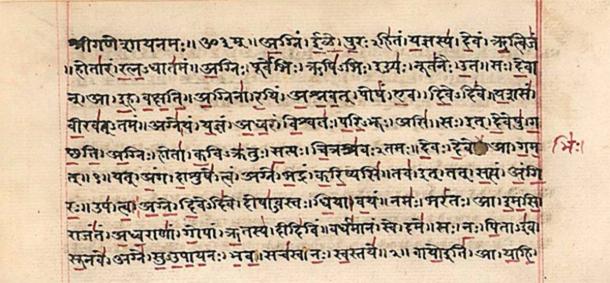
The English term “Aryan” comes from the Sanskrit word ārya. Representational image of Sanskrit manuscript. (Public domain)
Uncovering the Origins and Evolution of the Kingdom of Aryan
There is a distinct lack to evidence which sheds light on the true history of the Kingdom of Aryan. The ancient sources that reference the Aryans only do so in passing, and their accuracy cannot be ascertained. For instance, the Greek historian Herodotus described the people of Media as having once been called Aryans. “The Medes were called anciently by all people Aryans; but when Medea, the Colchian, came to them from Athens, they changed their name. Such is the account which they themselves give,” he wrote.
However, scholars are divided on the credibility of this account. Some believe that Herodotus was merely recording a popular legend, while others maintain that the story may have some historical basis. Despite these uncertainties, the study of ancient texts and archaeological findings provides some insights into the origins and evolution of the Aryan civilization.
The lack of archival evidence related to the Aryans is not very helpful when it comes to understanding the character of Aryan people. An equally sketchy account of ancient Aryan legitimacy is the Zoroastrian religion. The term Airyana Vaejah, which translates as “Aryan expanse,” refers to the mythical homeland of the Iranian people and is supposed to be the center of the world. This engenders the term with a certain amount of respectability, but still does not really give any racial or hierarchical meaning to it.
Elsewhere, Persian kings like Darius the Great and Xerxes were historically described as Aryans of Aryan stock. This most likely refers to the original Aryans coming from Central Asia. Possibly due to Zoroastrian influences on Vedic religions, the terms arya and anarya are used in a moral sense, as to distinguish proper behavior from improper behavior. An Aryan thus was one who lived according to his or her dharma. Although it is not clear if this word derives from a tribal name, this provides clues as to how this designation could have begun to take on connotations of nobility and superiority.
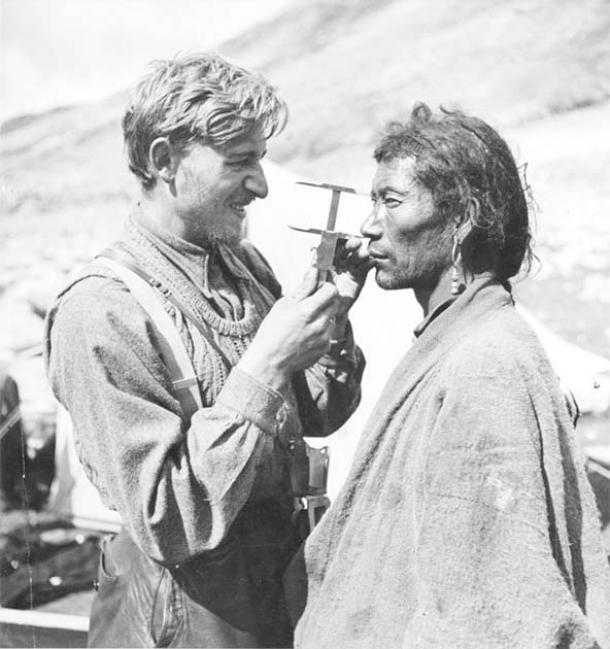
German anthropologist, Bruno Beger, conducting anthropometric studies as part of his work with the Nazis in their “scientific” studies to prove the superiority of the “Aryan” German race, as opposed to that of the “racially inferior” Jewish race. (Krause, Ernst / CC-BY-SA 3.0)
“Aryan” Becomes Distorted: Nazi Ideology and Aryan Race Theory
The use of the term Aryan has a long and complicated legacy that extends from ancient history into the modern era. For instance, in the Indian epic the Ramayana, the demon king Ravana refers to himself as an arya. Some scholars believe that this could be because he belonged to the highest caste or because he acted honorably, while others argue that it reflects the ancient usage of the term to denote a community or tribe.
At some point in history, the term Aryan transitioned from its original use as an Indo-Iranian term to describe a language, to being applied to Indo-European peoples. The theory that these ancient European peoples originated from the frigid north and conquered all of Eurasia gave rise to the notion that they were the Aryans.
Due to lack of any scientific or concrete evidence, this theory has been largely debunked by modern scholars. Nonetheless, the concept of the Aryan race continued to evolve over time and became deeply embedded in certain ideologies and beliefs, leading to widespread discrimination and prejudice.
Over time, the meaning of the word became muddled and misappropriated for political purposes. By the dawn of the 20th century, the idea of the Aryan race had become entangled with notions of nobility and superiority. These ideas were embraced by some and misused by others, including the Nazis, who sought to promote their twisted ideology of racial purity.
- Stash of Books from the Witch Library of Nazi Chief Himmler Found in Prague
- Sorry European Racial Purists, It Turns Out Your Ancestors were African and Middle Eastern
The concept of legitimacy and superiority has often been associated with age and antiquity. Thus, the Nazi Germans found it convenient to declare themselves the descendants of the ancient and noble so-called Aryan race.
According to this line of thinking, the Aryan race was believed to be the most superior race in the racial hierarchy, who once ruled all of Eurasia. This pseudo-scientific propaganda served as a powerful tool for the Nazis to promote their ideologies of racial superiority and achieve their political ends, ultimately leading to the atrocities of the Holocaust.
Please note that today, the appropriate term is Proto-Indo-European (PIE) languages, and it implies not that one language conquered and influenced all the others, but rather that many ancient languages in Eurasia seem to share common origins. PIE subcategories include Proto-Celtic, Proto-Baltic-Slavic, Proto-Greek and Proto-Indo-Iranian (the Indo-Aryan language can be found under this last category). Certain neo-Nazi groups still posit that the Aryan race is Germanic or Nordic - but this is not supported by any historical or archaeological evidence.
Top image: Tablet depicting Aryan warriors. Source: Justin Gauraqv Murgai / CC BY NC ND 2.0













The true Aryans
Permalink
I would add that the article follows an ancient thinking that the Aryans, whoever they were, had entered northern India from Iran. This theory is disproved now. Linguistic evidence is very clear about this. The language of the incoming Aryans to India did NOT come from Iran, but rather from a previous precursor language common to both Iranians and Indian Aryans. From a cultural perspective, Iranian culture did not come into India with the Aryans; Indian Aryans had a completely different culture, folklore, legends and philosophy. None of it can be thought of coming from Iran. Iranian culture did indeed come to India, but that happened MANY years later - thousands of years - with the Muslim rulers which came to India - in large numbers after the 12th century AD. So the claim that Indian Aryans came from Iran is a discredited theory and it should be put to rest now. It is not known where they really came from; certainly they traversed central Asia; may have originated in the southern Caucasian mountain region. But they carried into India, a completely unique culture that is of neither Iranian, nor central Asian origin. There are people in India (a rather large number) who do not think the Aryans came into India from anywhere; they were indigenous, and had fanned outward from India than inward migration. Even that theory has been proven wrong by recent genetic studies; unquestionably, a group of outsiders with a distinctly different gene pool did indeed enter India from the outside around 1,500 BC; they were presumably the Aryan that the ancient Indian literature speaks of.
Aryan migration
Permalink
In reply to The true Aryans by A. Rakshit (not verified)
This is false, ARYANS DID MIGRATE FROM INDIA IF THEY WERE A PEOPLE! ThIs HAS BEEN PROVEN BY MODERN GENETICS! Spencer wells the geneticist from national geographic PROVED THAT AFTER THE OUT OF AFRICA MIGRATION, THERE WAS AN OUT OF INDIA MIGRATION TO THE REST OF THE EURASIAN LANDMASS!
There is no evidence of an Aryan migration, the ancient India DNA samples have not been tested in IVC sites and published so far, infact not all of the India/South Asia region has been tested due to difficulties with population sampling in the region; it was actually illegal to take genetic samples in the South Asia region until recently. Also when geneticists are publishing these sort of moronic research articles, they don't take into account that Afghanistan, Pakistan, Bangladesh, Sri Lanka, Nepal etc etc were all originally part of Indian civilization; infact the Indus Valley civilization stretched from parts of Iran and Afghanistan to all the way to near Central India.
Those countries DNA results and lineages are not counted when these genetic reports are published regarding subject matter like these. So when the genetic reports state steppe DNA, this really doesn't make sense because for one the steppe region populations TODAY are not the SAME as the ones from the Neolithic or ancient time periods, just like modern White Europeans are not the same population as Neolithic Europeans, which basically backfires and leads to the opposite conclusion that Aryan invasion proponents come to; secondly India/South Asia has the highest genetic diversity of populations of the Eurasian continent outside of Africa and was one of the first places that Out of Africa migrants stopped to before peopling the rest of Eurasia.
This means that the "steppe DNA" would in all likelihood originated IN INDIA BEFORE TRAVELLING TO EUROPE AND CENTRAL ASIA AND PART PARCEL OF THE WIDE GENOMIC VARIETY OF THE INDIA REGION! This is proved by the fact that genetic haplogroup R1a, the genetic haplogroup associated with the spread of IE/Turkic steppe peoples, also originated in the India/South Asia region BEFORE TRAVELLING TO EUROPE!
There is more R1a in the India/South Asia region then the entirety of the Europe region combined; not to mention the fact that European versions of R1a ARE NOT FOUND IN INDIA/SOUTH ASIA, HOWEVER INDIAN VERSIONS OF R1a ALONG WITH INDIAN MATERNAL GENES ARE FOUND WITHIN EUROPEAN POPULATIONS AS WELL AS CENTRAL ASIAN POPULATIONS AND IN THE TARIM MUMMIES!
Then there is the fact that there is virtually zero evidence of Vedic Indian culture outside of the India/South Asia region during the Indus Valley civilization period and even during its decline phase; there is no evidence of sanskritic, or Indic style monuments or artifacts or Vedic fire altars found in Europe or Central Asia or Siberia before the decline of the Indus Valley period or even during the supposed Aryan migration period; on the otherhand THERE IS EVIDENCE OF CULTURE CONTINUITY AND AN INDIGENOUS ORIGIN OF VEDIC ARYAN INDIAN CULTURE, IN THE FORM OF VEDIC STYLE FIRE ALTARS, SWASTIKA SYMBOLISM, VEDIC STYLE WHEEL AND CHARIOT REMAINS FOUND IN THE INDUS VALLEY REGION PREDATING THE SUPPOSED ARYAN MIGRATION PERIOD!
There is also no actual physical archaeological evidence of an Aryan migration happening, there is no corded ware pottery, no remains of actual eurasian steppe horses found within the IVC area during it's decline phase, no battle axes or weapons caches, no large scale horse and chariot burials, no Kurgan burial mounds or large burial mounds of any kind as would be expected from a steppe Androvono type presence, no actual skeletons of Aryan peoples and fossil evidence of battles between supposed Aryans and Dravidians (but which we find plenty in Europe) and in the archaeological record.
Indeed there is no actual PHYSICAL ARCHAEOLOGICAL EVIDENCE OF THIS EVENT EVER HAPPENING! The dearth of actual archaeological evidence of this occurring MEANS IT NEVER HAPPENED! I mean there is so much more evidence that easily refutes AMT/AIT, but you white nationalist eurocentric morons aren't interested in the truth or even logic, but simply subscribing to your stupid idiotic contrived and artificial fantasy pseudo-scientific world view and religions of eurocentrism!
False
Permalink
In reply to Aryan migration by Dan Neutron (not verified)
False, out of Africa has been debunked already many times. True aryans are also white indo Europeans.
Aryans
Permalink
I agree with Mr. Rakshit. I would like to add that Aryans came from the west and were Europeans from the Aegean Sea and the Black Sea...Their most advanced human civilizationat Hemus peninsula dates back to 6000 BC.
Iran and Hindus
Permalink
I'm sorry but the idea that the original 'aryans' came to India from Iran is amateur conjecture. There is a good amount of analysis by Indian Indologists that the Zoarastrian text is a mirror representation of the later parts of the Vedas. This means they are a provincial offshoot of the Indian religion. Western analysis of 'Aryan' history is getting more and more obsolete because westerners either totally ignore the writings of Indian scholars by lumping all of them in one category under the rubric 'right-wing Hindus' or they are outdated because they have not keep themselves abreast with the latest research-based writing coming out of India and elsewhere.