
Could our entire universe, including the planet we live on and the lives we lead, actually be a highly complex holographic illusion? A number of respected physicists are proposing exactly that, and not as a metaphor, but as a serious framework for understanding the cosmos.
This radical concept is gaining support as a possible solution to some of the biggest mysteries in modern physics. These include paradoxes surrounding black holes, the strange mechanics of quantum particles, and even the nature of the universe moments after the Big Bang (although the Big Bang itself may be an illusion). Seen through the lens of holography, some of these puzzles might finally begin to make sense.
One of the leading voices in this field is Professor Marika Taylor, a theoretical physicist at the University of Birmingham. She suggests that what we perceive as a vast, three-dimensional universe might actually be a projection originating from a two-dimensional surface. Similar to how 3D visuals are created from a flat cinema screen, our experience of depth and space could be an illusion created by the underlying physics.
“In reality, the universe could be fundamentally two-dimensional,” Taylor explained in an interview published in the Daily Mail. “However, it appears three-dimensional to us due to the way it is projected.”
This doesn’t mean the universe or our experiences are somehow false, Taylor added. Instead, it points to a cosmos far more complex and counterintuitive than we've imagined, one where we have to take the information we collect from our own senses with a grain of salt.
- Chronovisor: The Time Machine That Captured The Crucifixion of Jesus
- A War in the Heavens: In the Far Reaches of Outer & Inner Space
The Holographic Principle: Reality Is Not What It Seems
To understand what scientists mean by a “holographic universe,” it’s helpful to look past everyday uses of the word "hologram." In physics, a hologram is a two-dimensional surface that stores and displays three-dimensional information. Think of the reflective images on some credit cards, where the image shifts as you tilt it. Although it appears to have depth, it’s ultimately flat.
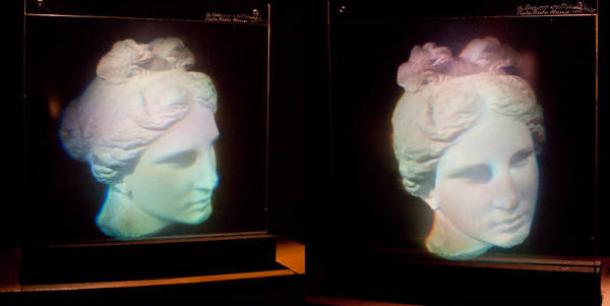
Hologram version of an ancient bust of Aphrodite. (Kenneth Lu/Flickr/CC BY-SA 2.0).
Some physicists propose that our universe works the same way. Instead of existing in true 3D space, howeer, all of reality might be encoded on a distant 2D boundary, with everything we perceive—including galaxies, stars, planets, and even people—emerging as a projection from this surface.
Professor Taylor describes the universe as more like a hollow ball than a solid object. All the familiar structures—solar systems, star clusters, nebulae—reside inside the apparent 3D volume of the ball. But the true source of this structure, according to the theory, lies on the ball’s 2D outer surface.
According to what's known as the holographic principle, you don’t need to describe every detail of the three-dimensional space to understand the universe. Alternatively, all the information can be thought of as residing on this two-dimensional shell. The way planets move and gravity behaves inside the “ball” can be calculated purely based on what's happening on its 2D border.
“It is very hard to visualise this. However, it is also quite hard to visualise what happens inside an atom,” Taylor points out. “We learned in the early twentieth century that atoms follow quantum rules, which are also quite different from our everyday reality. Holography takes us into an even more extreme world, where not only are the forces quantum in nature, but the number of dimensions is different from our perceived reality.”
This view can seem disorienting, especially to those who have seen Hollywood depictions like The Matrix that are essentially dystopian in nature. But Taylor emphasizes that such comparisons can be misleading. “The Matrix movies are very thought-provoking but probably don't quite capture all the ideas in holography,” she said.
Fermilab, a leading particle physics lab in the United States, agrees. While the idea of the universe as a kind of projection may sound like simulation theory, that’s not what scientists are claiming. “The notion that our familiar three-dimensional universe is somehow encoded in two dimensions at the most fundamental level does not imply that there is anybody or anything ‘outside’ the two-dimensional representation, ‘projecting’ the illusion or ‘running’ the simulation,” Fermilab states.
- Science Versus Religion on Our Ancient Origins: What if They’re Both Wrong?
- Radical new documentary claims Copernicus and four centuries of science is wrong
This means we don’t have to see ourselves as characters in someone’s computer program in order to accept that we’re living in a hologram—although perhaps there really is a programmer at the top, and scientists just find that idea too unsettling to contemplate.
The Black Hole Puzzle and the Origins of Holographic Thinking
A major driving force behind the holographic universe theory is the need to resolve a long-standing problem in physics: the black hole information paradox. Originally proposed by Stephen Hawking, this paradox challenges one of the core tenets of quantum mechanics—namely, that information can’t be destroyed.

Matrix imagery, the production of 3D visual images encoded digitally in ones and zeros. (phsymyst/Flickr/CC BY-SA 2.0).
Professor Taylor elaborates: “The information paradox is that black holes seem to lose memory of what has been thrown inside them.”
Imagine you write a note, shred it into tiny pieces, and toss the confetti into a trash bin. Technically, someone could reassemble the scraps to recover the original message. But if you throw that shredded note into a black hole, it appears that the information vanishes entirely. That’s a big problem for physicists because it implies a fundamental law of the universe is being broken. However, some researchers believe that if we think of black holes as two-dimensional surfaces instead of deep, 3D pits, this problem can be sidestepped. In this version of reality, any information that falls into a black hole becomes encoded on its surface, not lost inside it. Even Hawking, who first posed the paradox, began to support this solution in the years leading up to his death.
The implications of this idea go beyond black holes. They suggest that aspects of reality like gravity and the third dimension aren’t basic ingredients of the universe, but instead are “emergent properties”—features that arise only when the underlying structure behaves in certain ways.
Professor Kostas Skenderis, a mathematical physicist from the University of Southampton, offered a useful analogy: “Temperature is not an intrinsic property of elementary particles. It rather emerges as a property of a collection of them. This does not make temperature less real. It rather explains it.”
In the same way, gravity and spatial depth may emerge when components of a 2D universe interact. They’re real, but not fundamental.
“Black hole physics suggests that we only need information in 2D space to describe the 3D universe,” said Skenderis, which represents the sort of simplicity that many scientists find attractive.
Searching for the Universal Truth
Proof of the holographic theory is elusive. Despite strong theoretical support, there’s no definitive “smoking gun” evidence that the universe is holographic. But that hasn’t stopped researchers from searching.
Professor Taylor acknowledges that conclusive proof could be challenging to find. But promising clues may be found in the oldest light in the universe: the Cosmic Microwave Background (CMB), which is a faint afterglow left behind from the Big Bang.
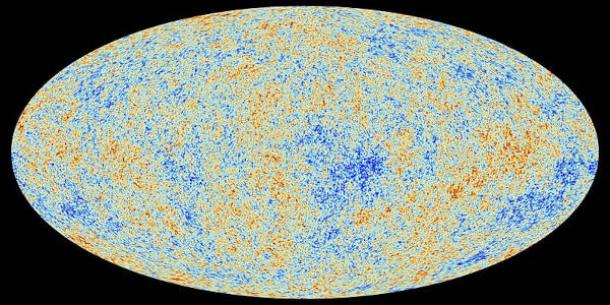
Map of the Cosmic Microwave Background radiation, imprinted on the sky when the universe was 370,000 years old, with colors representing temperature variations. (ESA and the Planck Collaboration/CC BY-SA 4.0).
Professor Craig Hogan, director of the Fermilab Center for Particle Astrophysics, believes this ancient radiation could contain hints of the universe’s holographic structure.
“The CMB, and all large-scale structures, are supposed to come from quantum-gravitational noise,” he explained. “If it’s holographic, the CMB pattern shows signs of that. It preserves an image of the process that made [it].”
In fact, research conducted by Skenderis and his team found that holographic models can accurately describe the tiny variations in the CMB. “We tested the predictions of holographic models against the observed properties of CMB, finding excellent agreement,” he said. “This is the only direct observational test of holography to date.”
While scientists continue to investigate the holographic nature of the cosmos, one thing is clear: if true, this theory doesn’t reduce the universe to a trick of the light and shadow. Instead, it reveals a richer and stranger reality—one where dimensional depth, gravity, and even time might be side effects of a deeper, more abstract truth. And in that reality, what we see isn’t false—it’s just not the whole story.
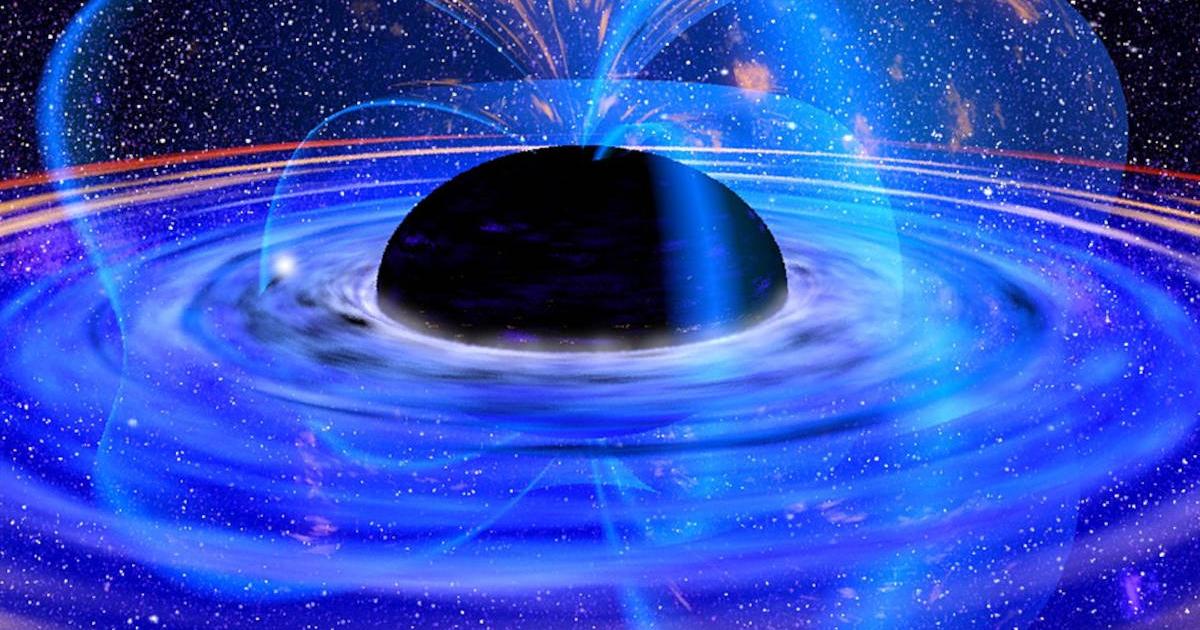
Top image: Artist’s conception of a spinning black hole, warping reality as predicted by Einstein’s theory of relativity.
Source: NASA.
By Nathan Falde