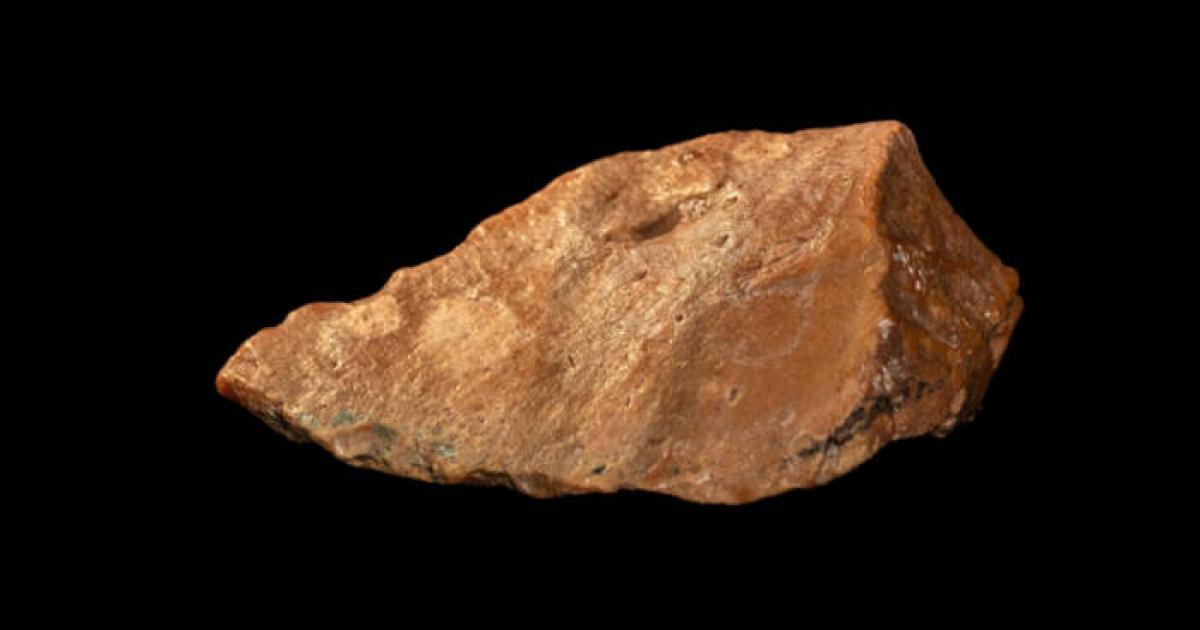

Archaeological excavations on the Indonesian island of Sulawesi have uncovered seven stone tools dating back at least 1.04 million years, potentially extending to 1.48 million years ago. This groundbreaking discovery, published in the journal Nature, represents the oldest evidence of hominin occupation in the Wallacean archipelago and suggests that unknown human relatives were capable of oceanic crossings far earlier than previously imagined. The identity of these ancient toolmakers remains one of archaeology's most tantalizing mysteries.
- Taking a 'Knapp' With Our Ancient Ancestors - Stone Tools Through Time
- Ancient Stone Tools Found on Sulawesi, but who made them remains a mystery

The seven stone tools discovered on Sulawesi. (M W Moore/Nature)
The Calio Site Discovery
The seven chert stone artifacts were excavated between 2019 and 2022 at Calio, located in a modern corn field in southern Sulawesi. These simple yet sophisticated tools were manufactured using hard-hammer percussion techniques, where ancient toolmakers struck larger pebbles from nearby riverbeds to create sharp-edged flakes suitable for cutting and scraping tasks. Professor Adam Brumm from Griffith University's Australian Research Centre for Human Evolution, who co-led the international research team, described the artifacts as "simple, sharp-edged flakes of stone that would have been useful as general-purpose cutting and scraping implements."
The tools demonstrate remarkable technical knowledge despite their straightforward appearance. Evidence suggests a two-step reduction process was sometimes employed, where large flakes were further reduced into smaller, more manageable tools. Some artifacts even showed retouching - deliberate trimming of edges to enhance sharpness. This level of sophistication indicates that the toolmakers possessed expert understanding of fracture mechanics within a pragmatic, "least effort" approach to tool manufacturing.
- Homo Erectus Fossils Found Undersea Reveal Lost World of Java Man's Journey
- Is Ancient Human Species Homo Floresiensis Still Alive in Indonesia?
Dating the Ancient Toolmakers
The research team employed multiple sophisticated dating methods to establish the artifacts' antiquity. Paleomagnetic dating of the sandstone layers containing the tools, combined with coupled uranium-series and electron-spin resonance dating of fossilized pig teeth found alongside the artifacts, confirmed a minimum age of 1.04 million years. The potential maximum age of 1.48 million years places these tools among the earliest evidence of hominin activity outside mainland Asia.
This timeline corresponds with the presence of Homo erectus on the neighboring island of Java, where fossils dating to approximately 1.6 million years ago have been discovered. However, Sulawesi's fossil record remains frustratingly incomplete, with the oldest previously known human remains being a modern Homo sapiens upper jaw fragment dating to just 25,000-16,000 years ago.
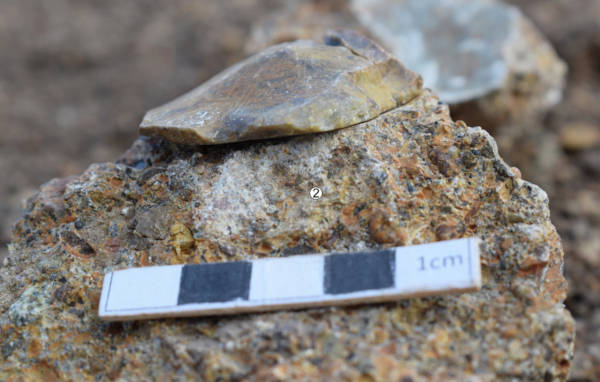
One of the Early Pleistocene stone artifacts found at Calio, Sulawesi. (Hakim, B. /Nature)
The Wallacean Crossing Challenge
The discovery fundamentally challenges our understanding of early human maritime capabilities. Sulawesi lies within Wallacea, a vast archipelago of islands situated between the Asian and Australian continental shelves. Even during periods of lowest sea level, reaching Sulawesi would have required crossing significant stretches of open ocean - a feat that demonstrates remarkable seafaring abilities among these ancient human relatives.
The timing of this occupation may predate hominin presence on other Wallacean islands, including Luzon to the north and potentially even Flores to the south, where Homo floresiensis (the famous "hobbits") lived. This suggests that Sulawesi may have served as a crucial stepping stone in the dispersal of early humans across Southeast Asia's island chains.
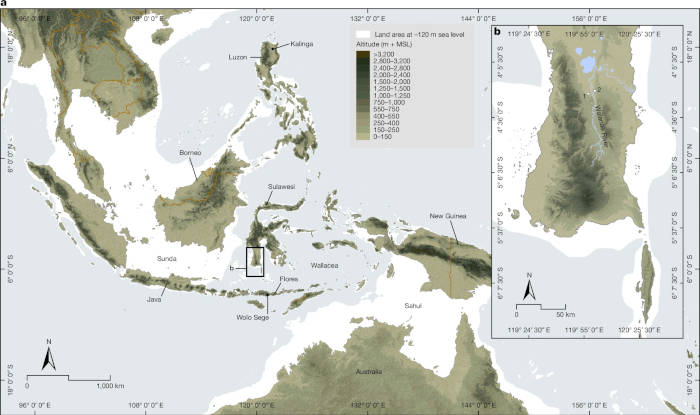
The location of Sulawesi within the Wallacean archipelago (Wallacea)—the zone of oceanic islands between the Asian and Australian continental regions (Sunda and Sahul, respectively). (General bathymetric maps/Nature)
Mysterious Identity of the Toolmakers
The taxonomic identity of Calio's ancient toolmakers remains tantalizingly unclear. Without accompanying fossil remains, researchers can only speculate about which hominin species crafted these tools. The most likely candidates include Homo erectus, given the chronological correspondence with Java populations, or possibly an unknown archaic hominin similar to Homo floresiensis.
"Until we have found fossils of archaic hominins on Sulawesi, it would be premature to assign a hominin species to the tool-makers," Professor Brumm cautioned. However, he suggested that the most probable scenario involves either H. erectus or a species similar to H. floresiensis, noting, "We think the Flores hominins came from Sulawesi originally."
The implications extend beyond species identification. If hominins remained isolated on Sulawesi for a million years, they might have undergone unique evolutionary changes. As Brumm wondered:
"Sulawesi is a wild card - it's like a mini-continent in itself. If hominins were cut off on this huge and ecologically rich island for a million years, would they have undergone the same evolutionary changes as the Flores hobbits? Or would something totally different have happened?"
Implications for Human Evolution
This discovery significantly extends the timeline for hominin presence in island Southeast Asia and demonstrates that ocean crossings were achieved much earlier than previously thought. The sophistication required for such maritime journeys suggests these ancient human relatives possessed cognitive abilities and technological skills that enabled complex planning and execution of long-distance travel.
The tools themselves, while simple in appearance, reveal nuanced understanding of stone-knapping techniques and strategic resource procurement. The use of chert, obtained from nearby riverbeds, shows intimate knowledge of local geology and material properties. Evidence of core rotation during tool manufacture and understanding of fracture mechanics indicates technical expertise passed down through generations.
Moreover, the discovery raises intriguing questions about the broader pattern of hominin dispersal across Southeast Asia. Rather than a single, linear migration, these findings suggest multiple waves of occupation involving different species or populations, each adapting to island environments in unique ways.
Top image: Stone tools discovered at Calio, Sulawesi, dating to over 1 million years ago. Source: M.W. Moore/University of New England
By Gary Manners
References
Brumm, A. et al. (2025). Hominins on Sulawesi during the Early Pleistocene. Available at: https://www.nature.com/articles/s41586-025-09348-6
Pappas, S. (2025). 1.5 million-year-old stone tools from mystery human relative discovered in Indonesia. Available at: https://www.livescience.com/archaeology/human-evolution/1-5-million-year-old-stone-tools-from-mystery-human-relative-discovered-in-indonesia-they-reached-the-region-before-our-species-even-existed
Phys.org. (2025). Archaeologists find oldest evidence of humans on 'Hobbit's' island neighbor. Available at: https://phys.org/news/2025-08-archaeologists-oldest-evidence-humans-hobbit.html