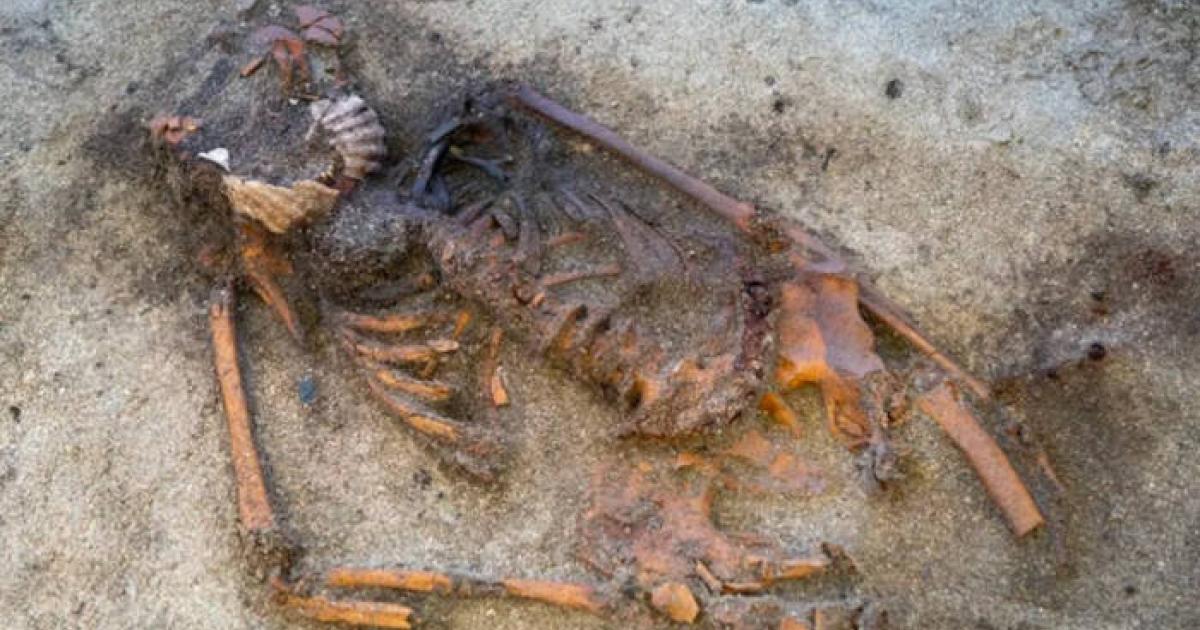

Archaeologists excavating a ninth-century burial site in Bjugn, Norway have uncovered something unprecedented in Scandinavian archaeology: a Viking Age woman's grave featuring two scallop shells deliberately placed around her mouth. The discovery, kept secret for months during excavation, challenges everything experts thought they knew about pre-Christian burial customs in the region and opens tantalizing questions about ritual practices during this fascinating period.
The remarkable find at Val in Bjugn, located in the coastal region of Trøndelag, began with a stroke of luck when metal detectorist Roy Søreng discovered a beautifully crafted bowl-shaped brooch earlier this year. What started as a routine report to authorities quickly escalated into one of Norway's most significant archaeological discoveries, with researchers from NTNU University Museum and Trøndelag County working diligently to preserve every detail of this extraordinary grave, notes the report from Gemini.no. Project leader Raymond Sauvage emphasized that the shells represent "a practice that is not previously known from pre-Christian graves in Norway."
- Viking Age Burial Site Yields Luxuries of Wealthy Elite
- Viking Woman and Her Dog Found in Boat Burial in Norway
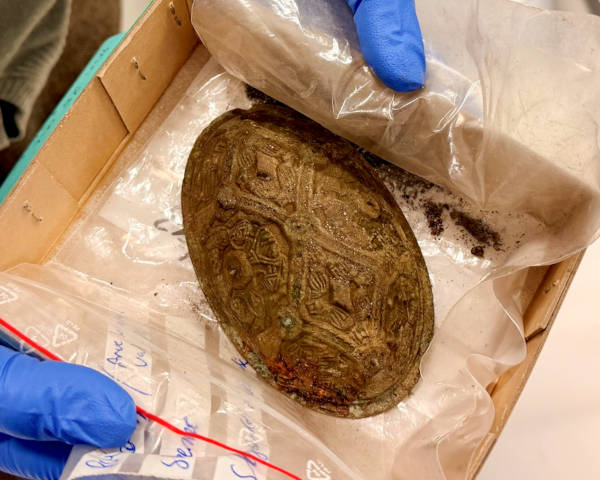
The bowl shaped buckle/brooch was the first find from the grave. (Raymond Sauvage, NTNU Science Museum)
A High-Status Woman Adorned for Eternity
The skeleton, remarkably well-preserved despite Norway's typically acidic soil conditions, belonged to what researchers believe was a married woman of considerable status living during the 800s. Her identity as a free woman of the Viking community was evident from her burial attire and accompanying grave goods. She was interred wearing a complete traditional dress ensemble secured by two large oval cup brooches that fastened the shoulder straps of her halter dress. A smaller ring brooch closed the neckline of her underskirt, reflecting the fashion and social markers of Viking women's clothing during this era.
According to Gemini.no, senior engineer Raymond Sauvage explained that the woman's dress and jewelry indicated she was "a free and probably married woman, perhaps the lady of the farm." The quality and completeness of her burial attire suggest she held an important position within her community, possibly serving as the matriarch of a prosperous farmstead. These brooches and jewelry pieces weren't merely decorative; they functioned as visible markers of social standing and marital status in Viking society.
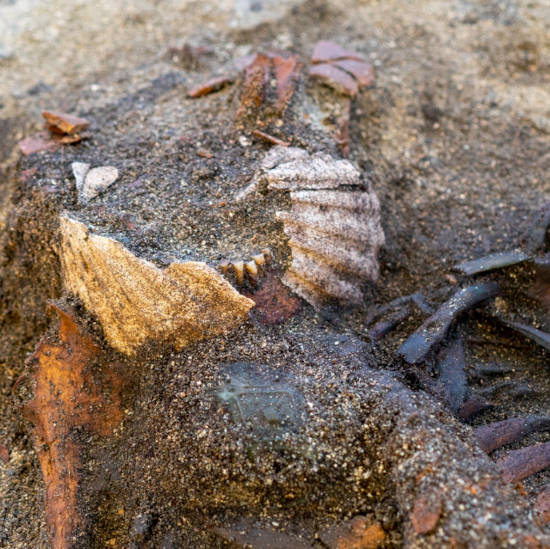
The woman was found with scallops around her mouth. (Raymond Sauvage/NTNU Science Museum)
The Enigmatic Scallop Shell Ritual
The most extraordinary aspect of this burial lies in the positioning of two scallop shells near the woman's mouth. The shells were carefully arranged with their curved sides facing outward and straight edges pointing upward, partially covering the deceased's mouth in what appears to be a deliberate ritual gesture. This practice has never been documented in any pre-Christian Scandinavian burial, making it a completely unique archaeological phenomenon. "We do not yet know what the symbolism means," Sauvage admitted, highlighting the profound mystery surrounding this unusual burial custom.
Complicating matters further, scallop shells carried deep Christian symbolism in medieval Europe, particularly in connection with the pilgrimage to Santiago de Compostela and the cult of Saint James. However, this burial predates the widespread Christianization of Norway by several centuries. The shells typically don't appear in Scandinavian graves until 300 to 400 years later, making their presence in this ninth-century pagan burial completely anomalous. Researchers are investigating whether this represents evidence of early cultural contact with Christian pilgrimage routes, an indigenous ritual practice previously unknown to archaeology, or perhaps metamorphic beliefs where shells held significance in Norse spiritual traditions.
Adding to the burial's mystique, archaeologists discovered small bird bones scattered along the grave, likely representing wing fragments. Field leader Hanne Bryn from NTNU's Institute of Archaeology and Cultural History suggested these bones may have been sewn onto a garment or blanket, or the deceased might have been laid to rest upon a bed of feathered wings. Bird symbolism held powerful meaning in Norse culture, with connections to transformation, spiritual journeys, and the passage between worlds.
Racing Against Time to Preserve History
The grave was discovered perilously close to being destroyed. Located just 15-20 centimeters below the surface, it had already sustained damage decades ago when a ditch was dug across the burial site in the 1960s or 70s, harming the skeletal remains below the knees. The rest of the skeleton faced imminent danger from modern agricultural practices and increasingly acidic soil conditions that threatened to dissolve the precious remains entirely. During a routine field inspection following Søreng's metal detector find, archaeologists quickly realized they were confronting a burial in "acute danger of being damaged at the next plowing," according to Bryn's statement on Arkeonews.
Recognizing the exceptional significance of the find, Norway's Directorate for Cultural Heritage allocated emergency funding for a comprehensive salvage excavation. Riksantikvar Hanna Geiran praised the collaborative effort that saved this irreplaceable piece of history: "This is an incredibly exciting find. It is extremely rare to find such a well-preserved skeleton in old graves." She commended both landowner Arve Innstrand and finder Roy Søreng for their crucial roles in preserving Norway's archaeological heritage, noting that without their cooperation and prompt reporting, this window into Viking burial traditions would have been lost forever.
The excavation team worked meticulously to document every detail before removing artifacts and remains for laboratory analysis. Their painstaking efforts ensured that maximum information could be extracted from the site, including soil samples, precise measurements of artifact placement, and photographic documentation of every stage of the excavation process.
Celtic Knot Wooden Coasters Set from the Ancient Origins Store.
Unlocking the Secrets Through Science
NTNU University Museum specialists are now conducting comprehensive analyses of the skeletal remains and artifacts. The research program includes radiocarbon dating to pinpoint the exact burial date, DNA extraction to determine possible familial relationships with other burials in the region, and stable isotope analysis to reveal whether the woman grew up locally or migrated to Bjugn from elsewhere during her lifetime. Physical anthropologists will examine the bones for evidence of disease, injuries, nutritional deficiencies, and other health indicators that paint a picture of her life experiences.
The timing of this discovery is particularly fortuitous because another exceptionally well-preserved Viking Age skeleton was found on the same property earlier this year, dating to the 700s. Located just thirty feet away from the scallop shell burial, this earlier grave represents someone who lived one to three generations before the woman with the shells. DNA comparison between these two individuals could potentially reveal family connections spanning multiple generations, offering unprecedented insights into a single Viking Age family's continuity on the same farmstead over time.
Sauvage explained the research objectives: "We will examine the skeleton, preserve the artifacts, and take samples for dating and DNA analysis. The goal is to learn more about the person and possible kinship with the earlier find from the same location." Body height reconstruction, sex determination through skeletal features, and pathological analysis will all contribute to building a comprehensive biographical portrait of this mysterious woman whose burial has captivated the archaeological community.
Rewriting Viking Ritual Understanding
This discovery arrives at a particularly exciting moment in Viking archaeology, as scholars increasingly recognize the diversity and complexity of Norse spiritual practices. The presence of scallop shells in a pagan context centuries before their Christian associations became widespread in Scandinavia suggests either remarkable cultural exchange networks or indigenous symbolic meanings that have been lost to history. The bird wing remains add another layer of complexity, potentially connecting to Norse beliefs about transformation, spirit animals, and the journey to the afterlife.
Viking Age burials were carefully staged performances designed to communicate messages about the deceased's identity, status, and community relationships. The inclusion of specific grave goods, body positioning, and ritual objects all conveyed meaning to those who witnessed the burial ceremony. As researchers from NTNU noted in their report, these funerals "were ritual stagings where jewelry, clothing, and grave goods expressed status and identity." The scallop shells clearly held profound significance, but decoding their meaning requires bridging an 1,200-year gap in cultural understanding.
The Val burial site may contain additional undiscovered graves, and archaeologists hope future surveys will reveal whether this was an isolated burial or part of a larger family cemetery. Each new discovery at the site has the potential to provide additional context for understanding the woman with the scallop shells and the community she belonged to during Norway's fascinating Viking Age.
Top image: The Viking Age woman’s remains, buried with mysterious scallop shells around her mouth and traditional Viking dress. Source: Raymond Sauvage, NTNU University Museum. Available at: Raymond Sauvage, NTNU University Museum/Gemini
By Gary Manners
References
Arkeonews. 2025. Archaeologists Uncover Astonishing Viking-Age Grave in Norway: A Discovery Unlike Anything Seen Before. Available at: https://arkeonews.net/archaeologists-uncover-astonishing-viking-age-grave-in-norway-a-discovery-unlike-anything-seen-before/
Gemini.no. 2025. Oppsiktsvekkende vikingtidsgrav begeistrer arkeologene. Available at: https://gemini.no/2025/11/oppsiktsvekkende-vikingtidsgrav-begeistrer-arkeologene/
The History Blog. 2025. Viking woman buried with scallop shells cupping her mouth. Available at: https://www.thehistoryblog.com/archives/74661