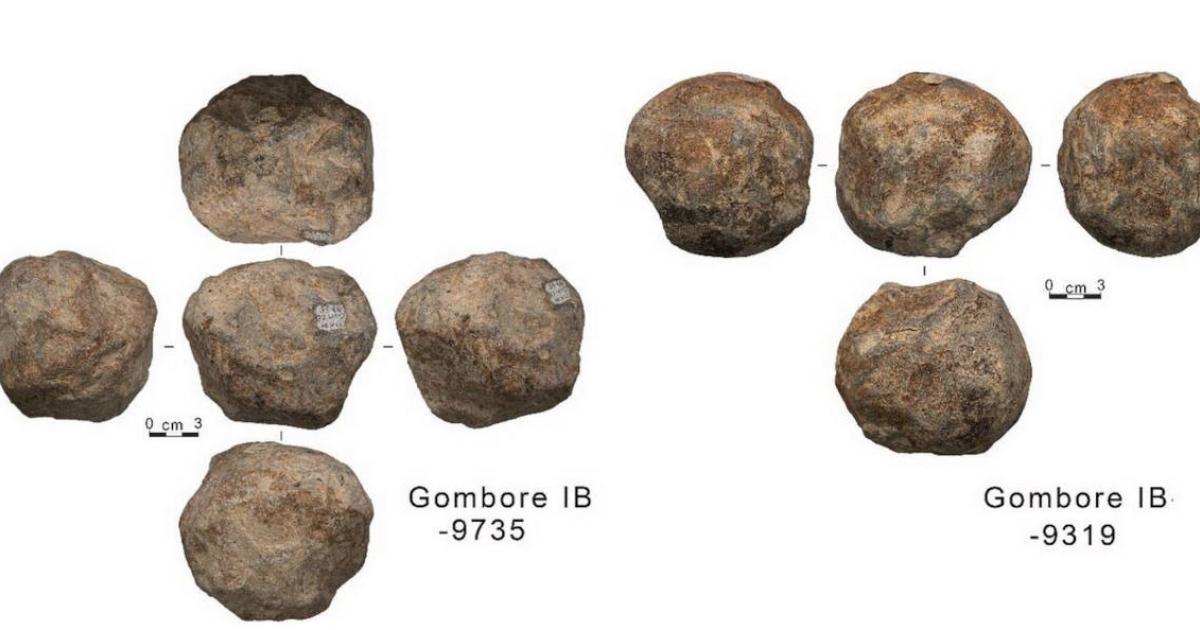

More and more discoveries are revealing the creative capacities and impressive intelligence of archaic human ancestors, who were not the unthinking brutes they were once portrayed as being.
The latest find to reflect this fascinating truth was made at a site known as Melka Kunture, which is located in the Ethiopian highlands. Here an archaeological team recovered naturally occurring rock spheres created by volcanoes that had been repurposed as tools by distant human relatives, starting more than one million years ago.
This groundbreaking discovery was reported by Dr. Margherita Mussi, an archaeologist affiliated with the International Association for Mediterranean and Oriental Studies (ISMEO) in Italy.
In an article just published in Quaternary International, Dr. Mussi highlights how naturally occurring basalt spheres were used by hominin species as hammering, crushing, and scraping tools during the Lower and Middle Pleisocene periods. She identified two of the more well-known Homo sapiens forerunners, Homo erectus and Homo heidelbergensis, as the hominins responsible for using the spheres in this manner.
“The volcanic spheres of Melka Kunture are not manufactured tools but the Pleistocene hominins undeniably noticed those well-rounded, strikingly geometric shapes,” she wrote.
- Paleolithic Tools Prove Hominins Were in Europe 1.4 Million Years Ago
- Who Made the Giant Stone Spheres of Costa Rica?
The spheres were recovered at archaeological sites that featured intentionally crafted tools from the Acheulean industry, a technology that dates back to two million years ago and is associated with the arrival of Homo erectus on the evolutionary scene.
A Closer Look at a Unique “Toolmaking” Strategy
Across Europe, Asia, and Africa, researchers have long been intrigued by the presence of intentionally crafted globular lithic objects in Pleistocene excavation layers. Over time, these items have been referred to by various names such as "stone balls," "spheres," "speroids," "bolas," "balles polyédriques," "boules polyédriques," and "sphéroïdes à facettes." Theories surrounding their use range from functioning as percussion tools to hunting equipment.
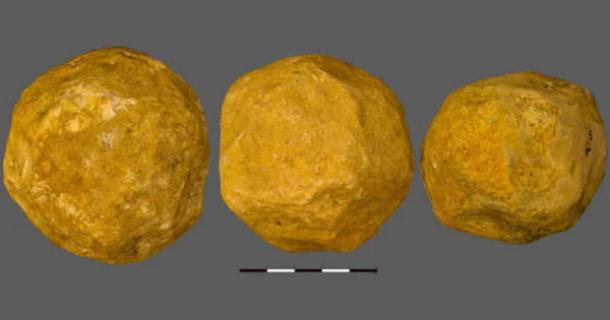
The spheroids of 'Ubeidiya, Israel, which were intentionally made by archaic hominins. (Muller, A., et al. /Royal Society Open Science).
In contrast, naturally occurring lithic objects, while equally captivating, have not been as extensively researched and are often only briefly mentioned in academic discussions.
One site where they’ve been found, Melka Kunture in Ethiopia, definitely stands out. In the Upper Awash region, several Pleistocene sites feature naturally occurring globular lithics known as "spheres."These spheres are particularly notable because they are composed exclusively of volcanic basalt, unlike those from surrounding regions, which are primarily made of limestone. The spheres used in the analysis were collected from eight distinct sites: Gombore IB, Atebella II, Garba XII, Gombore II-1, Gombore II-2, Garba IIIE, Gotu III, and Garba I.
Gombore IB, the earliest site, dates back to 1.7 million years ago. It yielded nearly 5,000 stone tools, three spheres, and two Homo cf. ergaster humerus fragments. The spheres from these sites were later stored at the National Museum of Addis Ababa. The youngest sites—Garba I, III, and II—date to around 0.6 million years ago, containing 22 spheres along with more than 7,000 lithic tools.

Ethiopian Highlands, location of the Melka Kunture site. (Giustino/CC BY-SA 2.0).
Altogether, over 30 spheres were recovered and housed at the National Museum of Addis Ababa. Hominin bone fragments, including those of Homo cf. ergaster, Homo heidelbergensis, and Homo sapiens, were also found, hinting at the species that may have collected or used these spheres.
- 10 Ancient Technologies That Are Still a Mystery Today
- Mystery of Stone Balls at ‘Magic’ Qesem Cave Finally Solved
Notably, the spheres were carefully examined to assess their size, shape, weight, and signs of flake scars. Despite their natural origins, Mussi argues that these spheres must have been intentionally brought to these sites rather than being transported by natural means such as water.
"The metric characteristics, shape, and orientation of pebbles transported by water have been researched and are well understood, as can be seen in previous papers,” she wrote in her Quaternary International article. “Furthermore, note that some of the sites are fine-grained deposits where the relatively heavy rock spheres are at odds with the surrounding environment, and also that the rather soft lapilli ones would have been easily crushed during water transport."
Mussi proposes that these spheres were selected by early hominins for use as percussive tools. "The volcanic ones were likely used for knapping or retouching lithic tools, while the softer lapilli spheres might have been used for tasks like rubbing vegetables, hides, or other materials," she suggested in an interview about her research with Phys.org.
Rather than traditional tools, Mussi refers to these objects as outils à posteriori, meaning they are recognizable as tools only because of signs of wear. This discovery offers eye-opening insights into the evolution of tool use among early hominins, showing clearly how they utilized their environment to make their lives better.
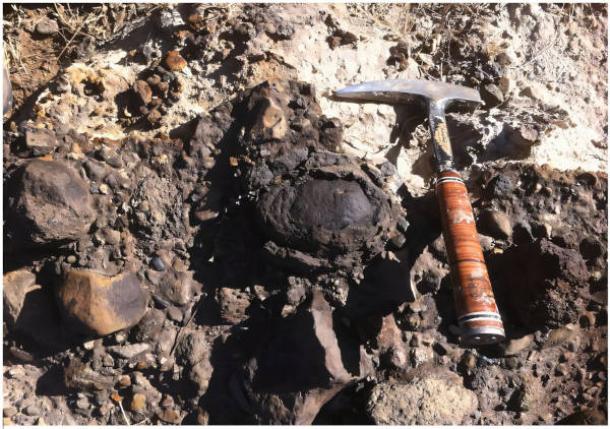
Tool used for removing embedded spherices from Lower and Middle Pleistocene site at Melka Kunture. (Mussi/Quaternary International).
"It is possibly the first evidence of the use of natural shapes for varied activities, and this happened repeatedly over more than one million years of human evolution at Melka Kunture," Mussi noted.
"While hominin species were changing from Homo erectus to H. heidelbergensis, the round rocks were selected from various sources in a changing environment. In my opinion, this is good evidence of how the hominins were carefully exploiting any new resource and cleverly using them."
Homo sapiens has long been credited with this kind of ingenuity and industriousness, which it seems they inherited from their forerunners.
Top image: Examples of naturally occurring spherical basalt tools recovered from Melka Kunture, Ethiopia.
Source: Mussi/Quaternary International.
By Nathan Falde