

The Oxford English dictionary defines soothsaying as ‘the art of being able to foresee the future.’ A sooth tells the truth, and by deduction, a soothsayer is someone who tells the truth about a future event. Such practices have fascinating origins, despite a
What is Soothsaying … and Who Are the Soothsayers?
During the 14th century, this term ‘soothsayer’ described anyone who spoke the truth, whether the people listening wanted to hear it or not. Nowadays, soothsayers foretell the future, primarily, although they have uncanny instincts that can help their friends, family members and clients solve difficult problems in the here-and-now.
Prediction and prophecy center around the art of foretelling events. They are forms of divination that have enjoyed tremendous popularity in literature throughout human history, notably from 1768 through 1888, as revealed by information gathered from charts, graphs, and data sets compiled by Google Books Ngram Viewer. Modern-day soothsayers are just as revered as those from the days of old, despite the efforts of skeptics to give the art a bad name.
Notably, a soothsayer possesses extraordinary abilities based upon a deep knowledge of what will happen in the future. Similar to a forecaster and a predictor, a soothsayer is often cast in the same category as clairvoyants, harbingers, profits, psychics, futurologists, fortunetellers, diviners, prophetess, seers, palmists, and the like. They are the intrepid explorers of a metaphysical realm with origins spanning the space-time continuum, transgressing worlds, physical and spiritual barriers, and complex cosmic elements.
- How Did the Skeptical Astrology of Johannes Kepler Contribute to Our View of the Cosmos?
- Why So Few Witches Were Executed in Wales in the Middle Ages
Soothsaying is as old as the proverbial hills and as profound as scripture. It exists and manifests in different forms, with established psychics delving into the unknown with depth, integrity, and gravitas.
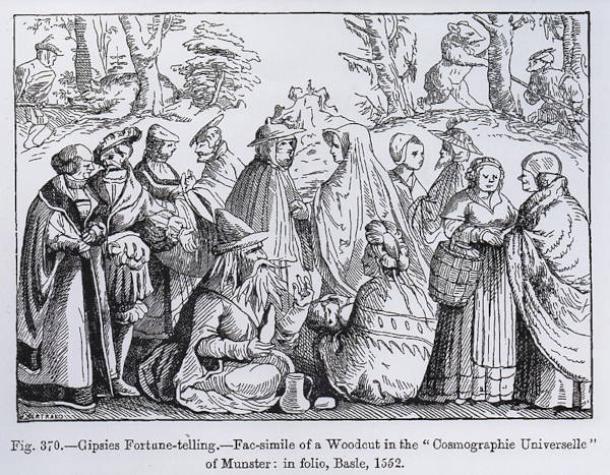
Woodcut of Romani fortune telling practices in medieval Europe, created in 1552. (Robert Dawson Romani Collection/CC BY-SA 4.0).
Historical research has shown that soothsaying has origins in several unique realms, notably lay religion, pop culture, and magic. Indeed, every culture has contributed to the vast body of knowledge that comprises the comprehensive history of soothsaying practices.
Soothsaying in the United Kingdom
One significant example emerges in late medieval England, where soothsayers provided an alternative to law court justice. They revealed the truth to the parties involved directly rather than remediating the conflicts.
But of course, they also generated a lot of fear among those who didn’t understand soothsaying and saw it as the work of Satan. And it was women who suffered the most because of this misunderstanding.
A pair of researchers, Karen Jones and Michael Zell, produced an article in 2005 called ‘The Divels Speciall Instruments’ that detailed the imbalances in accusations of black witchcraft leveled against men and women in medieval England. Whenever examples of alleged witchcraft/soothsaying were presented to the courts in England, most of the accused were women (32 of 55), while the remainder were men (22/55) men with one person’s gender remaining unknown.
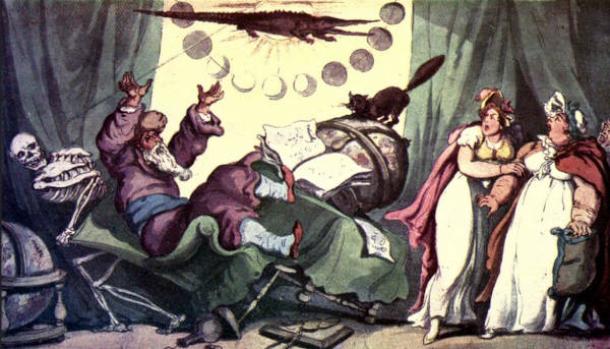
Painting entitled ‘The Fortune Teller.’ (Arallyn/Flickr/CC BY 2.0).
Whenever witchcraft prosecutions were presented to the courts in Essex from 1560–1640, one researcher (Alan MacFarlane) discovered that it was mainly indigent elderly women who were accused of being witches when claiming to be soothsayers. This information was presented in a 1970 publication by McFarlane entitled ‘Witchcraft in Tudor and Stuart England: A Regional and Comparative Study.’
Soothsaying in Ancient Rome
In ancient Rome, soothsayers had influential positions in government. They were officials who interpreted the world of the gods. They studied the flight of the birds, entrails of sacrificial animals, and a cornucopia of natural phenomena to understand the will of the gods.
- The Rise and Persecution of Witchcraft Through History
- In Medieval England, Magic Was A Service Industry
Incredibly, these powerful and influential individuals were famed for their ability to interpret omens and determine future events – fortunate and unfortunate. Their predictive abilities were renowned in ancient Rome, with tales of soothsayers telling Julius Caesar to beware the ides of March. Unfortunately, the iconic Emperor discounted their opinion, much to his detriment.
According to the ancient Romans, soothsayers have magical abilities. So great was their fortunetelling prowess, the Romans said, that they could control flora and the minds of influential people. Granted – according to the ancient Romans – there were good and bad soothsayers, and it wasn’t considered wise to make enemies of the bad ones.
With respect to Mark Anthony and Cleopatra, the soothsayer predicted that Anthony would remain in Caesar’s shadow forever, which turned out to be accurate. Nevertheless, Anthony was forever faithful to Julius Caesar, and their reunion at Narbo in 45 BC culminated in a reconciliation in 44 BC.
Is Soothsaying Witchcraft?
It must be remembered that definitions are the express domain of those providing them. Generally, witchcraft is defined as something specifically that witches do, involving sorcery and magic and the use of supernatural powers to influence and predict future events. While based on the art of foretelling the future, soothsaying is not expressly the same as witchcraft.
There is no iniquity, no ominous undercurrent, and no ill-intent with one who is blessed with premonitions and seeing into the future. These differences and nuances in definition often create a particular bias for or against the ancient practice of soothsaying.
To this day, soothsaying has a special place in our cultural zeitgeist. It is appreciated by some and viewed with skepticism by others. But those who believe in the abilities of soothsayers are convinced of its veracity. The power, insight, and accuracy of a professional reading entirely defies logic, they say, and no amount of argument is enough to change that opinion.
Top image: Image of transparent crystal ball.
Source: Uki_71/Needpix.