

The scientific community finds itself divided over an interstellar visitor that has captured global attention. Since its discovery by the ATLAS survey telescope in Chile on July 1, 2025, the object designated 3I/ATLAS has sparked an unprecedented debate between those who see a natural comet and others who suggest something more extraordinary might be traveling through our solar system. So here we go forth, perhaps more tentatively than boldly, into the debate that has the astronomical community ruffled and the public fascinated.
Harvard astrophysicist Avi Loeb has documented what he calls ten anomalies that distinguish 3I/ATLAS from typical comets, rating it at four on his eponymous scale for potential technological origins. The interstellar object's ‘unusual’ characteristics include a retrograde trajectory aligned within five degrees of the ecliptic plane, extreme negative polarization unprecedented among known comets, and a gas composition containing far more nickel than iron. Most intriguingly, the comet displayed only 4% water content by mass, significantly lower than familiar comets, and exhibited a sunward jet that Loeb argues is not merely an optical illusion.
The Case for Extraordinary Claims
Avi Loeb has maintained that the anomalies warrant serious consideration of a technological origin, though he carefully hedges his position at approximately 30-40% probability. His analysis points to several features that he argues deserve investigation beyond standard astronomical assumptions. The object's arrival was "fine-tuned" to bring it within tens of millions of kilometers of Mars, Venus, and Jupiter while remaining unobservable from Earth at perihelion (the point where it is closest to the Sun). Additionally, near perihelion, 3I/ATLAS brightened faster than any known comet and appeared bluer than the Sun, behaviors Loeb suggests may indicate something beyond natural processes.
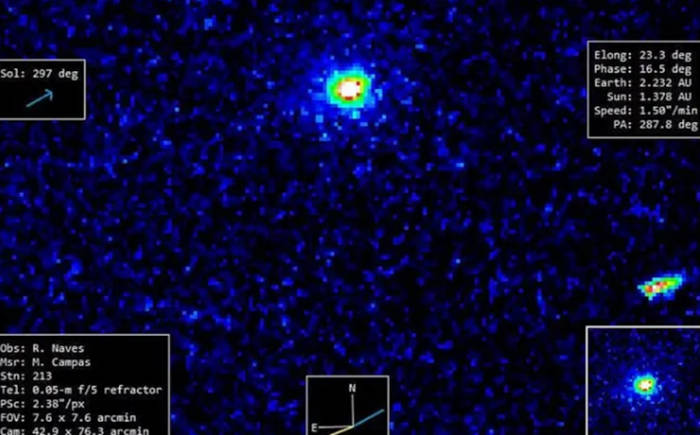
Post-perihelion image of the interstellar object 3I/ATLAS, taken on November 5, 2025 by the R. Naves Observatory, shows a fuzzy ball of light. The Sunward direction is towards the bottom left corner (with the arrow on the left pointing in the anti-Sun direction). No obvious cometary tail is seen. (Credit: R. Naves Observatory, Spain/Avi Loeb)
The Harvard physicist has emphasized that his approach follows the scientific method of proposing theoretical interpretations when faced with anomalies inconsistent with past paradigms. In statements to Reuters, Loeb explained that such proposals motivate the collection of new data, which eventually helps rule out all but one interpretation. He also notes that;
“But more than any other benefit, 3I/ATLAS offers a new opportunity to attract public appreciation to science and to inspire kids to become scientists.”
His open minded enquiry here then would seem to have fairly honorable intentions, but he has attracted both criticism and support for his willingness to publicly explore unconventional hypotheses, with some viewing his approach as refreshing scientific curiosity, while others see it as premature speculation.
- Have Oumuamua Aliens Been Watching Us?
- Is 3I/Atlas Alive? The Interstellar Comet That Defies Everything We Know
The Scientific Consensus Responds
Popular celebrity British physicist Brian Cox has emerged as a vocal critic of the alien spacecraft theories, stating unequivocally that 3I/ATLAS is "a completely natural object: made of carbon dioxide, water ice, and cosmic dust." In an October 2025 post, Cox described the comet as potentially seven and a half billion years old, formed before Earth and the Sun from clouds of dust, offering what he called "a message from a dead world" rather than evidence of extraterrestrial technology.
Penn State astrophysicist Jason Wright has provided detailed rebuttals to Loeb's claims in a comprehensive blog post, arguing that the anomalies are exactly what scientists should expect from an interstellar comet from another solar system. Wright notes that planetary scientists have long observed that "comets are like cats: they have tails, and they do precisely what they want," meaning no two comets behave identically. He points out that 3I/ATLAS displays all the characteristics of a comet - including a coma, tail, and appropriate outgassing of water, carbon dioxide, and carbon monoxide - just in different proportions than Solar System comets.
Regarding Loeb's statistical arguments about the comet's trajectory, Wright cites mathematician Hector Socas-Navarro's critique, explaining that computing probabilities for specific orbital features after observing them represents a classic statistical fallacy. The approach would only be valid if someone had predicted those precise characteristics before the comet's discovery. Well, of course, that’s one way of looking at it.
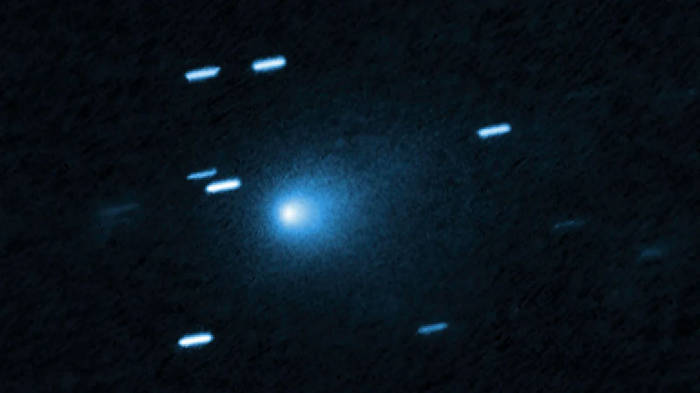
Early detection of 3I/ATLAS showing unusual activity patterns. (NASA/ESA/David Jewitt (UCLA)/ Image Processing: Joseph DePasquale (STScI))
NASA's Official Position
NASA's official statements have been measured and focused on the scientific opportunity the object represents. The space agency confirmed that 3I/ATLAS poses no threat to Earth, maintaining a minimum distance of 1.6 astronomical units (approximately 150 million miles). NASA emphasized that its missions are working together to track and study this rare visitor, noting that it reached its closest approach to the Sun on October 30, 2025, at a distance of 1.4 astronomical units.
The agency has faced criticism from Loeb regarding delayed release of high-resolution images from the HiRISE camera, though NASA attributes such delays to standard review processes and, more recently, government operational challenges. NASA's position remains that 3I/ATLAS should remain visible to ground-based observatories through its December 19, 2025 closest approach to Earth, providing ample opportunity for continued observation and analysis.
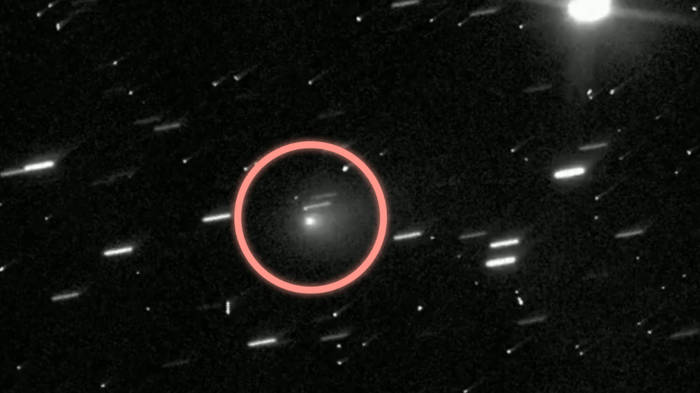
Detection of significant water outgassing from the interstellar visitor. (NASA/ ESA/Hubble)
Understanding the Anomalies
Wright's analysis addresses each of Loeb's claimed anomalies systematically. Regarding the high nickel abundance, he explains that the Fe/Ni ratio varies significantly among comets, and scientists are observing nickel at a much larger distance from the Sun than typical, where standard chemistry can explain the unusual ratios. The extreme negative polarization, while stronger than previously observed, remains consistent with what comets do - just at the extreme end of the spectrum. The rapid brightening near perihelion, while notable, likely results from 3I/ATLAS approaching the Sun much faster than Oort cloud comets, giving it less time to heat up at equivalent distances.
The anti-tail or sunward jet that Loeb highlights as anomalous has actually been observed in other comets and was explained in scientific literature fifty years ago. Wright provides examples of comets 17P/Holmes, C/2016 R2 (PanSTARRS), and C/1961 R1 (Humason) displaying similar jet structures. The supposed coincidence of arriving near several planets simply reflects the fact that any object in the ecliptic plane will pass relatively close to some Solar System bodies.
Wright emphasizes his view:
"If Avi had not claimed it could be an alien spacecraft, no one would be talking about it as anything but a comet."
The object exhibits the fundamental behaviors expected of comets - outgassing, developing a coma and tail, and brightening as it approaches the Sun. No planetary scientists outside Loeb's circle give credence to the technological hypothesis, not because they fear unconventional ideas, but because the evidence simply doesn't support that interpretation.
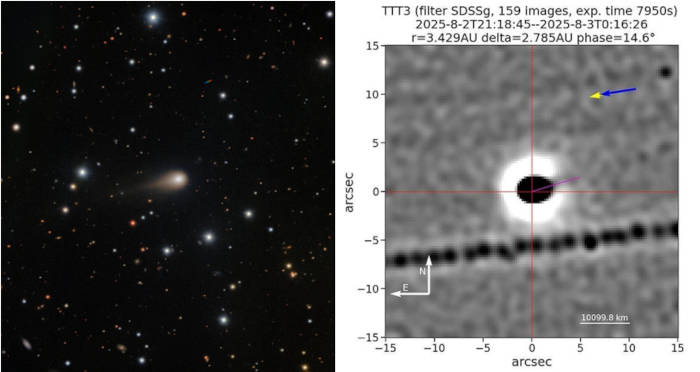
Post-perihelion imagery reveals complex jet structures emanating from the comet. Left; A deep image of interstellar Comet 3I/ATLAS captured by the Gemini Multi-Object Spectrograph (GMOS) on Gemini South at Cerro Pachón in Chile. Right; An image of the interstellar object 3I/ATLAS from the Two-meter Twin Telescope in the Canary Islands, Spain. It shows a faint jet pointed towards the Sun, marked by a purple line. (Left; International Gemini Observatory/NOIRLab/NSF/AURA/Shadow the Scientist/CC BY 4.0, Right; M. Serra-Ricart et al.)
A Gift to Science and Public Engagement
Regardless of the debate's ultimate resolution, 3I/ATLAS has achieved something remarkable: reigniting public fascination with astronomy and space science. Loeb has received hundreds of messages from people around the world, including parents whose children have become passionate about astronomy after following the story. One Canadian engineer wrote that after watching Loeb's interviews, his children immediately wanted a telescope and began reading books about space, asking to listen to astronomy podcasts in the car instead of music.
This public engagement represents perhaps the most valuable outcome of the 3I/ATLAS discussion. Whether the object proves to be an entirely natural comet or reveals unexpected characteristics requiring new physics, it has succeeded in demonstrating that science remains a field of wonder and discovery. The debate itself showcases the scientific process in action - hypothesis, observation, critique, and refinement - even when that process occasionally becomes contentious.
As Earth-based observatories prepare to focus on 3I/ATLAS again following its perihelion passage, the coming weeks should provide crucial data. The object's closest approach to Earth on December 19, 2025, offers astronomers their best opportunity to gather high-resolution observations that may finally resolve the nature of this visitor from interstellar space.
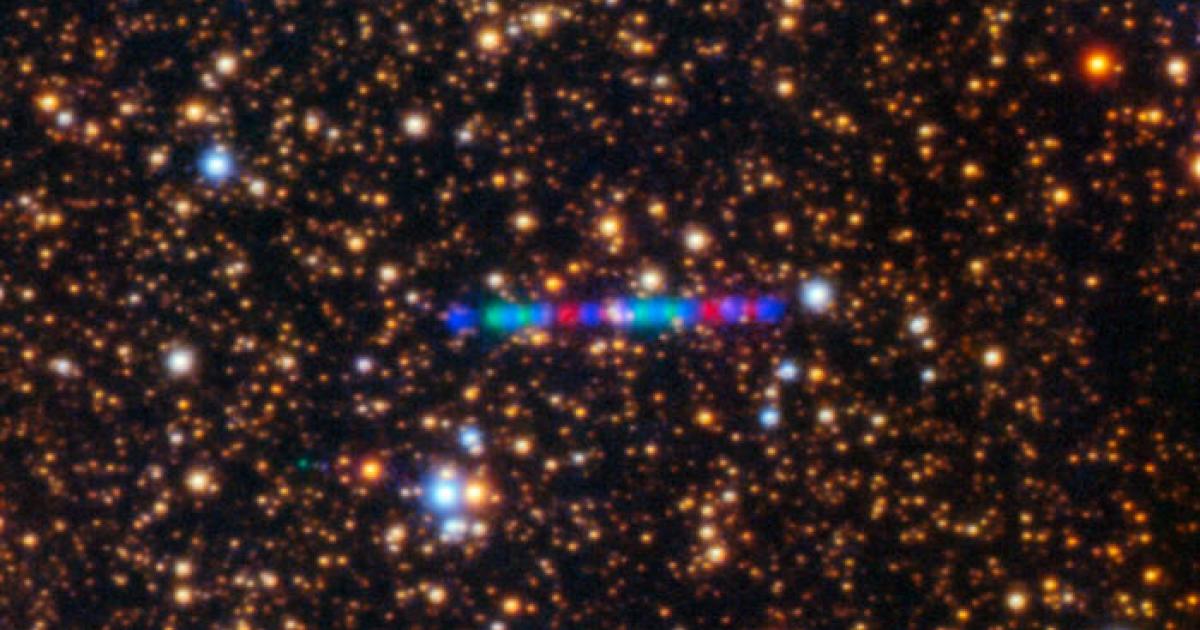
Top image: Interstellar comet 3I/ATLAS streaks across a dense star field in this image captured by the Gemini North telescope's Gemini Multi-Object Spectrograph (GMOS-N). The image is composed of exposures taken through three filters, shown here as red, green and blue. Source: International Gemini Observatory/NOIRLab/NSF/AURA/K. Meech (IfA/U. Hawaii) Image Processing: Jen Miller & Mahdi Zamani (NSF NOIRLab) (CC BY 4.0)
By Gary Manners
References
Loeb, A. 2025. The Inspiration Delivered by 3I/ATLAS to Our Doorstep. Available at: https://avi-loeb.medium.com/the-inspiration-delivered-by-3i-atlas-to-our-doorstep-c7bc08115d0f
NASA. 2025. NASA Discovers Interstellar Comet Moving Through Solar System. Available at: https://science.nasa.gov/blogs/planetary-defense/2025/07/02/nasa-discovers-interstellar-comet-moving-through-solar-system/
The News. 2025. Brian Cox responds to 3I/ATLAS mystery, challenges Avi Loeb's alien theory. Available at: https://www.thenews.com.pk/latest/1354784-brian-cox-responds-to-3iatlas-mystery-challenges-avi-loebs-alien-theory
Wright, J. 2025. Loeb's 3I/ATLAS "Anomalies" Explained. Available at: https://sites.psu.edu/astrowright/2025/11/09/loebs-3i-atlas-anomalies-explained/