


The name "Jesus Christ" is one of the most recognizable on Earth. However, experts now suggest that this might not have been the actual name of the central figure of Christianity. Scholars assert that the name "Jesus" would not have been used by him in his native language, Aramaic, which differs greatly from the modern version we are familiar with. In fact, the name "Jesus" contains letters that did not appear in the written language until about 1,500 years after his death.
Throughout Christianity’s two millennia of history, the original name of Jesus has been obscured by numerous translations and transliterations. The name journeyed from Aramaic to Hebrew, then to Greek and Latin, before eventually reaching an English translation in the 16th century. Additionally, experts believe that Jesus’ last name was not "Christ," but rather based on his hometown.
Based on what the scholars involved in this research know now, they believe his real name was likely "Yeshu Nazareen."
What Language Did Jesus Speak?
Jesus and his disciples lived in Judea, a region within the Roman Empire that corresponds to modern-day Israel and Palestine. Scholars generally agree that Jesus was born and raised in Nazareth, located in the northern province of Galilee.
- Ancient Texts Strongly Suggest Jesus was Literate and Multilingual
- The Fatal Secret Jesus took to Jerusalem
"We cannot know for sure which languages Jesus spoke. However, given his family background in Nazareth, we can assume his day-to-day language was Aramaic," said Professor Dineke Houtman, an expert in the relationship between Judaism and Christianity who teaches at the Protestant Theological University in the Netherlands, told the Mail Online.
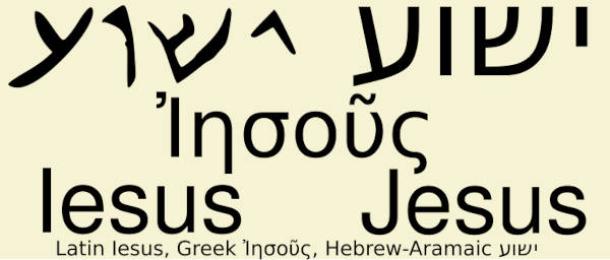
The name Jesus in Latin, Greek, Aramaic and English. (Stevert/Public Domain)
Aramaic, which originated in modern-day Syria, spread across the Middle East during Jesus' lifetime. Surviving papyri from Galilee indicate that it was the predominant language among the Jewish population and was almost certainly the language Jesus used daily. Additionally, early Greek versions of the Gospel note that Jesus used specific Aramaic words, such as "Abba," meaning father.
While Aramaic shares some similarities with Hebrew, they are distinct languages. By Jesus’ time, Hebrew was primarily used for religious purposes, much like Latin in the Christian church during the Middle Ages. Priests would use Hebrew for religious texts and discussions, but it was not spoken daily.
Nevertheless, Professor Houtman noted that Jesus likely knew Hebrew and would have had a basic understanding of Greek as well.
Jesus' Name in Aramic
The name "Jesus," as we know it today, with a hard "J," did not exist during Jesus’ lifetime.
"His name would probably have been in Aramaic: Yeshua,” Professor Houtman said. “It is likely that this is also how he introduced himself. Another possibility is the shorter form Yeshu, which is the form used in later rabbinic literature."
Research by archaeologist Rachel Hachlili reveals that variations of "Yeshu" or "Yeshua" were among the most common names in first-century Galilee, ranking as the sixth most popular name at that time.
"Most scholars agree that his name was Yeshua or possibly Yeshu, which was one of the most common names in first-century Galilee," confirmed Professor Candida Moss, an expert on early Christianity at the University of Birmingham in the UK.
Determining Jesus’ "full" name is a more complex enterprise. Contrary to common belief, "Christ" is not Jesus' surname but rather a title meaning "Messiah" or "God’s anointed one."
During the Roman period, individuals of high status typically had three names: a given name (praenomen), a family name (nomen), and a nickname (cognomen). However, as a poor Jewish man, Jesus would not have followed this naming convention.
Dr. Marko Marina, a historian from the University of Zagreb, explained that last names are a relatively modern convention and didn’t apply to life in ancient times.
"In the ancient world, most people didn’t have a last name as we understand it today,” he stated. “Instead, they were identified through other means, such as their parentage, place of origin, or other distinguishing characteristics. For example, someone might be referred to as 'John, the son of Zebedee' or 'Mary Magdalene,' with 'Magdalene' probably indicating she was from a place called Magdala."
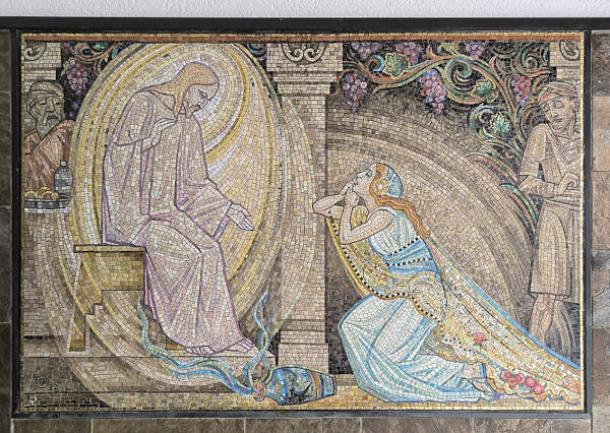
Mary Magdalene and Jesus mosaic in the Church of St. Peter and St. Paul, Amsterdam. (Reda Kerbush/CC BY-SA 4.0).
Since Jesus is often referred to as "Jesus of Nazareth" or "Jesus the Nazarene" in the Bible, it is possible that he used this geographic identifier to distinguish himself from others named Yeshu or Yeshua. Thus, his full name might very well have been "Yeshu Nazareen."
Solving the Pronunciation Puzzle
Unfortunately, the exact pronunciation of Jesus’ name has been lost to the passage of time. However, Dr. Marina notes that we can make an educated guess based on the linguistic and cultural context.
- Did Jesus Have a Wife? New Tests on Ancient Coptic Papyrus May Give Answers
- Doctor-Turned-Priest Determines How Jesus Died from the Shroud of Turin
Some biblical scholars suggest that "Yeshu" may have been pronounced "Yeh-shu" or "yay-shu" with a glottal stop at the end, a sound found in accents that drop the "t" in words like "wet" or "butter." The glottal stop, however, seems to have been fading from common usage by the first century AD, possibly due to Greek influence. This means the pronunciation of Jesus' name might have varied depending on the speaker and their exposure to Greek.
Dr. Marina adds, "Jesus would have likely pronounced his name as Yahshua or a closely related variant. For example, the letter 'yod' (י) in Yahshua would produce a 'Y' sound, and the 'ayin' (ע) at the end of the name may have been a glottal stop or a subtle guttural sound."
How "Yeshu" Became "Jesus"
Given that Jesus was originally called "Yeshu" or "Yeshua," it raises the question of how be came to be called "Jesus" in the first place. The answer lies in the practice of "transliteration," which is the process of transferring the sound of a word from one language to another.
When the Gospel writers composed the New Testament in Greek, they used this tactic to convert the Aramaic name Yeshua into something more familiar. By this time, the Jewish Bible, or Old Testament, had already been written in Hebrew and translated into Greek. But when those Greek translators encountered names like Yeshu and Yehoshua, they didn't have access to all the sounds and letters they needed in their own language to transliterate them properly. And so changed the Aramaic name "Yeshua" into "Iesous," failing to replicate the original name accurately despite their best efforts.
"By the first century CE there was already a precedent for transliterating the Aramaic name Yeshua as Iesous. So, when Paul and the evangelists refer to Jesus—Yeshu/a—they use the already established Greek equivalent of Iesous with an 's' sound at the end,” Professor Moss explained.

Artistic representation of Jesus Christ from the Cathedral of Cefalù, c. 1130. (Andreas Wahra/CC BY-SA 3.0)
When the New Testament was translated into Latin, "Iesous" became "Iesus,” with just one more change in linguistic required to produce the familiar "Jesus" that is used today.
In the 16th century, written texts began to distinguish between the letters "i" and "j," with the "J" sound gaining prominence thanks to the work of Italian grammarian Gian Giorgio Trissino. By the 17th century, "Iesus" had become "Jesus," and that is the way things have remained over the past 400 years.
Meanwhile, others named "Yeshua" or "Yehoshua" who didn’t undergo as many transliterations were anglicized to "Joshua." Ultimately, this process of transliteration across various languages from Aramaic to Greek, Latin, and finally English led to the addition of that name to the modern lexicon.
While the arguments that experts like Professors Moss, Marina, and Houtman make are persuasive and grounded in logic and sound scholarship, they are unlikely to convince many people to begin calling Jesus Christ by a different name. That name has the full weight of history and inter-generational custom behind it, and will likely retain its association with the founder of Christianity regardless of what the reality in ancient times might have been.
Top image: Image from page 321 of "Jesus of Nazareth: His life and teachings; founded on the four Gospels, and illustrated by reference to the manners, customs, religious beliefs, and political institutions of His times" (1869), by Lyman Abbot.
Source: Internet Archive/Public Domain.
By Nathan Falde