

The search for life on alien worlds has produced by far its most exciting discovery, in the form of a planet just 124 light years from earth that shows all the signs of hosting life. Translating galactic terms into an earth-centered perspective, this planet is literally right across the street from us, and the data that has been collected from there suggests it is likely “teeming with life,” at least some of which could be highly intelligent. It seems that much of the surface of this distant planet is covered with ocean, as is earth, which suggests the possibility of parallel stories of evolution.
For now, this unique exoplanet has been given the decidedly unromantic name of K2-18b—which is probably not what its inhabitants call it (assuming they exist, of course).
Using data collected by the James Webb Space Telescope (JWST), the team of astronomers responsible for this discovery, led by researchers from the University of Cambridge, have identified massive quantities of chemicals only produced by living organisms on Earth in the atmosphere of K2 – 18b. Specifically, they have identified the chemical fingerprints of dimethyl sulfide (DMS) and dimethyl disulfide (DMDS), molecules that are primarily produced by microbial life like marine phytoplankton.
- Astronomers Find New Planet Orbiting Red Dwarf 6 Light-Years from Earth
- NASA Telescope Discovers More than 2,600 New Alien Planets
The data obtained from K2 – 18b is the 'strongest hint yet' of biological activity outside our solar system, with experts hailing this discovery as a 'huge, transformational moment'. And the fact that this planet is just 124 light years away, in the Zodiac constellation of Leo, only adds to the thrill of this unprecedented discovery.
The Marvels of Our Hycean Neigbor Are Revealed
K2-18b is what scientists call a “Hycean world,” meaning it likely harbors a vast ocean and has a hydrogen-rich atmosphere. It's about 2.6 times larger than Earth and has 8.6 times our planet’s mass. Despite being much closer to its host star—resulting in a year that lasts just 33 Earth days—the planet maintains a temperature range that could allow for liquid water to exist on its surface.
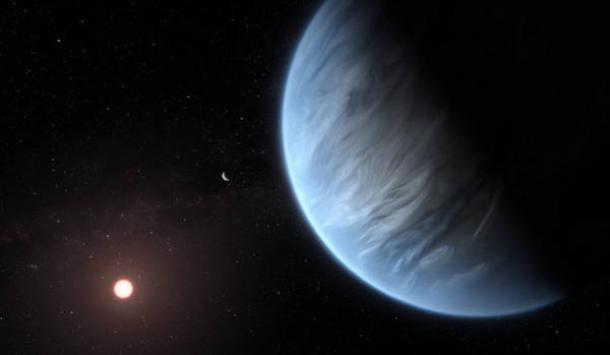
Artist’s conception of K2-18b, its star, and another smaller planet from its solar system, rendered with the assistance of data obtained by the Hubble Space Telescope. (ESA/Hubble/M. Kornmesser/CC BY-SA 4.0).
Previous studies had already picked up the presence of methane and carbon dioxide in the planet’s atmosphere, a groundbreaking find at the time. But now, with the discovery of DMS and DMDS, scientists are even more confident that something extraordinary may be unfolding on K2-18b.
Unlike on Earth, where DMS and DMDS levels are typically less than one part per billion, the concentrations on K2-18b are estimated to exceed 10 parts per million—thousands of times higher. This suggests a planet that is heavily populated by at least microbial lifeforms, and almost assuredly lifeforms that are far more advanced than that (if one assumes that evolution would follow similar paths on habitable planets like earth and K2-18b).
Professor Nikku Madhusudhan, who led the research at Cambridge’s Institute of Astronomy, explained the significance of these findings.
“Earlier theoretical work had predicted that high levels of sulfur-based gases like DMS and DMDS are possible on Hycean worlds,” he told Space.com. “And now we’ve observed it, in line with what was predicted. Given everything we know about this planet, a Hycean world with an ocean that is teeming with life is the scenario that best fits the data we have.”
Although the results are promising, Professor Madhusudhan emphasized caution. There’s still a possibility that unknown chemical processes not related to life might be responsible for the signals. More data is needed before scientists can declare the presence of alien life with 100-percent certainty.
- Don’t just look at Earth-like planets in the search for alien life, scientists say
- The Search for Extraterrestrial Megastructures Gains Momentum
The team is currently planning additional experiments to determine if non-biological mechanisms could generate these compounds in the quantities observed. JWST will also continue to collect more data to rule out statistical anomalies (although they believe this is highly unlikely).
“This could be the tipping point,” Madhusudhan noted. “Decades from now, we may look back at this point in time and recognize it was when the living universe came within reach.”
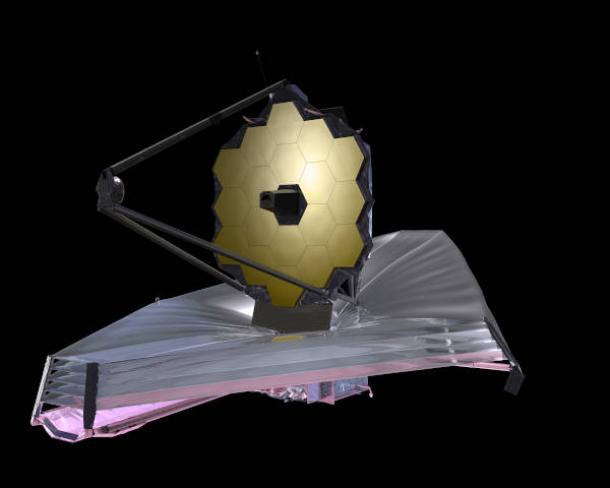
Illustration of the James Webb Space Telescope, as it looks in space. (NASA/Public Domain).
A Miracle Find Using the Most Advanced Tools of Scientific Detection
To analyze the chemical composition of a far-off planet’s atmosphere, astronomers study the light emitted from the planet’s star during a transit, or when the planet passes in front of its star from our viewpoint. During this alignment, a portion of starlight filters through the planet’s atmosphere, imprinting unique spectral signatures of its gases, which can then be analyzed back on Earth.
Last year, JWST first picked up subtle anomalies in the atmosphere of K2-18b, in addition to the already-confirmed presence of methane and carbon dioxide. The team decided to take a closer look using different instruments on the telescope.
Initially, they used JWST’s NIRISS (Near-Infrared Imager and Slitless Spectrograph) and NIRSpec (Near-Infrared Spectrograph), both of which analyze wavelengths between 0.8 and 5 microns. These early hints of DMS led to further investigation using JWST’s MIRI (Mid-Infrared Instrument), which covers a different range—6 to 12 microns. The separate instrument provided independent confirmation of the earlier findings.
“This is an independent line of evidence,” said Madhusudhan. “We used a different instrument and a different wavelength range of light. The signal came through strong and clear.”
Måns Holmberg, a co-author from the Space Telescope Science Institute in Baltimore, said, “It was an incredible realization seeing the results emerge and remain consistent throughout the extensive independent analyses and robustness tests.”
Though DMS and DMDS are similar and sometimes hard to distinguish due to overlapping spectral features, both are considered potential biosignatures. Additional observations will help scientists more clearly identify which compound is present, and in what quantities.
Statistically, the current observations have reached the "three-sigma" level, meaning there's just a 0.3% chance the data is a fluke. However, to meet the gold standard of scientific discovery—"five-sigma" significance—the probability must fall below 0.00006%. The researchers believe that 16 to 24 more hours of observing time with JWST could get them to this threshold.
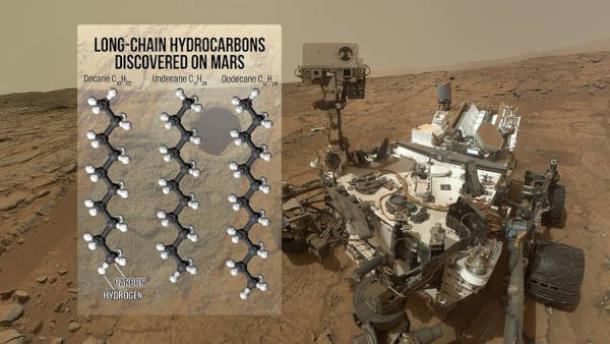
Illustration of the organic molecules found on Mars by NASA’s rover Curiosity, which is also pictured (on the Martian surface). (NASA/Public Domain).
Interestingly, this announcement comes on the heels of another major scientific revelation related to the ongoing quest to find signs off-planet signs of lie. Just last month, researchers reported finding massive organic molecules on Mars—carbon chains with up to 12 atoms—in rock samples dating back billions of years. These molecules may have originated from fatty acids, which on Earth are made by living organisms. What exactly this means with respect to Mars’ past is uncertain, but the discovery is definitely consistent that the planet hosted life of some kind at some point in the distant past.
All in all, these are exciting times for scientists and other creative and imaginative people searching for proof that we are not alone in the universe.
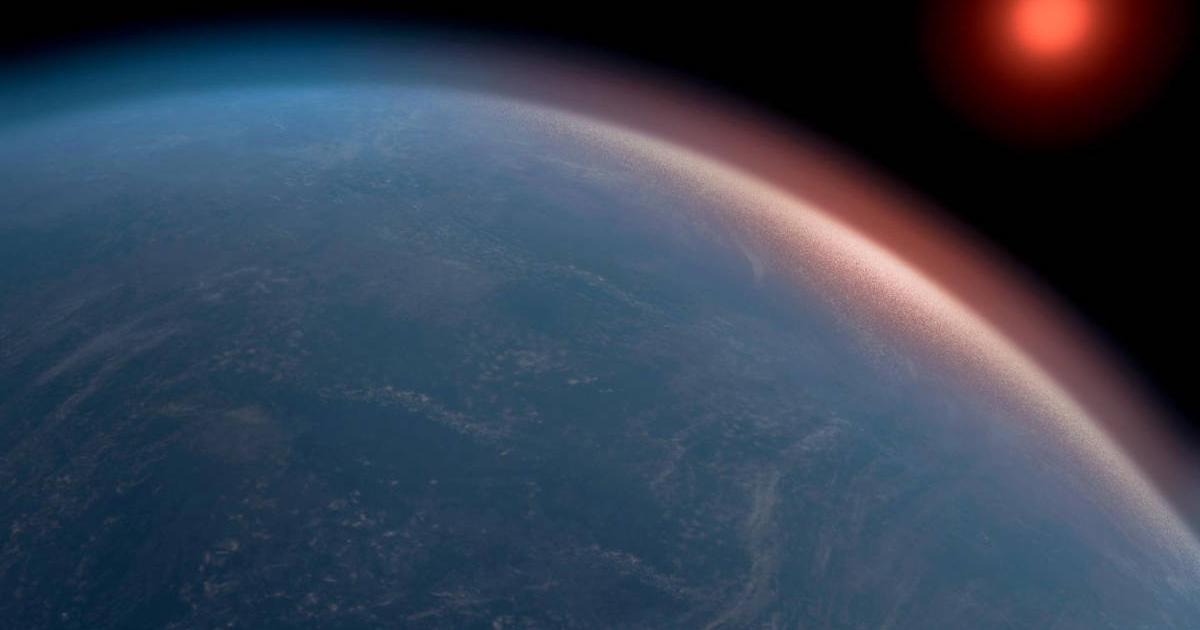
Top image: Artist’s conception of a big, blue K2-18b orbiting its red dwarf star.
Source: Amanda Smith/University of Cambridge.
By Nathan Falde