
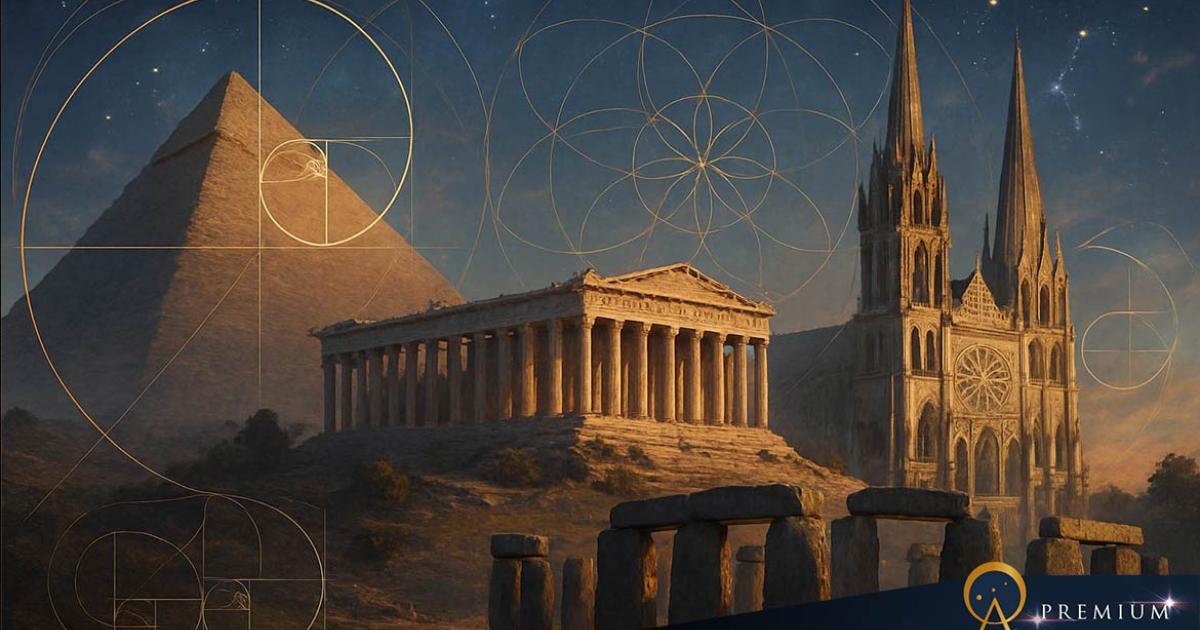

Have you stood in front of an ancient monument and experienced a sense of wonder, as though the building itself was whispering secrets of the cosmos? From Egypt's towering pyramids to Europe's beautiful cathedrals, these great buildings of architecture appear to be speaking a language beyond language. What if their architects used a code, a universal language of geometry that binds the terrestrial to the sacred? Sacred geometry, the science of shapes and proportions which is understood to be spiritually significant, could be used to unlock these secrets. But were these designs purposely embedded in ancient construction, or are we recognizing meaning where meaning was not intended? Let’s travel through time and space to examine whether sacred geometry was a code used at all in ancient architecture, and what the evidence, controversy, and worldwide perceptions leave alive about the mysteries.
The Language of Sacred Geometry
Sacred geometry is the investigation of geometric forms and shapes which are thought to bear symbolic or religious significance. They appear in nature, think of the logarithmic spiral of a nautilus shell or a bee's hexagonal honeycombs. They also appear in human affairs like art and architecture.
Sacred geometry, lends shapes symbolic significance: the circle symbolizes unity and infinity, the square stability, and the golden ratio (approximately 1.618) is prized for its beauty. The Fibonacci sequence, in which each number is the sum of the preceding two (1, 1, 2, 3, 5, 8.), frequently appears in natural shapes like flower petals and is linked with sacred geometry.
The concept has deep historical roots. Ancient philosophers like Plato saw geometry as a divine blueprint, with Plutarch quoting him as saying, “God geometrizes continually.”
Mathematicians like Carl Friedrich Gauss later echoed this, stating, “God arithmetizes.” Across cultures, sacred geometry has shaped sacred spaces, from Egyptian temples to Buddhist mandalas, reflecting a belief that these shapes bridge the physical and cosmic realms. For example, the Flower of Life, a pattern of overlapping circles, appears in ancient sites worldwide and is thought to represent the fundamental structure of existence.
Sacred Geometry in Ancient Structures
Ancient constructionists across civilizations seemed to have embraced geometric ideals during construction, but the question remains: were these intentional exhibitions of sacred geometry or pragmatic solutions that happen to follow mathematical ideals? Let’s look at a few examples.
The Great Pyramid of Giza
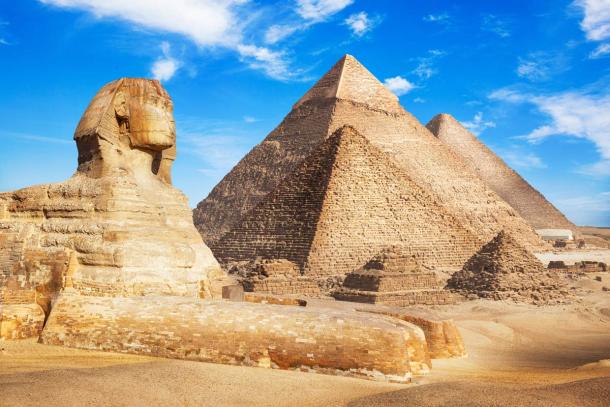
Egypt Cairo – Giza (Adobe Stock / By merydolla)
The Great Pyramid of Giza, built around 2580–2560 BC, stands as a demonstration to ancient Egyptian engineering and a focal point for sacred geometry theories. Its dimensions reveal intriguing mathematical relationships. The pyramid’s base measures approximately 230.4 meters, and its height is about 146.5 meters. The slant height (from the middle of a base side to the apex) is roughly 186.4 meters, making the ratio of slant height to half the base (115.2 meters) approximately 1.618 - the golden ratio. Additionally, the base perimeter (921.6 meters) divided by twice the height (293 meters) yields about 3.145, remarkably close to pi (3.1416).

Like this Preview and want to read on? You can! JOIN US THERE ( with easy, instant access ) and see what you’re missing!! All Premium articles are available in full, with immediate access.